18v Solar Panel: A Practical Guide for Homeowners
A data-driven handbook for homeowners on 18v solar panels, covering voltage basics, system integration, wiring strategies, installation tips, and cost considerations.


An 18v solar panel delivers about 18 volts under standard test conditions, making it compatible with 18V charge controllers and many 12V battery banks when wired correctly. In practice, homeowners use 18V panels in series for higher voltage or in parallel for more current, depending on battery and inverter configuration.
What is an 18v solar panel?
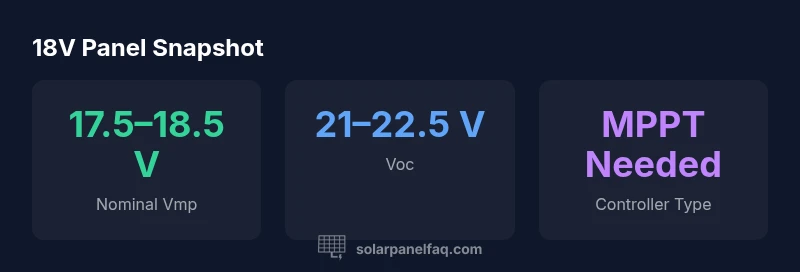
According to Solar Panel FAQ, an 18v solar panel is a photovoltaic module whose nominal voltage is around 18 volts under standard test conditions. This voltage class is designed to pair with MPPT (maximum power point tracking) charge controllers and batteries sized for higher-voltage operation. In practice, the electrical output of any panel varies with sunlight, temperature, angle of incidence, and shading. For homeowners, the key takeaway is that “18v” is a nominal target, not a fixed ceiling—the actual voltage will move within a safe range as conditions change. When planning a system, expect the panel to deliver about 17.5–18.5 V at Vmp and roughly 21–22.5 V Voc under STC (standard testing conditions). This class is particularly useful when you want to minimize wiring losses across longer runs, or when integrating with a higher-voltage battery bank.
How 18v panels integrate with home battery systems
Integrating 18v panels into a residential setup hinges on two core choices: wiring configuration and controller type. In series, several 18v panels sum voltages to feed higher-voltage DC buses or 24V/48V battery banks, reducing current and thus mitigating wiring losses over long distances. In parallel, panels maintain the same voltage while increasing current, which is preferable when space limits the number of panels but a larger current output is feasible. The best results typically come from an MPPT charge controller, which can efficiently convert higher panel voltages down to the battery’s charging level with minimal loss. PWM controllers are simpler and cheaper but less efficient at high voltage differences. For a home with an 18v or 24v battery bank, ensure the controller’s input range comfortably accommodates the panel’s Voc and Vmp under typical weather.
Comparing 18v vs 12v solar panels
The main distinction between 18v and 12v panels is the nominal operating voltage that drives compatibility with battery banks and inverters. A higher nominal voltage (18v) can reduce current for the same power output when wired in series, which lowers wiring losses and can simplify cabling over longer distances. However, 18v panels often require a charger capable of accepting higher input voltages and stepping them down efficiently to the battery. In contrast, 12v panels align naturally with common 12V lead-acid and some Li-ion battery systems but may demand thicker wiring or more panels to achieve the same energy delivery, depending on your roof layout and space. The choice between 18v and 12v should align with your battery bank voltage, inverter compatibility, and roof area.
Key components and compatibility considerations
A successful 18v solar panel installation depends on several core components: a compatible MPPT charge controller, a battery bank sized to handle the expected charging currents, appropriate wiring gauge, and protective equipment such as fuses and disconnects. Compatibility considerations include ensuring the controller’s maximum input voltage exceeds the panel Voc, verifying the battery bank’s voltage matches the controller’s charging profile, and confirming inverter or DC-AC conversion stages can accept the controller’s DC bus. Junction boxes, bypass diodes, and weatherproof mounting hardware should be selected for long-term reliability. In practice, planning for margin—about 10–20% extra input range—helps accommodate temperature shifts and partial shade without tripping the controller.
Real-world installation considerations
Roof orientation, shading, and temperature all impact the real-world output of an 18v solar panel. For best results, orient panels to capture maximum sun during peak hours and consider microinverters if shading is unavoidable; microinverters optimize daily production at the panel level, though they change the system topology. When mounting, ensure panels are securely fastened with proper weather sealing and consider air-flow space to prevent heat buildup, which can reduce efficiency. Cables should be routed safely along rafters or through conduit, with strain relief at entry points. If you’re wiring in series, verify that every panel in the string meets the same rating to avoid mismatched currents. Finally, schedule periodic inspections to check for micro-cracks, loose connectors, and degraded seals.
Cost, reliability, and maintenance considerations
Costs for 18v solar panels vary by brand, efficiency, and warranty length, but homeowners should budget for the modules, controller, mounting hardware, and potential permits. Reliability hinges on build quality, corrosion resistance, and the controller’s lifespan. Maintenance is typically straightforward: clean dust and debris from the glass surface, inspect wiring for chafing, ensure connectors remain tight, and monitor performance against expected output. Warranties usually cover both power output and materials for 10–25 years, with performance degradation commonly around 0.5–0.8% per year depending on climate and usage. Planning for a modest annual maintenance budget helps preserve system performance and extend the usable life of the 18v panel array.
18V panel specifications at a glance
| Aspect | 18v Panel Spec | Notes |
|---|---|---|
| Nominal Voltage (Vmp) | 17.5–18.5 V | Under STC |
| Open-Circuit Voltage (Voc) | 21–22.5 V | Temperature effects |
| Recommended Controller Voltage | 18 V nominal input | Requires MPPT for efficiency |
Frequently Asked Questions
What is an 18v solar panel?
An 18v solar panel has a nominal operating voltage near 18V under standard test conditions. The actual voltage varies with sunlight and temperature, and is managed by the charge controller to suit the battery.
An 18v solar panel has a nominal voltage around 18V; actual output varies with sun and temperature, managed by the controller.
Can 18v panels charge a 12V battery bank?
Yes. It’s common to use an MPPT controller to step voltage down from 18V to 12V, or connect panels in configurations that match the battery bank, ensuring safe charging.
Yes, with the right controller and wiring you can charge a 12V battery bank from 18V panels.
Are 18v panels compatible with standard inverters?
Most inverters can handle common DC inputs, but 18v panels usually require an MPPT controller to optimize charging and a DC-DC stage that matches the inverter’s input. Check inverter specs.
Inverters usually need an MPPT-enabled setup when using 18v panels.
What is the difference between 12V and 18V solar panels?
The difference is the nominal module voltage, affecting battery bank matching, controller type, and wiring strategy. Higher voltage panels can reduce current for the same power, cutting wiring losses.
12V and 18V refer to the panel’s nominal voltage and guide how you wire and charge your batteries.
Do 18v panels require special maintenance?
Maintenance is similar to other panels: keep the surface clean, check connections, and monitor performance. No special maintenance is typically required beyond regular upkeep.
Maintenance is the same as other panels—clean the surface and check wiring periodically.
“An 18v solar panel system, when paired with a capable MPPT controller and well-sized batteries, can reliably optimize charging efficiency for residential setups.”
Top Takeaways
- Plan for MPPT controllers with 18V inputs
- Use series wiring to optimize voltage; parallel for current
- Match battery bank voltage to controller and panel output
- Budget for maintenance and warranty coverage