What Size Inverter Do Solar Panels Need? A Practical Guide
Learn how to size an inverter for solar panels with practical steps, examples, and safety tips. This guide covers continuous vs surge ratings, loads, and how to match inverter size to your home's solar system for reliable energy.


To size the inverter, total your expected AC loads and choose a continuous inverter rating that exceeds that load by about 20–25% to cover startup surges. For most residential solar systems, a 2–4 kW inverter handles small homes, while 5–7 kW covers mid-sized homes; larger setups require proportionally bigger inverters. Always factor safety margins and potential future loads.
How Inverters Work and Why Sizing Matters
An inverter converts the DC electricity produced by solar panels into AC power your home can use. The inverter's continuous rating shows how much steady load it can reliably handle, while the surge rating covers brief startup spikes. If the inverter is undersized, voltage sags, tripped breakers, or reduced system output can occur. Proper sizing also accounts for power factor and the number of circuits the inverter serves. When sizing is done correctly, you maximize energy capture, improve reliability, and extend the lifespan of connected equipment. According to Solar Panel FAQ, applying a 20–25% headroom margin helps accommodate surges and potential future loads. This article builds on that guidance to help homeowners size what size inverter needed for solar panels for real-world setups.
Gather Your Load Data: What You Need to Calculate
Before you can size an inverter, you must know what your home will draw. Gather a current inventory of devices, their wattage, and typical usage hours. Create a list that includes HVAC, water heater, refrigerator, lights, electronics, and any heavy loads like EV chargers. Add up the running watts and peak watts, then estimate daily energy (kWh) to understand seasonal swings. If exact wattages aren’t listed on labels, use an energy meter or manufacturer specs. This is where the phrase what size inverter needed for solar panels becomes a practical calculation rather than a guess.
Step-by-Step Overview for Sizing Your Inverter
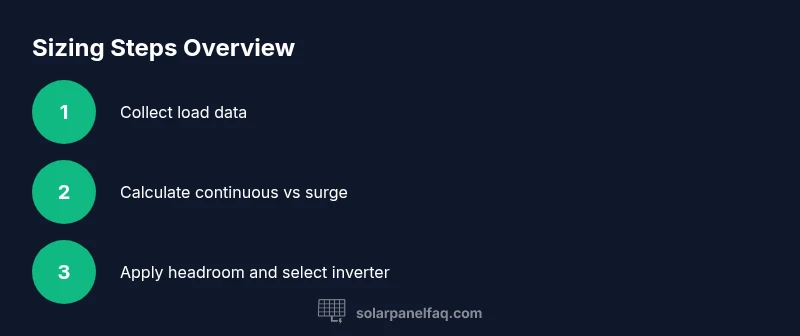
Sizing an inverter is a structured process. Start by compiling load data, move to peak and continuous power needs, apply a safety margin, and then verify compatibility with your solar array voltage and battery setup if applicable. Finally, confirm code compliance and prepare for future changes such as appliances additions or efficiency upgrades. The core idea remains: ensure the inverter’s continuous rating comfortably exceeds your total loads while supporting startup surges.
Practical Scenarios and Examples
- Small home (limited loads): A typical 2–4 kW inverter might cover essential circuits, lighting, and a few appliances. This keeps costs reasonable while delivering reliable AC power during sun hours.
- Mid-sized home (average loads): A 5–7 kW inverter aligns with common kitchen, laundry, and climate-control use, offering ample headroom for surge and occasional high-demand events.
- Larger home or phased solar with storage: You may require 8–12 kW or more, especially if you plan to run heavy loads simultaneously or integrate a substantial battery bank.
In all cases, the inverter size should reflect your daily energy usage plus a margin for surges. The calculations become more precise when you include battery storage and plan for future loads.
Safety, Efficiency, and Common Pitfalls
Use a pure sine wave inverter for compatibility with sensitive electronics and many appliances. Efficiency varies with load; inverters are typically most efficient around mid-load. Common mistakes include underestimating surge power, ignoring startup current for refrigerant compressors, or selecting an inverter based only on peak DC power rather than continuous AC output. Always verify wiring, grounding, and electrical code requirements before install. This careful approach aligns with best practices in the solar field and reinforces why the question what size inverter needed for solar panels matters for long-term reliability.
Tools & Materials
- Load data collection tool(Spreadsheet or notepad to list each device, wattage, and daily hours)
- Inverter sizing calculator(Spreadsheet template or online tool to sum continuous loads and surge needs)
- Pure sine wave inverter(Choose a model with continuous rating >= planned loads and surge rating above peak start-up currents)
- Battery storage (optional)(Needed if planning off-grid or home backup with solar)
- Electrical safety gear(Gloves, eye protection, and insulated tools for safe handling)
- Voltage and wiring checklist(Ensure inverter voltage matches array and panel voltages; check wire gauge and breaker sizes)
Steps
Estimated time: 60-90 minutes
- 1
Gather your load data
Create a list of all appliances and circuits you plan to run on solar power. Record wattage and estimated daily usage for each item. This establishes the baseline for inverter sizing.
Tip: If wattage is unknown, use a watt-meter or check the manufacturer label. - 2
Sum continuous and surge requirements
Add up running watts to determine continuous load. Identify devices with high startup surges (compressors, pumps) and estimate their peak watts.
Tip: Remember that some devices draw more power briefly on startup than during steady operation. - 3
Apply headroom for reliability
Multiply the total continuous load by 1.2 to 1.25 to include a safety margin for surges and minor future additions.
Tip: A conservative margin reduces nuisance trips and keeps future growth feasible. - 4
Choose an inverter with proper ratings
Select a model whose continuous rating meets or exceeds the adjusted load and whose surge rating covers startup currents.
Tip: Confirm the inverter’s output voltage matches your home’s electrical system (e.g., 120/240V). - 5
Consider battery integration (optional)
If storing energy, ensure the inverter is compatible with the battery bank and that the combined system maintains safe voltage levels.
Tip: Battery sizing should account for depth of discharge and round-trip efficiency. - 6
Check code compliance and safety
Review local electrical codes, labeling, and grounding requirements with a qualified electrician if needed.
Tip: Better to have plans reviewed early than to retrofit after installation. - 7
Validate with a professional
Consult a solar installer or electrician to verify calculations and confirm compatibility with your solar array and panel voltages.
Tip: Getting a second opinion helps prevent costly mistakes. - 8
Document the final spec
Record the chosen inverter model, continuous and surge ratings, and wiring details for future maintenance.
Tip: Keep the documentation with your system’s commissioning papers.
Frequently Asked Questions
What is the difference between continuous and surge inverter ratings?
Continuous rating is the power the inverter can deliver steadily over time, while surge rating covers brief startup spikes. For solar sizing, you want the continuous rating to meet your average loads and the surge rating to cover startup surges.
Continuous rating is what you can rely on for regular use; surge rating handles momentary spikes. Ensure both are adequate for your loads.
Can I size an inverter smaller than my daily load?
sizing an inverter smaller than your daily load can cause frequent shutdowns or tripping. Always target the continuous rating to cover most daily use with a margin for surges.
No—don’t size smaller than your daily load. You’ll likely trip breakers and limit functionality.
Do solar panels power appliances directly without a battery?
In grid-tied systems, solar panels power loads when the grid is available, but most off-grid setups require a battery or storage. Inverter sizing remains essential for both configurations.
Solar can power loads with the grid or a battery system; sizing still matters for reliability.
Is a bigger inverter always better?
Not always. Oversizing raises upfront costs and may reduce efficiency at lower loads. Size to meet typical usage, with headroom for surges and future needs.
Bigger isn’t always better—you pay more and might waste efficiency unless you have high loads or planned growth.
How does system voltage affect inverter size?
Inverter input/output voltage must match your array voltage and home service. Mismatches can cause efficiency loss or safety concerns, so verify voltage compatibility early.
Voltage compatibility is essential for safe, efficient operation; check that the inverter voltage matches your system.
Do I need a professional to size my inverter?
While you can do preliminary sizing on your own, a licensed electrician or solar installer should confirm calculations and wiring safety for code compliance and reliability.
For safety and code reasons, have a professional verify your sizing and wiring plan.
Can I upgrade inverter size later if my loads grow?
Upgrading can be possible but may require changes to wiring, mounting, and permits. Plan for some future flexibility to minimize retrofit costs.
Upgrading later is possible but may be disruptive—plan for future needs from the start.
Watch Video
Top Takeaways
- Calculate loads first, then add headroom
- Match continuous rating to total loads with margin
- Include surge considerations for startup devices
- Verify compatibility with home electrical system
- Document final sizing and safety requirements