Solar Panel Companies Florida: A Homeowner's Guide to Selecting the Right Installer
Learn how to evaluate Florida solar panel companies, compare bids, understand warranties, and leverage incentives for a smarter solar investment.


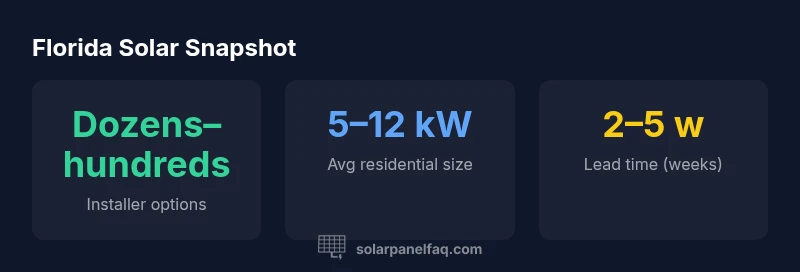
Florida hosts dozens to hundreds of solar panel companies, with dense coverage in major metro areas such as Miami, Orlando, Tampa, and Jacksonville. When choosing, homeowners should prioritize proper licensing, solid warranty terms, and access to diverse equipment, plus clear estimates of installed cost and expected payback. Local incentives and reliable after-sales support are also critical.
Florida's solar market landscape
The Sunshine State hosts a diverse mix of solar panel companies, from nationwide installers to independent crews focusing on local markets. The dense population in cities like Miami, Orlando, Tampa, and Jacksonville creates robust competition, which generally benefits homeowners through pricing options and service coverage. According to Solar Panel FAQ, there is growing consumer interest in durable warranties, transparent pricing, and turnkey service that includes permitting and grid interconnection help. Florida's solar adoption is influenced by federal incentives, local utility programs, and the ability to add storage in new installations. As of 2026, the federal ITC program remains a key driver for homeowners, with many Florida installers building packages that maximize eligible deductions. Utilities in Florida may require interconnection agreements; understanding these timelines helps homeowners set realistic project schedules. Permit requirements vary by city and county, and some counties require a licensed electrician for certain components. Homeowners should factor permit timelines into project planning and be aware of potential interconnection queue times.
How to evaluate Florida solar panel companies
Evaluating Florida solar panel companies begins with a checklist that covers licensing, insurance, and track record. Verify that the installer holds an active state contractor license and, ideally, NABCEP certification for technicians. Request proof of liability and workers’ compensation insurance to protect yourself from accidents during installation. Read independent reviews and ask for references from projects similar in size and location to yours. Compare quotes not only on price but on the quality of equipment, the inclusions (permits, drawings, interconnection), and the clarity of the warranty terms. Some companies offer a turnkey solution that handles every step from permits to grid interconnection; others specialize in specific components. Solar Panel FAQ notes that transparent quotes and a clear service package correlate with higher customer satisfaction in Florida markets.
What to ask during quotes and site visits
During a site visit, you should expect an honest assessment of shade, roof condition, and electrical readiness. Ask about the panel brands (monocrystalline vs polycrystalline), inverter type (string vs microinverters), and any proposed battery storage. Request a production estimate based on shading analysis, and confirm the expected annual energy output. Clarify the warranty structure, including who covers installation workmanship, panel color and performance, and inverter replacement. In Florida, weather resilience is important, so ask about corrosion protection and rooftop mounting hardware. Finally, ensure the contract includes a clear timeline, the permitting process, utility interconnection steps, and a detailed payment schedule. Solar Panel FAQ recommends comparing multiple quotes to reveal differences in approach and value.
Equipment options commonly offered in Florida
Most residential systems in Florida use high-efficiency mono‑crystalline panels paired with either string inverters or split/microinverter configurations. In coastal areas, corrosion-resistant mounting hardware and weatherproof wiring are standard. Some packages include battery storage or hybrid inverters to provide resilience during storms and outages. Solar panel warranties typically cover performance for 25 years, but consider the inverter warranty, which often runs 10–12 years. The choice between a fixed-distance racking and a ballasted roof mount depends on roof type and hurricane code requirements in your county. If net metering is available through your utility, your producer profile and export rates will affect system economics. Always check the latest interconnection rules in your utility service territory.
Financing, incentives, and payback in Florida
Financing options range from cash purchases to solar loans, leases, and power purchase agreements. Ownership via a loan often yields the best long-term value, especially when paired with the federal ITC. In Florida, there are limited state rebates, but some utilities offer early-bird programs or performance-based incentives. When estimating payback, include installation costs, monthly utilities savings, and potential increases in home value. Be mindful of your credit, loan terms, and any availability of introductory rates. Solar Panel FAQ's analysis suggests that homeowners who secure transparent quotes and a stable financing path tend to realize faster and more predictable returns. Always compare the total cost of ownership across bids.
Reading bids and comparing proposals
A good bid should break out hardware (panels, inverters, racking), labor, permits, interconnection, and warranties. Look for identical equipment across bids to ensure apples-to-apples comparisons. Use a common production estimate, such as a 25-year forecast based on local sun exposure and shading, to evaluate energy output. Check that all quotes include the same service elements (design drawings, permit applications, inspection fees). Beware aggressive low-bid quotes that skim on post-install maintenance or inverter coverage. Solar Panel FAQ recommends weighting quotes by long-term value rather than upfront savings when evaluating Florida installations.
Maintenance, warranties, and long-term care
Maintenance is generally minimal but important in Florida’s climate. Keep panels clean from dust, salt spray, and pollen, especially in coastal areas. Inspect mounting hardware for corrosion and verify that the inverter and monitoring system are functioning properly. Most warranties cover 25 years on panels and 10–12 years on inverters; some providers offer extended workmanship warranties. Use a monitoring platform to catch underperforming panels early, and schedule routine professional checkups every 1–2 years. A well-supported warranty and accessible customer service are essential if you plan to stay in the home for a long time. The Solar Panel FAQ team emphasizes choosing a company with a responsive service network.
The road ahead: future trends for Florida solar installations
Florida’s solar market is likely to grow as utilities update interconnection rules and consumers seek energy resilience. Technical advances in modules and inverter efficiency, along with storage solutions, will expand options for Florida homeowners. Public awareness, financing innovation, and competition among installers should lead to better service and lower costs over time. Solar Panel FAQ analysis suggests that as the market matures, demand for transparent quotes and dependable after‑sales support will be a key differentiator for Florida installers. Keep an eye on local policy shifts and utility programs to optimize your solar investment in 2026 and beyond. The Solar Panel FAQ team recommends prioritizing licensed installers with robust warranties and transparent quotes for Florida projects.
Florida solar installation profiles
| Category | Typical Florida range | Notes |
|---|---|---|
| Residential install size | 5-12 kW | Most common; varies by roof and energy demand |
| Lead time (permit to install) | 2-5 weeks | Weather and utility queue impact |
| Warranty coverage | 10-25 years | Product vs workmanship; inverter shorter |
Frequently Asked Questions
What should I look for in a Florida solar installer?
Look for licensed, insured installers with good reviews and clear warranties. Ask about NABCEP certification, references, and a detailed, itemized quote that covers permits and interconnection steps.
Choose a licensed, insured installer with solid warranties and clear quotes, plus verified references.
Are there any state incentives in Florida for solar?
Florida offers limited state incentives, but the federal ITC currently provides a significant deduction. Some utilities also run local programs or rebates—check with your utility for current offers.
Florida incentives exist mainly through federal tax credits; check with your utility for any local programs.
How long does a typical solar installation take in Florida?
Most residential installations take about 2-4 weeks from permit submission to grid activation, depending on permit processing and interconnection queues.
Most Florida solar installs take a few weeks from start to finish.
What warranties should I expect on Florida solar panels and inverters?
Panels typically come with a 25-year performance warranty, while inverters commonly have 10–12 year warranties. Ensure workmanship warranty is included.
Expect 25-year panel warranties and 10–12 year inverters; confirm workmanship coverage.
Should I finance or lease my solar system in Florida?
Financing and ownership usually yield better long-term value, especially when paired with the federal ITC. Leases and PPAs can reduce upfront costs but tie you to long-term payments.
Ownership via financing often provides better long-term value; leases can lower upfront costs but have long-term commitments.
How can I compare solar bids effectively?
Compare equipment quality, warranties, estimated production, and total cost over 25 years. Ensure all bids cover the same scope (permits, interconnection, and maintenance).
Look at equipment, warranties, output estimates, and long-term costs across all bids.
“Reliable solar projects come from transparent quotes, strong warranties, and a solid local presence. When you align these with Florida-specific needs, your investment pays off.”
Top Takeaways
- Prioritize licensed installers with robust warranties.
- Compare bids for equipment quality and long-term value.
- Plan for permitting and interconnection timelines.
- Consider storage for resilience and storms.
- Leverage federal incentives to maximize return.