How to Mount Solar Panels on the Ground: A Practical Guide
Learn how to mount solar panels on the ground with a safe, code-compliant plan. This guide covers site planning, mounting options, step-by-step installation, maintenance, and safety.


Learn how to mount solar panel on ground safely with a structured plan. This guide covers layout, foundation options, mounting rails, wiring basics, and maintenance. You’ll get a clear, step-by-step approach and safety tips to ensure a durable, code-compliant ground-mounted solar array for homes. Follow the steps, check local permits, and verify tilt and clearance before you power up.
Why ground-mounted solar panels are a practical choice
Ground-mounted solar arrays offer a flexible alternative to roof installations, especially for properties with limited roof suitability or shading concerns. When you learn how to mount solar panel on ground, you unlock the ability to optimize panel orientation for peak sun exposure, simplify access for cleaning and maintenance, and adjust tilt to suit seasonal sun paths. A ground mount also makes it easier to integrate with larger systems or future expansions. That said, this option requires stable soil, proper drainage, and careful adherence to local setbacks and electrical codes to ensure long-term performance and safety.
Site assessment and planning
A successful ground-mounted installation starts with site assessment. Evaluate sun exposure through the year, check for shading from trees or structures, and confirm soil stability and drainage. Plan for fencing, access paths, and clearances around panels for maintenance. Local codes may require setbacks from property lines and utilities, and permits might be needed before you proceed. According to Solar Panel FAQ, thorough site assessment reduces performance losses due to shading and drainage issues, helping you choose the best layout and mounting method for your site.
Design options: mounting structures and tilt
Ground-mount systems come in several configurations, each with trade-offs. Common options include ballast-based frames that sit on the soil or concrete, and driven anchors or auger-based foundations for more permanent setups. Decide between fixed-tilt racks or adjustable tilt to optimize annual output. Consider wind loading and snow considerations for your climate, and plan for accessible wiring channels and cable management. Your goal is a sturdy frame that keeps panels level, allows for easy cleaning, and minimizes shading from nearby objects.
Tools, materials, and safety essentials
Preparing a ground-mounted installation requires a mix of tools, hardware, and safety gear. You’ll need mounting rails, clamps, fasteners, ballast blocks or anchors, a shovel or post-hole digger, measuring tape, a level, a wrench set, and safety gear (gloves, glasses, hard hat). Have concrete or ballast blocks on hand for foundations, plus conduit or cable trays to route wiring neatly. Always follow local electrical codes and use weatherproof connectors and appropriate sealants to protect connections from moisture and corrosion.
Step-by-step overview (phases, not the step-by-step actions)
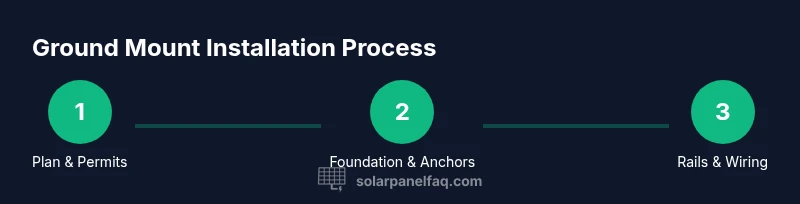
installing a ground-mounted solar system typically passes through these phases: (1) finalize layout and secure permits, (2) prepare the foundation and anchors, (3) install mounting rails and frames, (4) mount the solar modules, (5) wire the array and connect to an inverter, (6) perform electrical tests and adjust tilt, and (7) perform site cleanup and inspection. The order helps ensure safety and minimizes rework, while permitting checks ensure you stay compliant with regulations.
Maintenance, inspections, and safety considerations
Ground-mounted systems require regular inspection to ensure mounts remain tight, fasteners are not corroded, and wiring is intact. Periodically check for ground erosion, vegetation encroachment, and proper drainage around foundations. Keep panels clean and free of debris to maintain efficiency. Safety reminders: never work near energized equipment, isolate the system before wiring tasks, and consider a professional inspection if you’re uncertain about electrical work or structural integrity.
Final thoughts and next steps
With a solid plan, the right mounting approach, and ongoing maintenance, a ground-mounted solar array can deliver years of reliable power. The Solar Panel FAQ team recommends engaging qualified help for electrical connections if you’re unsure about local codes or safety requirements, and documenting all aspects of the installation for reference and warranty purposes. A well-executed ground mount is not only efficient but also adaptable to future expansions.
Tools & Materials
- Ground mounting hardware kit (rails, brackets, clamps)(Includes rails, clamps, and hardware compatible with your panel size)
- Concrete ballast blocks or driven anchors(Provides a stable, code-compliant foundation)
- Auger or post-hole digger(For anchoring into the ground where needed)
- Shovel and rake(Site preparation and leveling)
- Measuring tape, chalk line, and compass(Accurate layout and orientation)
- Level and torque wrench(Ensure panels are plumb and hardware is properly torqued)
- Safety gear (gloves, glasses, hard hat)(Personal protection is essential)
- Conduit, cable trays, and weatherproof connectors(Routing and protecting wiring)
- Inverter and wiring equipment(Convert DC to AC and connect system safely)
- Waterproof sealants and anti-corrosion hardware(Used where needed for durability)
Steps
Estimated time: Estimated total time: 6-12 hours
- 1
Assess site and finalize layout
Walk the site, measure open space, and sketch the panel layout. Confirm sun exposure, orientation, and spacing to avoid shading. Document setbacks and accessibility requirements for maintenance.
Tip: Double-check property lines and utility setbacks to avoid permitting issues. - 2
Prepare foundation and anchor points
Clear vegetation and level the chosen area. Install ballast blocks or set anchors according to your mounting design. Ensure foundation is firm and evenly distributed.
Tip: Use a level across the foundation base to prevent wobble and misalignment. - 3
Install mounting rails and frames
Attach rails to anchors or ballast bases, making sure they are square and plumb. Run conduit channels and plan cable routing to minimize exposure to weather.
Tip: Tighten all fasteners to manufacturer specs and avoid over-torquing. - 4
Mount solar modules
Place panels onto rails and secure with clamps or mounting hardware. Maintain proper spacing to avoid mutual shading and allow for thermal expansion.
Tip: Check for level orientation before securing all fasteners. - 5
Wire the array and connect to inverter
Route wiring through weatherproof conduits, connect panels in series/parallel as designed, and connect to the inverter per local codes. Ensure DC disconnects are accessible.
Tip: Lockout-tagout procedures and verify polarity before energizing. - 6
Test system and adjust tilt
Run initial checks for continuity, insulation resistance, and output. Adjust tilt or orientation if needed and verify grounding and surge protection are in place.
Tip: Perform a low-power test under supervision before full operation. - 7
Finalize anchorage and weatherproofing
Seal any gaps, secure cables, and verify drainage around foundations. Confirm all hardware is corrosion-resistant and protected from moisture.
Tip: Keep a maintenance log and warranty documents. - 8
Cleanup and documentation
Remove debris, store tools, and document layout, wiring diagrams, and performance expectations for future reference.
Tip: Take photos of the completed installation for your records.
Frequently Asked Questions
Is ground mounting safer than roof mounting for most homes?
Both methods can be safe when properly designed and installed. Ground mounts offer easier access for maintenance and inspection but require solid foundations and proper drainage. Always follow local codes and consult a professional for critical electrical work.
Ground mounting can be safer to access, but you still need solid foundations and proper drainage. Always follow local codes and consider professional help for electrical tasks.
What permits or approvals are typically required for ground-mounted solar?
Permit and inspection requirements vary by locality. Check with your city or county building department and utility provider to determine necessary approvals before purchasing equipment.
Permits vary by locality. Check with your city or utility to know what approvals you need before starting.
Can I install a ground-mounted system without a licensed electrician?
Electrical work often requires a licensed professional to ensure safety and code compliance. You can perform non-electrical tasks, but plan for professional installation of wiring and inverters.
You can do some non-electrical setup, but for wiring and the inverter, hire a licensed electrician to stay compliant and safe.
How do I estimate the cost and potential ROI for a ground mount?
Costs vary with site conditions and system size. Consider equipment, foundations, permitting, and installation labor. ROI depends on local incentives, energy prices, and system performance.
Costs vary; ROI depends on incentives, energy savings, and system performance.
What maintenance is required for a ground-mounted system?
Regularly inspect mounts, fasteners, and wiring for corrosion or wear. Clean panels as needed to maintain efficiency and monitor performance via the inverter.
Inspect mounts and wiring periodically, clean panels as needed, and monitor performance.
Watch Video
Top Takeaways
- Plan with site-specific factors to maximize performance
- Use proper foundations and secure mounting hardware
- Route wiring with weatherproofing and clear labeling
- Prioritize safety and compliance at every step