Can You Disconnect Solar Panels During the Day? A Safety-First Guide
Learn why daytime solar panel disconnection is generally discouraged for homeowners, the safety risks involved, and how to work with professionals to isolate a solar array safely when needed.


Can you disconnect solar panels during the day? In most cases, daylight disconnection is discouraged for homeowners because live PV circuits can pose shock and backfeed risks. Only licensed professionals should isolate a solar array, typically using approved DC disconnects and utility-approved procedures. For routine maintenance, plan around non-peak sun hours or coordinate with your installer and grid operator.
Why daytime disconnection is risky for homeowners
During daylight, photovoltaic panels generate DC electricity and feed voltage into the system. Even when a disconnect switch appears off, parts of the array may remain energized. An accidental arc, shock, or backfeed can occur if the PV array wiring is accessed without proper de-energization. For homeowners, the risk isn't just the electrical shock; backfeeding can energize the inverter and potentially energize rooftop hardware, creating a dangerous situation for anyone nearby. Utility safety rules often require that only qualified personnel perform isolation and maintenance, so attempting to disconnect during the day without proper training can lead to compliance issues or injury. It’s essential to recognize that solar systems are not the same as a simple appliance; they are high-energy sources that can remain hazardous until the appropriate safety steps are completed. The Solar Panel FAQ team emphasizes caution and planning: if something needs to be done, engage a licensed professional who can implement a controlled shutdown with the correct LOTO procedures, PPE, and verification steps.
Electrical safety basics you should know before touching a solar system
Approach to any solar work should begin with safety. Personal protective equipment (PPE) such as insulated gloves, safety glasses, and a hard hat reduce the risk, but PPE alone does not make work safe. Before touching any wiring, verify that energy is isolated at the source using a meter and that the relevant lockout/tagout (LOTO) devices are applied. Do not rely on the 'off' position of a switch; PV systems may remain energized despite appearances. Maintain a clear, dry workspace and keep others away from the roof line or electrical areas. If you are unfamiliar with how the system is wired, step back and call a licensed electrician or solar installer. Reading the system's manuals and utility requirements will help you understand the exact isolation points and procedures that apply to your setup. The key concept is to treat a solar array as a live power source that requires formal shutdown procedures, documentation, and verification before any work begins.
DC vs. AC disconnects: what they do and why it matters
Solar installations typically include both DC and AC disconnects. The DC disconnect isolates the direct-current side of the PV array, which is where the solar voltage is generated. The AC disconnect isolates the inverter side, cutting off power to the home’s electrical panel. In many systems, the DC disconnect must be opened first to ensure no current remains in the PV conductors, even if the AC side is off. Understanding which disconnect to use and when to operate it is essential for safe isolation. If you’re unsure, do not attempt to operate either disconnect. A licensed professional will follow the correct sequence to prevent backfeed and arc flash risk and will verify energization states with appropriate testing.
When daytime disconnection might be necessary (and who should do it)
There are scenarios where a daytime disconnection could be required, such as roof repairs, module replacement, or maintenance near electrical components. Even in these cases, daytime work should be performed only by a licensed solar installer or electrician who understands utility requirements and local codes. If work must occur during daylight, coordinate in advance with your installer and utility to arrange a controlled shutdown that minimizes risk. Attempting an unsanctioned isolation can void warranties, breach safety rules, and create hazards for family members and neighbors.
How professionals isolate a solar array: a typical process
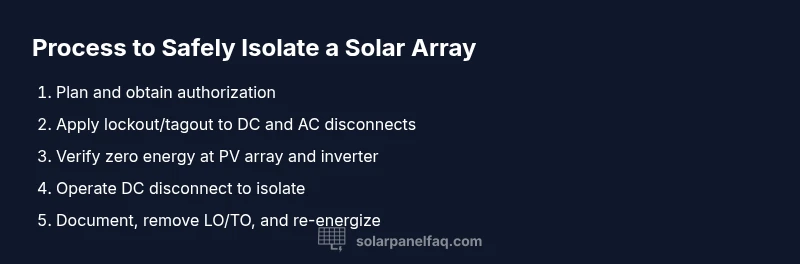
A licensed professional will begin with a planned shutdown, ensuring all affected parties are informed and that a permit or notification may be required. They will verify the utility has been informed and will apply lockout/tagout devices to the appropriate disconnects, both on the DC side and at the inverter/AC side where applicable. The technician will then test to confirm there is zero energy at the PV array and inverter, using a meter rated for PV systems. After confirming isolation, they will document the process and place clear signage. Only after all checks are complete will re-energization be performed in the reverse sequence, with tests again confirming safe operation.
Safer alternatives for daytime work: planning around weather and grid coordination
If maintenance is needed during the day, homeowners should explore safer alternatives to full disconnection. Schedule work during times of lower sun exposure when practical, and work with your installer to use temporary monitoring or remote diagnostics that don’t require a full shutdown. Some tasks can be performed at the electrical panel without accessing live PV wiring, while others must wait for a formal shutdown performed by a professional. Proactively coordinating with your utility and installer can reduce the risk while ensuring the system remains compliant with safety and interconnection requirements.
What to ask your installer before attempting any disconnection
Before any isolation, ask about the exact steps, required permits, and whether a formal shutdown is necessary for your job. Request documentation of the energy isolation plan, the sequence of disconnect operations, and the validation steps used to confirm zero energy. Clarify who is responsible for safety briefings, tagging, and removal of lockout devices after work concludes. Finally, confirm that all warranties and interconnection agreements remain valid after any service activity.
Tools & Materials
- Lockout/Tagout kit(Lockout devices for AC/DC disconnects; tamper-evident tags)
- Voltage-rated DC disconnect switch(As installed on your system; do not improvise)
- Insulated gloves(Class 2 or higher; test voltage before use)
- Voltage tester / multimeter(PV-specific testing points; verify zero energy)
- Safety glasses or face shield(Protection from arcs and debris)
- Non-conductive tools(Plastic or insulated tools for handling components)
- Hard hat and proper clothing(Protective PPE for rooftop work)
- Documentation forms (LOTO tags, permits)(Recordkeeping and compliance)
- Communication device(Phone or radio to coordinate with team)
Steps
Estimated time: 60-120 minutes
- 1
Review scope and secure authorization
Confirm the maintenance need and obtain written authorization from the system owner and utility if required. Review system schematics and ensure all involved parties are informed about the work window.
Tip: Document approvals and dates; clear communication prevents last-minute changes. - 2
Identify isolation points
Locate the DC disconnect near the PV array and the AC disconnect at or near the inverter or main service panel. Mark these points with LO/TO tags to indicate they are isolated.
Tip: Do not rely on visual cues alone; confirm with the system diagram. - 3
Apply lockout/tagout devices
Place lockout devices on all disconnects and attach a durable tag that states who is responsible and the work scope. Ensure the devices cannot be removed without a key or tool.
Tip: Keep your tags visible and maintain a record of who placed and removed them. - 4
Verify energy is isolated
Use a PV-rated multimeter to check for voltage at the PV array conductors and at the inverter inputs. Confirm zero energy readings before touching any components.
Tip: Test at multiple points and confirm both DC and AC sides show no energy. - 5
Operate the DC disconnect and isolate
With the disconnects secured, switch the DC disconnect to the open position and confirm there is no current flow. Do not touch exposed conductors during this step.
Tip: Only perform this step if you are trained for DC isolation. - 6
Re-energize and remove LO/TO
After maintenance, reconnect in the reverse order, remove lockout devices, and re-test to ensure safe operation. Notify all parties the work is complete.
Tip: Document the final energization state and keep records for future reference.
Frequently Asked Questions
Can I disconnect solar panels during the day myself?
No. Daytime disconnection should be performed by trained technicians with proper PPE and utility-approved procedures to prevent shocks or backfeed. Homeowners should contact a licensed installer for any isolation work.
Daytime disconnection should be handled by a trained professional. If you’re unsure, contact a licensed installer for a safe shutdown.
What is the difference between AC disconnect and DC disconnect in a solar installation?
A DC disconnect isolates the solar array on the direct current side, while an AC disconnect isolates the inverter side that feeds the home panel. Both may be required for full isolation, depending on the system.
DC disconnects isolate the PV side; AC disconnects isolate the inverter side. Both may be needed for full isolation.
Will disconnecting affect my battery storage or grid connection?
Yes, disconnecting will isolate the solar system from the home and the grid, which may affect storage operation and backup power during maintenance. Re-energization should follow proper procedures.
Disconnecting isolates the system; battery storage and grid interactions are paused until re-energized.
Is there any scenario where daytime disconnection is necessary?
Yes, for rooftop repairs, module replacement, or safety concerns that require access to electrical components. Such work should be performed by a licensed professional following approved procedures.
Only when maintenance or safety requires it, and a licensed pro should do the work.
How long does a professional disconnection take?
The time varies with system type and access, but a licensed professional will allocate enough time to perform a safe shutdown, verification, and restart. Expect it to take longer than a simple switch flip.
It depends on the system; a safe shutdown and verification can take some time, not just a quick switch.
Can daytime disconnection be avoided by scheduling maintenance at night?
In some cases, maintenance can be scheduled during off-peak hours, but this depends on utility requirements and system configuration. A professional can advise the safest timing.
Sometimes yes, but it depends on your utility and system setup. A pro will advise.
Watch Video
Top Takeaways
- Disconnection during daylight is hazardous; hire professionals.
- DC disconnect isolates PV side; AC disconnect handles inverter side.
- Follow lockout-tagout and verify zero energy before work.
- Plan around weather, utility rules, and maintenance windows.
- Document all steps and re-energization procedures.