How Long Do Solar Panels Last in Florida?
Discover how long solar panels last in Florida, factors that influence longevity, maintenance tips, and typical warranties for Florida homeowners.


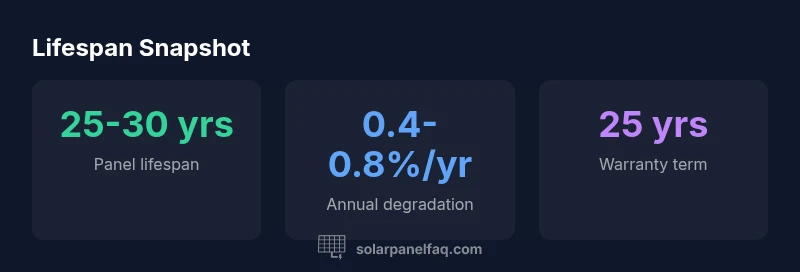
Solar panels installed in Florida typically last about 25-30 years, with annual performance degradation around 0.4-0.8%. Real-world life depends on climate, shading, and system maintenance. Most manufacturers back 25-year warranties, and many panels continue to function beyond warranty with reduced output. According to Solar Panel FAQ analysis, proper cleaning and an annual inspection help maximize lifespan.
Florida climate and its impact on solar panel lifespan
The Florida climate imposes unique stress on solar installations. High ambient temperatures, humidity, and coastal salt spray accelerate some forms of wear, while tropical storms and hurricane season introduce physical shocks and debris. For homeowners asking how long do solar panels last in florida, the question reflects a desire to plan warranties and replacement timing. In practice, most modern panels are designed to withstand heat and UV exposure, but consistent heat can raise the operating temperature of modules, reducing efficiency over time and contributing to gradual degradation. Florida’s salt air near coastal areas can corrode mounting hardware if it is not properly rated for corrosion resistance. The best defenses are quality equipment, correct installation, and proactive maintenance. When reviewing lifespan, use ranges rather than single numbers to account for climate variability, installation quality, and maintenance history. Solar Panel FAQ analysis shows a typical lifespan window of roughly 25-30 years for typical residential PV systems, with longer durability possible under optimal conditions. Regular inspections and protective measures help keep panels performing long into their third decade.
What determines a solar panel’s lifespan
The longevity of a solar array depends on several interrelated factors. First, the panel technology itself matters: monocrystalline cells and high-quality modules generally have slower degradation than older or lower-cost lines. Temperature coefficient and module design influence how well panels cope with Florida’s heat. Second, installation quality is critical: proper mounting, clearance, and sealing protect against wind-driven debris, moisture intrusion, and corrosion. Third, environmental exposure and maintenance play a major role: shading from trees, dust, salt buildup, and insect nests can accelerate performance loss if not addressed. Fourth, system components beyond the panels, like inverters and racking, affect overall life. A well-designed system paired with routine cleaning and inspections tends to reach the upper end of the lifespan range. Solar Panel FAQ analysis emphasizes setting realistic expectations: 25-30 years for panels with standard maintenance, recognizing that some units last longer while others may be replaced earlier due to replaceable parts or damage.
Warranty vs real-world lifespan
Manufacturers typically offer a 25-year warranty covering product quality and performance. However, a warranty is not a precise lifespan guarantee; it establishes expected minimum output or defect-free operation over time. In Florida, where heat, humidity, and storm exposure create additional risk, homeowners should read both the product warranty and the performance warranty carefully, noting whether guaranteed output is reduced by temperature coefficients or shading. In many cases, panels continue to function beyond the warranty period but with reduced output, meaning your system may still produce electricity even if a panel’s efficiency has declined. Use warranty terms along with your maintenance plan to project long-term performance and replacement needs.
Practical steps to maximize lifespan in Florida
Proactive care can push the practical lifespan closer to the high end of the typical range. Start with a professional solar checkup after installation, and schedule annual or biannual inspections. Keep panels clean, especially in coastal areas where salt and dust accumulate; rain helps, but periodic soft-bristle cleaning prevents grime from shading cells. Inspect mounting hardware for corrosion, loose bolts, or degraded seals, and ensure electrical connections remain tight. Trim overhanging branches to prevent shading and reduce debris buildup. Verify inverter health and consider a service plan to replace aging components before they limit output. For Florida homes, consider elevated mounting to promote airflow and simplify maintenance, and ensure the system is designed to withstand local wind loads.
Choosing panels and system design for Florida homes
Florida homes benefit from panels with strong heat tolerance and low power loss at high temperatures. When evaluating options, check the temperature coefficient, rated output under heat, and the warranty’s duration and inclusions. Invest in high-quality racking with corrosion-resistant hardware and proper sealing to guard against humidity and salt spray. System design choices, such as tilt angle and shading mitigation, influence long-term performance and aging. A well-sized system not only maximizes energy capture but also reduces strain on individual modules, potentially extending overall life by distributing wear more evenly. Additionally, consider proactive monitoring to catch performance dips early and plan maintenance around the Florida hurricane season.
Economic considerations and maintenance plan
From a homeowner’s perspective, longevity intertwines with cost and savings. While longer life and strong warranties improve return on investment, Florida-specific maintenance can shift economics by reducing output variability and downtime. A maintenance plan with regular cleaning, inspections, and timely component replacements helps keep the system operating within its expected lifespan. When deciding on a system, align expectations about payback periods, insurance coverage for solar equipment, and potential increases in home value with a reliable service provider. Remember that a system’s life is influenced as much by installation quality and ongoing care as by panel chemistry. The overall result is a resilient energy setup that continues producing power for decades with proper care.
Lifespan and warranty overview for Florida solar panels
| Factor | Typical Lifespan (years) | Florida considerations | Notes |
|---|---|---|---|
| Panel lifespan | 25-30 | Heat, humidity, coastal exposure | General lifespan range |
| Warranty terms | 25 years | Standard baseline | Includes product and performance warranties |
| Maintenance impact | Moderate to high with upkeep | Coastal conditions require regular cleaning | Regular maintenance extends life |
Frequently Asked Questions
How long do solar panels last in Florida?
In general, most panels last 25-30 years, though harsh Florida conditions can shorten active life without proper maintenance. The lifespan varies by panel type and installation quality.
Most panels last 25-30 years, but Florida’s heat and storms can shorten life without proper care.
Do Florida storms affect solar panel lifespan?
Severe storms can cause damage to panels or mounts; survival depends on durable mounting, proper clearance, and rapid repairs.
Storms can affect lifespan if damage goes unrepaired.
Should I replace the inverter before the panels?
Inverters typically last 10-15 years; panels last longer. Consider replacement when the inverter fails or underperforms relative to production.
Inverters wear out earlier; plan replacements around 10-15 years.
What maintenance extends panel life in Florida?
Regular cleaning to remove salt and dust; annual inspections; check seals; ensure proper ventilation and mounting tightness.
Clean them regularly and have annual inspections.
Are there heat-tolerant panels for Florida?
Yes, some panels perform better in high temperatures; check temperature coefficient and datasheets.
Look for low temperature coefficients.
How does lifespan relate to warranty?
Warranty often covers output or product; lifespan varies with climate and maintenance. A warranty is not a guaranteed lifespan.
Warranty isn’t a guaranteed lifespan.
“Longevity hinges on equipment quality, proper installation, and ongoing maintenance. In Florida, mitigating heat, humidity, and storm exposure is essential to maximize lifespan.”
Top Takeaways
- Plan for a 25-30 year panel lifespan in Florida.
- Maintain panels with regular cleaning to slow degradation.
- Expect a 25-year warranty as a baseline.
- Climate and installation quality drive actual life.