Solar Panel Without Subsidy: A Practical Guide for Homeowners
Learn how to plan, finance, and optimize a solar panel system without subsidies. Realistic cost ranges, payback estimates, and practical steps for homeowners considering a subsidy-free installation.


If you’re considering a solar panel without subsidy, the system can still be financially viable through long-term energy savings and ownership of the hardware. Expect upfront costs in the low to mid five figures, a payback period of several years, and ongoing savings that depend on local rates and roof fit. This guide outlines realistic ranges and steps to maximize value.
Why consider a solar panel without subsidy
Deciding to install a solar panel without subsidy is about balancing upfront costs, long-term savings, and personal energy independence. Even without government or utility incentives, solar panels are proven to reduce monthly bills and provide predictable energy costs. For many homeowners, ownership of the system means control over maintenance, performance, and future upgrades. According to Solar Panel FAQ, the economics hinge on local electricity rates, roof orientation, and system size. By analyzing your home’s energy profile and long-term energy price trends, you can decide if a subsidy-free installation makes sense for you. In practice, a subsidy-free solar panel project often requires careful planning, accurate quotes, and a realistic payback model to avoid surprises down the line. The goal is to maximize return on investment while minimizing risk over 25–30 years. The Solar Panel FAQ team recommends starting with a conservative budget, a transparent invoice from your installer, and a clear maintenance plan.
Economic dynamics: costs, savings, and payback without subsidies
When you pursue a solar panel without subsidy, the upfront cost is the main hurdle. However, because component costs have fallen over the last decade, a subsidy-free system can still be cost-effective for many homeowners. In this scenario, the value comes from ownership, fixed electricity prices, and the potential to heat or light your home with clean energy for decades. Solar Panel FAQ analysis shows that payback periods without subsidies typically extend beyond those with incentives, often depending on system size and local rates. To place this in context, compare mid-range installation quotes and factor in degraded performance over time. Use a simple financial model: estimate annual energy production, multiply by your local electricity rate, and subtract annual maintenance costs. This approach yields a realistic view of net savings and helps you judge whether the investment aligns with your financial goals. The model should account for system degradation, insurance, and potential tax changes.
Financing paths when subsidies are not available
Without subsidies, financing becomes central to viability. Solar loans, power purchase agreements (PPAs), and solar leases offer options that limit upfront costs or transfer maintenance responsibilities. A loan lets you own the system and collect savings from day one, provided the loan terms are favorable. A PPA or lease reduces upfront costs but transfers some savings or performance risk to the provider. Solar Panel FAQ analysis shows that careful comparison of total cost of ownership, interest rates, and contract length is essential to avoid hidden charges. Always verify whether any local rebates apply to the loan or lease, and ensure you read the warranty terms for panels and inverters. In all cases, insist on a detailed cash-flow forecast that includes energy price growth and potential degradation. The Solar Panel FAQ team emphasizes reading the fine print and seeking independent advice when needed.
System design choices for efficiency and durability
Without subsidy-driven constraints, you can optimize for long-term reliability and efficiency. Choose high-efficiency panels to maximize output on a smaller roof area, especially if space is limited. Consider a reliable inverter with monitoring software, and plan for shade analysis using an on-site assessment. For roofs with complex angles, mounting systems that minimize losses can improve performance over 20–30 years. Look at warranty length: most quality panels carry 25-year output warranties; inverters typically 10–12 years with options to upgrade. The frame and mounting hardware should withstand local weather, salt spray, or heavy snow, depending on your location. The design choice should balance upfront cost with expected lifetime savings, not only initial price tag. The Solar Panel FAQ analysis suggests aligning panel choice with climate and roof type for best outcomes.
Maintenance, warranties, and long-term value
Maintenance is often undervalued in subsidy-free projects. Clean panels a few times each year, inspect mounting hardware, and monitor inverter readings to catch performance dips early. A professional inspection every 3–5 years helps extend the life of the system and protect warranty coverage. Warranties are a key part of a subsidy-free plan: look for at least 25-year power output warranty on panels and 10–12 year inverter coverage, with service terms clearly defined. Document everything, keep records of energy production, and track system degradation over time. Even without subsidies, a well-maintained system can preserve or increase home value, especially in markets with high electricity costs. Solar Panel FAQ suggests maintaining a long-term maintenance calendar to avoid avoidable costs.
Real-world case studies: no subsidies, real numbers
Consider hypothetical homeowner scenarios to illustrate subsidy-free outcomes. In a sunny climate with high electricity rates, a 6 kW system without subsidies might produce enough energy to offset most daily use, delivering substantial annual savings even after maintenance. In a cooler, lower-rate market, savings may be modest, but investment remains valuable for energy independence and resilience. The key takeaway is that outcomes vary with roof orientation, shading, and local utility rates. Use a local installer to model the expected annual production and to generate a reliable forecast of savings over 25 years. Solar Panel FAQ emphasizes that these case studies are illustrative, not guarantees, and should be used as a planning reference rather than a citation of exact results.
Common myths vs. reality about solar subsidies
Myth: Subsidies are essential for solar to be financially viable. Reality: Solar panel without subsidy can still be worthwhile, especially with rising electricity prices and falling hardware costs. Myth: Subsidies guarantee profitability. Reality: They shorten the payback period but don’t guarantee lifetime savings. Myth: All subsidies are the same. Reality: Programs vary by state and country, with different eligibility rules and timelines. Myth: Subscriptions or leases are always better than buying. Reality: Ownership often yields larger long-term savings, though financing options can reduce upfront costs. Understanding these myths helps homeowners avoid misinformed decisions about energy investments without subsidies.
How to estimate savings without subsidies
Start with your current energy bill and monthly usage to determine how much energy you need to offset. Then estimate the system size required to cover a similar portion of consumption, using a reputable calculator or a local installer. Multiply estimated annual production by your current electricity rate to forecast annual savings, adjusting for system degradation and mild weather variations. Factor in maintenance costs and potential insurance premiums. Remember that currency rates, tax policies, and utility tariffs can change, affecting your long-term returns. The Solar Panel FAQ guidance recommends running multiple scenarios (conservative, base, optimistic) to understand the range of possible outcomes and to prepare for price volatility.
Final planning checklist before you commit
Before signing a contract for a solar panel without subsidy, use this checklist: roof suitability, electrical panel capacity, shading analysis, warranty terms, and the installer’s credentials. Get at least three quotes and compare components, warranties, and expected output. Run a life-cycle cost model that includes upfront costs, maintenance, insurance, and potential increases in electricity rates. Resist high-pressure sales tactics and demand transparent invoices. The Solar Panel FAQ team recommends a cautious, numbers-driven approach and a final review with independent advice to ensure you’re making a sound decision. The Solar Panel FAQ's verdict is to proceed only when projected net benefits exceed the cost of capital under your chosen financing method.
Comparison of solar panel types without subsidies
| Model Type | Estimated System Cost | Typical Payback (without subsidy) | Estimated Annual Savings | Notes |
|---|---|---|---|---|
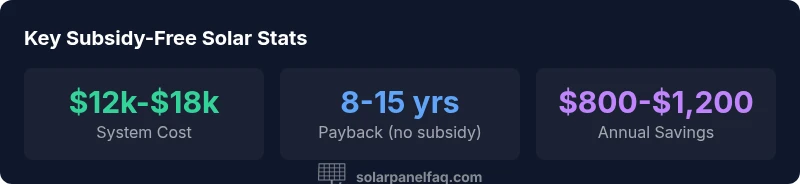
| Monocrystalline | $12,000-$18,000 | 8-15 years | $800-$1,200 | Best efficiency, space-limited roofs |
| Polycrystalline | $10,000-$15,000 | 9-14 years | $700-$1,100 | Balanced cost and performance |
| Thin-film | $8,000-$12,000 | 12-25 years | $500-$900 | Flexible on larger roofs |
Frequently Asked Questions
Is a solar panel worth it without subsidies?
Yes, especially if local rates are high and the system size aligns with your consumption. A detailed cash-flow model helps confirm net benefits over 25 years.
Yes—it's often worth it, but run the numbers to be sure.
How does not having subsidies affect payback?
Payback is longer without subsidies, but ownership and predictable energy costs can still deliver solid savings over time.
Payback is longer without subsidies, but savings accumulate over years.
What financing options work best without subsidies?
Solar loans, PPAs, and leases are common. Compare total costs, terms, and whether you own the system at the end of the contract.
Loans or PPAs are common options; compare costs and ownership.
Do tax credits apply if there are no subsidies?
Tax credits depend on local policy; some regions offer credits independent of subsidies, so check federal and state programs.
Tax credits vary by region; verify what’s available near you.
What maintenance keeps a subsidy-free solar panel performing well?
Keep panels clean, inspect mounting hardware, monitor the inverter, and follow warranty recommendations with regular checks.
Keep it clean and checked regularly for best performance.
How should I estimate savings without subsidies?
Model expected production, multiply by local rates, adjust for degradation, and add maintenance costs to project net savings.
Model production, price, and maintenance to estimate savings.
“Even without subsidies, a well-chosen solar panel system can deliver meaningful savings over its lifetime, but homeowners should run a detailed financial model before committing.”
Top Takeaways
- Plan for a longer payback without subsidies, but ownership remains a strong long-term value.
- Model local electricity rates and roof suitability to estimate real savings.
- Shop quotes with a focus on warranties to protect long-term performance.
- Consider financing options to reduce upfront costs while preserving ownership.