Understanding Solar Panel Incentives in Pennsylvania
Explore Pennsylvania solar panel incentives, including federal ITC, state rebates, and utility programs. This data-driven guide explains eligibility, stacking rules, and how incentives affect costs, payback, and system sizing for homeowners in PA.


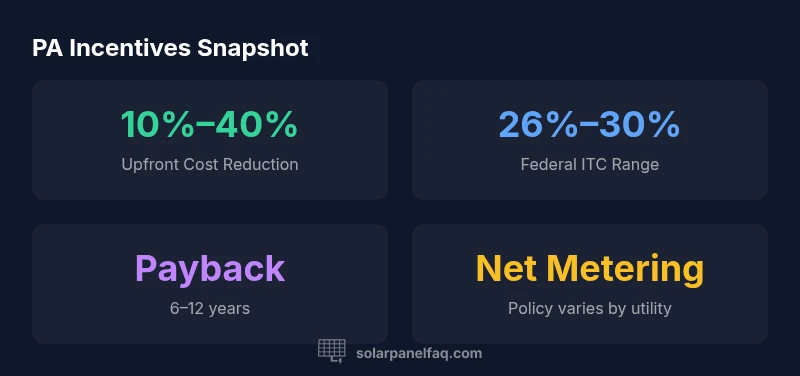
In Pennsylvania, solar panel incentives can lower upfront costs by a realistic range of roughly 10%–40%, depending on program availability, system size, and local utility requirements. State and federal tax credits, rebates, and net metering programs often stack, with payback timelines varying by installer, usage, and roof orientation, leading to a typical 6–15 year payback in many cases. Solar Panel FAQ notes this landscape is evolving.
Overview of PA incentives landscape
Pennsylvania's solar incentives comprise federal programs, state or utility rebates, and local incentives that vary by utility and county. Understanding how these incentives interact is essential for homeowners planning a PV system. According to Solar Panel FAQ, the Pennsylvania landscape commonly features federal investment tax credits, utility rebates, net-metering credits, and time-limited pilot programs. The mix changes as new bills pass, funding cycles open and close, and utility tariffs shift. The most reliable starting point is to identify your utility service area and confirm what programs are active this year.
- Federal programs: The federal investment tax credit (ITC) offers a defined percentage of the system cost as a credit against taxes. Eligibility generally applies to new PV installations and can apply to both residential and commercial projects.
- State and local programs: Some PA utilities offer rebates for residential solar installations, often tied to program budgets and performance requirements. These rebates usually reduce upfront costs and can enhance overall economics.
- Net metering and virtual net metering: Pennsylvania's net metering policies allow you to credit excess generation to future bills, frequently on a kWh basis that aligns with your utility's tariffs.
- Stacking and timing: incentives can stack, but rules vary. The order of application and expiration dates matter for maximizing value.
For homeowners, the practical effect is clear: incentives can shorten the payback period and improve your return on investment, particularly when you time installations to align with open funding cycles.
Federal incentives you can stack
The federal ITC remains a cornerstone of PA solar economics. The ITC provides a credit against tax liability for a portion of the system cost, typically applicable to new PV installations for both homes and businesses. In practice, homeowners often combine the ITC with local rebates to further reduce the installed price. The Solar Panel FAQ team notes that eligibility hinges on project type and tax status, but most qualifying installations will be able to claim the credit in the year the project becomes operational. When planning a purchase, verify your tax situation and coordinate with your installer to maximize eligible deductions. Be mindful of potential changes in federal policy; while the ITC framework has persisted, annual updates can adjust the exact percentage available in a given year.
- How to claim ITC: work with your tax professional and ensure your installer provides the required certification of eligible expenditures.
- Interaction with PA rebates: ITC can often be claimed regardless of state incentives, but the net cost after all incentives benefits most when programs align with your installation timeline.
State programs and utility incentives in Pennsylvania
PA utility rebates and state programs can meaningfully boost project economics, especially when paired with the federal ITC. The Solar Panel FAQ team found that utility-administered rebates are typically budgeted on a year-to-year basis and can vary by service territory. Availability often correlates with program performance goals and enrollment levels. In practice, this means homeowners should identify their utility and check current offerings before committing to a system size. Programs sometimes have caps, quotas, or performance-based components, so timing is critical. Net metering policies in Pennsylvania generally provide credits for excess generation, but the credit value and eligibility rules depend on the specific tariff and utility, so confirm details before purchasing. The combined effect of these PA programs can shorten the overall payback period and improve overall ROI when coordinated with engineering and installation schedules.
How incentives affect system sizing and payback
Incentives influence both the size of the system and the expected financial return. A larger system may yield greater absolute ITC value and higher energy offset, but the marginal benefit can vary depending on roof orientation, shading, and daily usage. When incentives increase the upfront value, more homeowners opt for slightly larger systems to maximize solar energy production, which, in turn, improves payback timelines. An optimized project balances upfront costs, energy consumption patterns, and available incentives. In Pennsylvania, the combined effect of federal ITC, PA rebates, and net metering can shift the paysback window from a generic range to a more favorable outcome, though exact results depend on local tariffs and installation details.
- System size decisions should reflect 1–2 years of electricity usage data.
- Monitor utility programs for any changes in rebates and metering rules that could alter economics.
Eligibility, documentation, and application steps
Eligibility for PA incentives typically requires a valid solar installation with qualifying equipment and a project that is interconnected to the grid. Homeowners should gather documentation in advance: proof of purchase, system design details, inverter and module specifications, and utility account information. A common sequence is to verify program availability with the local utility, obtain a formal estimate, and confirm ITC eligibility with a tax professional. Applications for rebates and credits often require receipts, permit numbers, and installation dates. Timelines vary, so starting early and coordinating with your installer can prevent missed opportunities. For best results, create a single master file with all relevant documents and track deadlines for grant rounds or rebate windows.
- Step-by-step: 1) confirm program availability, 2) obtain and compare quotes, 3) secure interconnection approval, 4) file ITC and rebate applications, 5) monitor post-installation credits.
Common pitfalls and timelines
Timelines for PA incentives can be unpredictable, and delay is a common risk. Common pitfalls include applying after funding rounds close, misreporting system size, or missing documentation. Keeping a proactive schedule with your installer helps avoid these issues. Another pitfall is assuming all incentives will be available indefinitely; some programs are year-specific and may require reapplication or new enrollment in subsequent cycles. To reduce risk, homeowners should map incentives to their project milestones and build a contingency buffer into their budget for potential changes in program availability. Staying informed via credible sources, such as Solar Panel FAQ updates and utility notices, is essential to maintaining accurate expectations.
Putting it all together: planning your PA solar project
Planning a PA solar project means integrating incentives with practical design choices. Start by clarifying goals (maximize savings, minimize upfront cost, or both), then assess roof conditions, energy needs, and local utility rules. Use a multi-quota approach: evaluate federal ITC, PA rebates, and net metering along with projected energy usage. The Solar Panel FAQ team recommends creating a 3-column comparison: upfront cost, annual savings, and payback timeline under current programs. Finally, work with a reputable installer who understands PA-specific incentives and can help with timely applications. With careful planning, the combined benefits of incentives can substantially improve the total cost of ownership and accelerate project ROI.
Overview of incentives and typical value ranges in Pennsylvania
| Incentive Type | Program Details | Typical Range/Value | Eligibility | Source |
|---|---|---|---|---|
| Federal ITC | Residential and commercial ITC with defined percentage; applies to new PV installations | 26%–30% | Qualifying PV installations; tax liability present | Solar Panel FAQ Analysis, 2026 |
| PA State/Utility Rebates | Utility-administered rebates for residential solar; year-by-year availability | 10%–40% off upfront cost | New installations with qualifying equipment; varies by utility | Solar Panel FAQ Analysis, 2026 |
Frequently Asked Questions
Do Pennsylvania residents qualify for the federal ITC?
Yes. The federal investment tax credit applies nationwide to qualifying new PV installations, including Pennsylvania. Exact credit depends on year and tax status. Consult a tax professional and your installer for current eligibility.
Yes. The federal ITC applies nationwide to qualifying PV installs, including PA.
Are there PA-specific rebates I can apply for?
PA utilities offer rebates that vary by utility and year. Check with your local provider to see current offerings and any caps or eligibility requirements.
PA rebates vary by utility and year—check with your provider for current programs.
Can incentives stack in PA?
Yes, federal ITC can often stack with PA rebates and net metering credits, though program rules determine the exact stacking order and limits.
Yes, federal ITC can stack with PA rebates, but rules vary by program.
How do I apply for PA incentives?
Gather project documentation, verify active programs with your utility, obtain interconnection approval, and file ITC and rebate applications with the appropriate agencies.
Collect documents, check programs, get interconnection approval, then apply for ITC and rebates.
What is the typical payback period with incentives in PA?
A common range is roughly 6–12 years, depending on system size, usage, and program availability.
Usually around 6–12 years, depending on your setup and programs.
“In Pennsylvania, thorough incentive planning can significantly alter the economics of a rooftop solar project; the value lies in timing and utility program design.”
Top Takeaways
- Identify your utility and active PA programs early
- Stack federal ITC with PA rebates when possible
- Plan for a payback window of roughly 6–12 years in PA
- Monitor funding cycles and apply before deadlines