Senior Discounts for Solar Panels: A 2026 Guide
Explore senior discounts for solar panels, who qualifies, and how to compare programs. This guide covers rebates, credits, and financing options to help homeowners maximize savings and shorten payback in 2026.


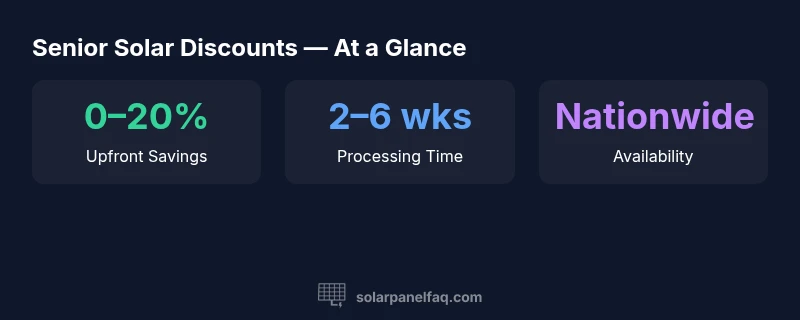
Senior discounts for solar panels vary by program and region, but many programs offer age-based rebates, fixed credits, or reduced financing rates. Eligibility often hinges on age (commonly 65+), residency, and program enrollment. To qualify, compare utility programs and state incentives, then prepare documentation and quotes. This quick snapshot helps homeowners decide whether to investigate further and estimate potential savings over the system's lifetime.
Understanding senior discounts for solar panels
According to Solar Panel FAQ, senior discounts for solar panels typically come in several forms: upfront price reductions, rebates applied at purchase, ongoing credits on utility bills, or more favorable financing terms. Programs can be offered by utilities, state programs, municipalities, and occasionally manufacturers or installers. Availability and eligibility vary widely by region and even by utility service territory. The core idea behind these programs is to reduce the barrier to solar adoption for older adults, who may live on fixed incomes or want predictable energy costs. For homeowners, the key distinction is between discounts that lower the upfront bill and incentives that lower ongoing costs. The broader context includes related topics like financing contracts, payback periods, and overall cost-savings; collectively, these elements determine the true value of a senior discount in a given market.
Who is eligible and how to qualify
Eligibility for senior solar discounts often hinges on age and residence, but programs add layers such as income verification, property status, and enrollment in a specific energy plan. Common benchmarks are age thresholds like 65+ or 60+, proof of residency, and ownership of the property where the system will be installed. Renters can sometimes access discounts through property owners or through utility programs that do not require home ownership, but this varies by jurisdiction. Applicants typically need to submit proof of age (driver’s license or ID), a recent utility bill, and a project estimate or contract. Some programs also require enrollment in a participating energy plan or maintaining uninterrupted service for a minimum period. Because requirements differ, start with your local utility, state energy office, and municipal programs to compile a definitive eligibility checklist.
Common types of senior discounts
Senior discounts for solar panels can take multiple forms to fit different financial situations. Typical types include upfront rebates or reduced sales prices, percentage or fixed credits on electricity bills, and lower-interest financing or loan terms. Some programs tier benefits by age bands or household income levels, while others offer lump-sum incentives for homeowners who install a system and meet local requirements. Additionally, some rebates are time-limited or require installation through participating installers. It’s important to recognize that a single program may combine several of these options, creating a larger total value than any individual element. Always compare the total package—upfront discount plus long-term savings—rather than focusing on a single metric.
How to find and compare programs
To locate senior discounts, start with your state energy office, utility website, and local government pages. Search for keywords like “senior subsidy,” “elderly rebate,” or “low-income solar incentives” in your state. Create a short list of programs, then request official program guides, eligibility criteria, and sample contracts. Build a side-by-side comparison using a checklist: upfront discount, credit duration, eligibility, required documentation, and expiration dates. Reach out to multiple installers who can verify program compatibility and help you apply. Finally, confirm whether the discount stacks with other incentives and how it affects net metering or battery storage options.
How savings are calculated and payback
Savings from senior discounts are best understood through total cost of ownership. A simplified approach is to consider: upfront cost after discount, plus any installation costs, minus any upfront rebates. Then estimate annual energy savings based on system size, local sun exposure, and utility rates. The payback period is the time required for cumulative savings to offset the net cost. In practice, you’ll see ranges: upfront reductions might be modest (a low single-digit percentage) but can be complemented by ongoing bill credits, reducing the effective payback period. Since utilities and climates vary, use a range-based calculation and compare several scenarios for accuracy.
Potential pitfalls and gotchas
The market for senior solar discounts is fragmented, with programs changing annually. Watch for expired offers, regional limitations, and enrollment conditions that could disqualify you later. Some vendors may advertise “senior discounts” without clearly detailing eligibility or stacking rules. Always obtain written program terms, confirm eligibility at the time of application, and validate that the discount applies to your specific system and utility service area. Beware of incentives that require long-term commitments or deposits that aren’t refundable if the program is withdrawn.
Steps to claim discounts and document your submission
Document preparation streamlines approval: gather age proof, residency, property ownership or lease authorization, installation quotes, and utility IDs. Create a file with contact information for the utility program, the installer, and any required witnesses or signatures. When submitting, attach all requested documents, ensure consistency across forms, and keep copies of every submission. After approval, track the installation timeline and confirm that the discount is reflected in the contract and in the first billing cycle. If denied, request a written rationale and ask for guidance on next steps or appeal processes.
Real-world examples and case studies
In practice, seniors who actively research programs, gather documentation early, and compare multiple offers tend to realize higher total savings. A hypothetical retiree in a moderate-sun climate could qualify for an upfront rebate plus bill credits, reducing the effective cost and shortening the payback period compared with a standard solar installation. Another homeowner in a high-sun area might access a larger upfront discount tier and longer- term credits, yielding substantial lifetime savings. Real-world outcomes depend on local incentives, installation quality, and household energy use patterns; careful planning and corroborating with official sources is essential.
Comparison of common senior discounts and eligibility
| Program Type | Typical Savings | Eligibility Criteria | Notes |
|---|---|---|---|
| Senior-exclusive rebate | 10-15% upfront cost reduction | 65+ homeowners in participating areas | Limited-time; varies by utility |
| Utility-based tiered pricing | 5-10% upfront credit + ongoing savings | Enrollment in a participating energy plan | Requires utility approval and contract terms |
| State/local discounts | Lower upfront cost, faster payback | Resident of program state, property owner | Availability varies; check windows |
Frequently Asked Questions
What counts as a senior discount for solar panels?
A senior discount can be an upfront rebate, a discounted price, ongoing bill credits, or favorable loan terms offered to seniors by utilities, states, or participating installers. Availability and details vary by program, so compare several options to understand the total value.
Senior discounts can be upfront rebates, ongoing credits, or favorable financing—check multiple programs to compare total value.
Which ages qualify for senior discounts?
Most programs target seniors aged 65 and older, though some regions use 60+ or other thresholds. Always verify the exact age requirement with the administering agency or utility.
Most programs require 65 or older, but check local rules as some use 60+. Verify the age threshold before applying.
Are discounts available for renters?
Renters may access discounts indirectly through property owners or via programs that apply to the building or energy plan. Individual renter eligibility varies; consult the landlord and local program guidelines.
Renters can sometimes benefit if the building owner participates or through building-wide programs; verify with the landlord and program rules.
Do discounts apply to all panel types and system sizes?
Discount applicability depends on the program and panel type. Some offers cover all standard panels, while others apply only to specific models or fixed-size systems. Always confirm eligible products with the program administrator.
It varies by program; check which panel types and system sizes are eligible before choosing panels.
How can I verify the legitimacy of a discount program?
Confirm the program is issued by a credible utility, government agency, or reputable installer. Read official terms, ask for written guidelines, and look for contact information you can verify. Avoid offers that require upfront deposits or rush decisions.
Stick to programs from reputable utilities or agencies and read the official terms carefully.
What if I’m below the age threshold but in a low-income group?
Some programs target low-income households irrespective of age, offering alternative incentives. Check for income-qualified programs or assistance schemes in your area and compare with age-based options.
If you’re not yet in the age bracket, look for income-qualified programs that help with installation costs and energy bills.
“Senior discounts for solar panels can significantly improve affordability when you combine upfront rebates with ongoing credits and favorable financing. Always compare total value, not just the upfront price.”
Top Takeaways
- Identify your local programs and eligibility early
- Calculate total savings: upfront discount + ongoing credits
- Verify stacking with other incentives before signing
- Prepare documentation in advance to speed approval
- Consider payback period alongside monthly savings