No Cost Solar Guide: How It Works for Homeowners in 2026
A practical guide to no cost solar arrangements (leases and PPAs), eligibility, trade-offs, and how to compare offers for homeowners in 2026.


No cost solar refers to solar power arrangements where homeowners install solar without upfront payment, typically through leases or PPAs, with the installer or lender owning the system and customers paying via fixed or variable monthly rates. This model can reduce or eliminate upfront costs but may affect long-term savings and ownership rights.
What no-cost solar means in practice
No-cost solar arrangements are not actually free; they shift ownership and risk from you to a third party while allowing you to benefit from solar energy. According to Solar Panel FAQ, the core idea is that a provider installs and maintains the system on your roof or in a related location, and you pay for the power or a predictable monthly rent. In most cases there is no upfront payment, and the provider recovers costs through ongoing payments and the value of incentives. The economics depend on your energy usage, local utility rates, and contract terms. When you compare options, compare your current electricity bill to the estimated monthly payment, and look at any escalators over the term. The Solar Panel FAQ team notes that no-cost solar can be a practical route for reducing bills and embracing solar energy, but you should consider ownership, maintenance responsibilities, and the total lifetime cost of the arrangement. In 2026, incentives and utility programs can influence the value of offers, so take time to shop around and request clear, side-by-side comparisons.
No-cost solar models: leases, PPAs, and more
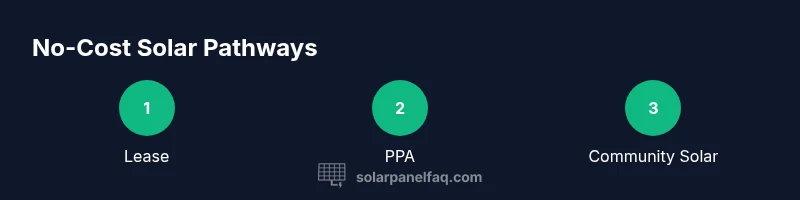
Two common no-cost paths are solar leases and PPAs. A lease provides a fixed monthly rent for the right to use the system; the provider owns and maintains the panels. A PPA charges for electricity produced, typically at a negotiated price per kilowatt-hour. Some programs also offer community solar subscriptions or solar-as-a-service arrangements that can involve no upfront costs but different billing structures. Each model affects maintenance, warranty, insurance, and long-term value. When evaluating offers, look for interconnection charges, meter upgrades, performance guarantees, and any price escalators. The goal is to quantify monthly costs against expected energy savings and consider any end-of-term buyout options.
How payments and long-term costs work
Under no-cost solar plans, your typical cost is replaced by a monthly payment or a price per kWh. Payments may be fixed or adjust with time, production, and weather. Many contracts include an annual escalation to protect the provider’s investment; however, escalation rates vary widely. You generally do not own the equipment, which means warranties and service are the provider’s responsibility rather than yours. The total of all payments plus any fees may be more or less than owning, depending on your usage and the contract terms. Before committing, insist on a transparent projection that shows total payments over the contract, the number of years, and any end-of-term buyout price. In 2026, energy prices and incentives can shift the economics, so a careful comparison is essential.
Eligibility and practical considerations
Before pursuing no-cost solar, verify roof suitability (direction, shading, roof age), access to a service area, and your credit profile if a lease or PPA is involved. The best candidates typically have moderate to high energy usage, a roof with good sun exposure, and a utility with favorable net metering or credit policies. Lenders or installers may perform a credit check, which can influence approval and pricing. Collect recent utility bills, take clear photos of your roof, and note any shading from trees or nearby structures. If you’re a renter or live in a multi-family home, check lease terms with your property owner or management company, as no-cost options often require consent or a coordinated multi-tenant agreement. Local incentives and interconnection rules vary by state, so consult your local utility to understand any requirements or credits that could affect your savings.
Pros, cons, and guardrails
The primary advantage of no-cost solar is zero upfront cost and quicker access to solar energy. It can also simplify the buying process and shield you from upfront capital risk. However, the trade-offs include not owning the system, potential higher long-term costs, and dependence on the provider for maintenance and performance. Consider the contract length, early termination fees, and whether you have an option to buy the system at a predictable price. Be wary of aggressive payment terms, insufficient disclosures, or high escalators that erode savings over time. Protect yourself by reading the fine print, verifying warranties, and confirming how much you’ll pay if the system underperforms or if you move to a different home.
How to compare offers and ask the right questions
When evaluating no-cost solar proposals, request a side‑by‑side comparison that includes: monthly payment or price per kWh, contract length, escalation rate, end-of-term buyout options, maintenance responsibilities, and insurance coverage. Ask for explicit details on interconnection costs, new meter installation, and any required equipment upgrades. Make sure you know who is responsible for equipment failures, what happens if the panels are damaged, and whether roof work is needed before installation. Also, verify the expected annual energy production and expected savings in your climate. Get everything in writing and avoid aggressive promises without a guaranteed performance statistic.
Alternatives and when no-cost options fit your goals
If ownership is important or you want maximum long-term savings, cash or loan purchases may be preferable. No-cost options can be attractive for homeowners who lack capital or who plan to move before the contract ends. Consider a blended approach, such as starting with a no-cost option and upgrading to a system loan later, or exploring community solar for urban or rental scenarios. Tailor your choice to your home’s configuration, climate, and local policy environment, and prioritize clarity, flexibility, and predictable costs.
Tools & Materials
- Computer or tablet with internet access(For researching offers and reading contracts)
- Notebook or digital note-taking app(To track questions, quotes, and calculations)
- Budget calculator or spreadsheet(To estimate payments vs. current bills)
- Photos of your roof and energy data(Roof orientation, shading, age, and any obstructions)
- Printer or PDF reader(Optional for printing contracts and receipts)
Steps
Estimated time: 2-6 weeks
- 1
Gather roof data and energy usage
Collect recent electric bills and take clear photos of your roof showing orientation, shading, and age. This helps estimate production and verify eligibility for no-cost options.
Tip: Have a recent utility bill handy and note any seasonal usage patterns. - 2
Identify no-cost options in your area
Search for leases, PPAs, and community solar programs offered by reputable providers. Request written terms and ask for a cost breakdown.
Tip: Ask for a side-by-side comparison of monthly payment vs. per-kWh charges. - 3
Request quotes from multiple providers
Contact at least three providers and request identical proposal formats to simplify comparison. Ensure each quote includes all fees, terms, and incentives.
Tip: Ask for production estimates and any performance guarantees. - 4
Compare terms and escalators
Review contract length, escalation rates, end-of-term buyout prices, maintenance responsibilities, and warranty coverage.
Tip: Calculate long-term cost by projecting escalators over the contract term. - 5
Review interconnection and incentives
Check interconnection fees, meter upgrades, and how net metering credits are applied on your bill. Verify eligibility for local incentives.
Tip: Call your utility to confirm how credits will appear and whether rules change with the contract. - 6
Have contracts reviewed
Have a trusted advisor or attorney review the contracts for hidden fees, termination clauses, or transfer restrictions if you move.
Tip: Look for a clear termination path if performance or costs are unacceptable. - 7
Make a decision and schedule installation
Choose the option that best fits your goals, sign the agreement, and coordinate installation dates. Prepare for any roof work or electrical permits.
Tip: Confirm project timelines, who handles permits, and what happens if weather delays install.
Frequently Asked Questions
How does no cost solar actually work?
No-cost solar arrangements involve a provider owning and maintaining the system while you pay for power or rent. You usually have no upfront costs, but you do not own the panels. Warranties, maintenance, and future ownership options depend on the contract terms.
No-cost solar works by letting a provider own and maintain the system, with you paying either a monthly fee or per-kilowatt-hour charges. You don’t own the panels, and your benefits depend on the contract terms.
Is no cost solar cheaper than owning?
Not always. Upfront ownership can yield higher long-term savings, but no-cost options may provide predictable bills and quicker solar adoption. Compare total payments, incentives, and potential buyout costs to determine which is cheaper for your situation.
It isn’t always cheaper. You need to compare the total payments over the contract with the potential long-term savings of owning.
What contract lengths should I expect?
Leases and PPAs typically run long, often over a decade. Common ranges are 15 to 25 years. Long contracts can include escalation clauses and end-of-term buyout options, so read carefully.
Most no-cost solar contracts last many years, usually between 15 and 25 years, with possible buyout options at the end.
What happens if I move before the term ends?
Transfer options exist in many agreements, but you may face fees or require the new homeowner to assume the contract. Some providers restrict transfers or require early termination terms.
If you move, the contract may transfer to the new homeowner or require settlement; confirm transfer rules before signing.
Can I buy the system at the end of the term?
Many leases and PPAs offer an option to buy the system at the end of the term, with a predetermined price or a methodology to determine it. Prices can vary, so check early.
Buyout options are common, but the price and terms vary—check early so you know your end-of-term cost.
Are there fees beyond the monthly payments?
Yes. Look for interconnection charges, meter upgrades, insurance requirements, maintenance fees, and possible early termination penalties. Always request a full, line-by-line cost breakdown.
There can be extra charges like interconnection or maintenance fees—get a full breakdown before signing.
Watch Video
Top Takeaways
- Compare multiple no-cost solar offers before signing
- Understand ownership and payment structure
- Check eligibility and roof suitability
- Assess long-term costs vs upfront savings
- Ask about incentives and interconnection terms