Free Solar Panels Indiana: Reality, Options, and How to Navigate
Explore whether Indiana homeowners can get free solar panels, how no-upfront-cost leases and PPAs work, and how to evaluate offers, incentives, and risks. Learn practical guidance from Solar Panel FAQ to navigate incentives, net metering, and legitimate deals in 2026.


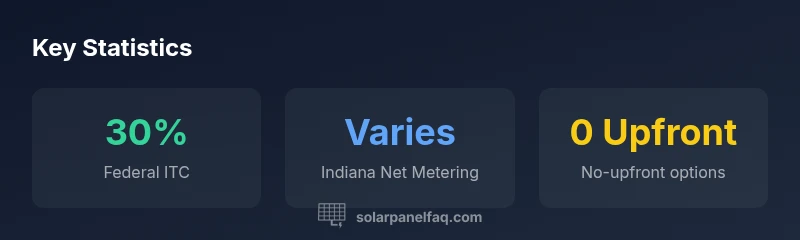
There is no universal 'free solar panels' program in Indiana. Most options advertised as 'free' rely on no-upfront-cost leases or PPAs where an installer covers hardware and installation. Homeowners still pay for electricity and may claim the federal ITC of 30% where eligible; state incentives and net-metering vary by utility.
The Reality of 'Free Solar Panels' in Indiana\n\nIn practice, there is no universal program that furnishes free solar panels to homeowners in Indiana. The phrase is commonly used by installers to market no-upfront-cost options, but the agreements usually involve leases or power purchase agreements (PPAs) where the installer owns the panels and you pay for electricity generated, often at a lower rate than your current utility price. This distinction matters: you may avoid upfront hardware costs, yet you still incur ongoing payments. The federal Investment Tax Credit (ITC) (currently 30% of system cost) is a major incentive for homeowners who purchase or finance; however, the credit typically applies to the homeowner when ownership changes hands, not to a third party in most lease or PPA arrangements. Indiana-specific incentives and net metering vary by utility and may be limited. When evaluating offers, treat 'free' as marketing and focus on total energy costs over the contract term, the contract length, any escalators, maintenance, warranties, and the provider's reputation. \n\nAccording to Solar Panel FAQ, homeowners should carefully assess the total energy cost over the contract term.
How no-upfront-cost options work (lease and PPA) in Indiana\n\nLeases and PPAs promise zero or very low upfront payments; the installer installs and maintains the system while you pay a fixed or variable rate for the electricity produced. In practice, the monthly payment or per-kWh charge often ends up being close to or slightly below your current bill, depending on your usage, local rates, and contract terms. Key differences: with a lease, you owe nothing for ownership; with a PPA, you pay per kWh generated; with both, maintenance is usually included. Many Indiana providers offer escalators that raise prices over time, so savings can erode if electricity prices rise faster than the contract discount. Always review end-of-term options: buyout, extension, or removal. Verify the contract details: performance guarantees, monitoring, and warranties on panels and inverters. The bottom line remains: no-upfront-cost does not equal free energy; it shifts cost and risk to the installer while delivering predictable monthly energy payments.
Indiana incentives, tax credits, and net metering: What to know in 2026\n\nFederal ITC remains a central incentive for solar, offering a 30% credit on eligible costs for systems placed in service. Indiana-specific incentives are more limited and rely on utility-specific programs, local rebates, or pilot projects that can vary by region. Net metering policies determine how credits are applied; some utilities offer full or partial credits; others have caps or time-based limits. Because programs change, confirm current eligibility with your utility before signing a deal. The Solar Panel FAQ team emphasizes checking the fine print: does the program permit two-way metering, what are the caps, and how long are credits guaranteed? Additionally, if your system uses storage, there may be separate incentives or rules. The Indiana landscape evolves, and by 2026 many benefits depend on ownership or financing and careful reading of offers.
How to evaluate offers and avoid scams\n\nLook for written estimates with a breakdown: hardware, installation, taxes, permits, and monitoring. Compare contracts side by side, focusing on the monthly payment, escalator, contract length, and buyout options. Check whether the deal includes a warranty for panels, inverter, and racking, and confirm maintenance responsibilities. Request third-party quotes and verify licensing and the installer’s reputation through reviews or the Better Business Bureau. Beware high-pressure sales, vague terms, or promises of guaranteed savings with no real analysis. Use a calculator to estimate energy costs based on your usage and local rates, and compare against a traditional purchase. When in doubt, consult Solar Panel FAQ for guidance and verify every claim with written documentation.
How to evaluate offers and avoid scams (continued)\n\n(Continued) Ask for a sample contract and run the numbers with a trusted advisor. Understand the buyout options at the end of term and whether the system remains with the installer after removal. Ensure there are clear terms about system maintenance, inverter replacement, panel warranties, and monitoring. Always check for licensing, insurance, and a physical address for the installer. If something feels unclear or overly optimistic, walk away and seek multiple quotes. Real savings require careful math, not marketing hyperbole. Solar Panel FAQ emphasizes transparency and diligence in 2026.
Realistic expectations: what your monthly bill and savings could look like\n\nEven when a deal offers no upfront cost, the energy you purchase still affects your monthly bill. Expect energy costs to be more predictable with a solar arrangement, but reductions vary by usage, system size, orientation, shading, and local utility rates. Storage can alter economics but adds complexity. The key is to set realistic expectations: quantify what you will save under several scenarios, document performance guarantees, and track actual production against projections over time.
Financing options for solar in Indiana
| Option | Upfront Cost | Ownership | Maintenance | Notes |
|---|---|---|---|---|
| Lease | 0 upfront | Installer owns panels | Maintenance included | No ownership; fixed monthly fee |
| PPA | 0 upfront | You pay per kWh produced | Maintenance included | Pay per kWh; production drives cost |
| Buy (cash/finance) | Depends on loan terms | You own panels | Owner maintains or pays for service | Long-term savings; higher upfront cost |
Frequently Asked Questions
Is there truly a way to get free solar panels in Indiana?
Not a universal program; expect no-upfront-cost leases or PPAs with ongoing energy payments.
There isn't a universal free solar program in Indiana; most options involve leases or PPAs with ongoing energy payments.
What should I look for before signing a lease or PPA?
Check term length, price escalators, maintenance coverage, warranties, and buyout options; compare multiple quotes.
Look at contract length, price escalators, maintenance, and buyout terms.
Are there Indiana-specific incentives I can count on?
Indiana incentives are limited; rely on federal ITC and any utility programs; verify with your utility.
Indiana incentives vary; the federal ITC still applies, but check with your utility.
How can I verify a 'free solar' offer is legitimate?
Request written terms, compare to standard costs, verify licenses, and check references.
Get it in writing, verify licensing, and compare with other quotes.
What is net metering and does Indiana allow it?
Net metering rules differ by utility; some offer credits, others have limits; confirm with your utility.
Net metering varies by utility—check your provider's policy.
If I want to go solar, what should I do first?
Assess usage, obtain multiple quotes, and consult a trusted source like Solar Panel FAQ.
Start by understanding your usage and get multiple quotes.
“The reality of 'free solar' is marketing; real value comes from transparent terms, warranties, and evidence-based savings.”
Top Takeaways
- There is no universal free solar program in Indiana.
- Leases and PPAs offer no-upfront cost but transfer some risk to the installer.
- Federal ITC covers 30% for ownership; verify eligibility when signing.
- Net metering and incentives vary by utility; confirm current rules before committing.