Free Solar Panels in California: A Practical Guide
Can you get solar panels for free in California? This analytical guide explains zero-upfront options, leasing, PPAs, incentives, and how to compare offers to avoid overpaying—with tips tailored for homeowners.


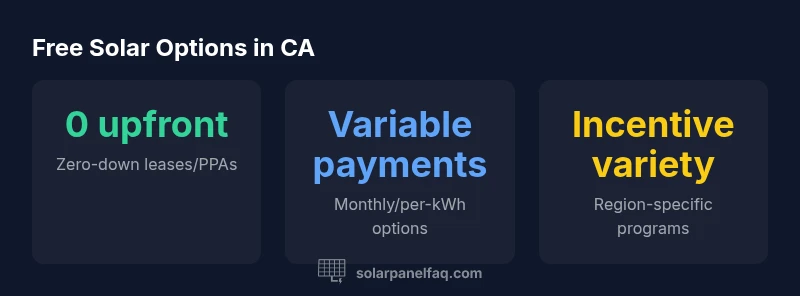
Zero upfront solar is common with leases and PPAs, but you do not own the panels and you’ll pay over time through monthly payments or per-kWh charges. In California, true ownership without upfront cost is rare; most so-called 'free solar' deals involve a third party. Always compare lifetime costs and read contracts carefully to understand total savings and long-term commitments.
Can you get solar panels for free in California? What 'free' really means
According to Solar Panel FAQ, the short answer is that 'free solar' usually means zero upfront costs through a lease or PPA, not actual ownership. In California, the market is competitive, and installers commonly promote zero-down options, but you will repay the system over time via a monthly payment or per-kWh charges. Homeowners should distinguish between owning a system and signing a third-party agreement. If you own, you may access incentives and long-term energy cost reductions; if you lease or sign a PPA, the installer retains ownership and your monthly or per-kWh charges cover the system's use. The economics hinge on your home's location, energy usage, sunlight exposure, and the specific contract terms. While there are legitimate zero-down deals, many offer financial benefits only when measured over the system's life, not in the first year. The key is to evaluate all costs, including maintenance, inverter replacement, and end-of-term options, before deciding whether 'free' solar is right for you.
Common pathways to low or zero upfront costs
There are several routes homeowners frequently encounter when considering solar with minimal or no upfront cash. First, leases allow a third-party installer to own the system while you pay a monthly lease fee or a share of the electricity generated. Second, PPAs (power purchase agreements) charge you for the electricity produced, typically at a set rate per kilowatt-hour, with little or no upfront cost. Third, community solar programs let you subscribe to a portion of a larger solar project, often with credits on your utility bill rather than a full installation at your home. Fourth, some utility-sponsored pilots and state-run initiatives offer zero-down options or low-cost financing for qualified households. Finally, traditional purchase financing remains available for those who want ownership from day one, often with longer loan terms and the potential for tax credits.
Leasing, PPAs, and ownership options
Leases and PPAs are popular because they remove upfront costs, but ownership stays with the installer or project owner. You typically receive predictable energy costs or savings measured against your baseline usage, but you miss the federal ITC and any long-term equity in the system. Ownership options—buying outright or financing—let you capture incentives and potentially higher lifetime savings, but require upfront or financed costs. When evaluating options, compare the total cost of ownership over the contract or loan term, including maintenance, inverter replacement, and potential end-of-term choices (renew/rebuy/retire). For California homeowners, differences in utility, location, and roof constraints can tilt the decision toward leases/PPAs or ownership, so side-by-side cost projections are essential.
California programs, incentives, and eligibility
California projects a favorable solar policy environment, but programs and incentives are not universal. Availability varies by utility, region, and household type, meaning some neighbors may qualify for no-down options while others do not. In general, owner-occupied systems may be eligible for federal incentives, while third-party arrangements may rely on contracts and credits tied to the agreement terms. Utility net metering credits, if applicable, can affect payback timelines. Because program rules change, it’s critical to verify current offerings with your local utility and read every contract clause related to performance, maintenance responsibilities, and transfer options if you move. Solar Panel FAQ emphasizes checking program eligibility early in the decision process.
Financing options and long-term costs to consider
Beyond upfront affordability, long-term cost analysis matters. With ownership, you gain potential tax credits and the ability to claim depreciation if applicable, along with system warranty protections. With leases or PPAs, you typically trade ownership for predictable payments and a guaranteed level of service, but you may face escalator clauses or buyout options at contract end. When evaluating financing, look for clear terms on maintenance, inverter replacement, performance guarantees, and what happens at the end of the contract—whether you can purchase, renew, or remove the system. In California, regional differences can also affect project performance due to climate, shading, and roof orientation, so performance estimates should reflect your specific site conditions. Solar Panel FAQ recommends obtaining multiple quotes to compare lifetime costs.
Step-by-step: how to evaluate offers and avoid scams
To avoid overpaying or signing unfavorable terms, follow a rigorous comparison process. Step 1: Gather at least three quotes from reputable installers. Step 2: Request a complete breakdown of upfront costs, ongoing payments, and any escalators. Step 3: Compare total lifetime costs, including maintenance and inverter replacements. Step 4: Review warranties for both equipment and workmanship. Step 5: Check for hard sales tactics or pressure to sign quickly. Step 6: Verify the installer’s licensing and references, and confirm transferability if you sell your home. Step 7: Read the contract's end-of-term options to decide future ownership or removal. Step 8: Consult independent advice if needed to avoid common pitfalls in third-party deals.
What to expect from installation timelines and warranties
Installation timelines can vary by contractor and permitting requirements, but most home solar projects take several weeks to a couple of months from contract signing to energization. The process includes site assessment, design, permitting, installation, and interconnection to the grid. Warranties are key: look for long-term panel warranties, typically 20–25 years, and separate workmanship warranties for installation, wiring, and racking. Inverter warranties are sometimes shorter, so plan for potential replacements. Note that third-party ownership arrangements may have different documentation and maintenance expectations than full ownership. Understanding these timelines and protections helps set realistic expectations and reduces the chance of surprises during or after installation.
True free solar options for low-income households
Some programs specifically target low-income households and multifamily buildings, offering subsidized or no-cost solar options in limited geographies. These programs are region-specific and time-limited, meaning eligibility can change. Even when a no-cost option exists, it may come with strings attached, such as program participation in a specific utility territory, annual income verification, or commitments to share a portion of generated energy with a program administrator. If you qualify, those opportunities can meaningfully reduce or eliminate upfront costs while contributing to long-term energy savings. Always verify current availability with your utility and community partners, and compare with standard ownership or financing paths to ensure you are making the best long-term choice.
Next steps and how Solar Panel FAQ can help
If you’re weighing zero-down options, start by documenting your current energy usage, roof characteristics, and local utility rates. Then collect quotes and compare the total cost of ownership over the system’s life. Solar Panel FAQ can help you interpret offers, benchmark against standard expectations, and flag suspicious terms. For homeowners in California, a careful evaluation—grounded in your site conditions and the contract’s specifics—will yield the most reliable balance of upfront affordability and long-term value.
Key practical data points for zero-upfront solar options in California
| Aspect | Notes | Impact |
|---|---|---|
| Upfront cost | 0 upfront options common in leases/PPAs | Low barrier to entry |
| Ownership | You may not own with lease/PPA | Long-term equity depends on contract terms |
| Incentives | Federal ITC may apply; regional incentives vary | Potentially larger savings if ownership is chosen |
Frequently Asked Questions
Is solar really free with a lease?
Leases can offer zero upfront costs, but ownership stays with the installer. You’ll pay a fixed monthly lease fee or a share of savings, and you may face escalation clauses or end-of-term options.
Leases can be zero upfront, but you won’t own the panels and there are ongoing costs to consider.
What is a PPA and how does it differ from a lease?
A PPA charges based on electricity produced (per kWh), while a lease charges a flat monthly amount. Both involve third-party ownership, but PPAs tie payments to energy generation.
A PPA charges per kWh; a lease is a fixed monthly fee; both are third-party ownership.
Are there true no-cost solar programs for homeowners in California?
Some programs offer zero upfront costs, typically region-specific and time-limited, often for certain utilities or income-qualified households.
There are some no-cost options, but they’re regional and time-limited.
How should I compare offers?
Obtain multiple quotes and compare total lifetime costs, equipment/warranties, contract lengths, and performance guarantees.
Get several quotes and compare lifelong costs and warranties.
What warranty protections should I look for?
Look for long-term equipment warranties and separate workmanship warranties; confirm inverter warranties and what’s covered.
Check equipment and installation warranties; longer terms are preferable.
Do programs differ by utility or county?
Yes. Availability, terms, and incentives vary by utility territory and local programs, so check with your provider.
Program options depend on your utility and location; ask for current offerings.
“Solar panel investments should be evaluated by total lifetime cost and energy savings, not just upfront price.”
Top Takeaways
- Know that
- Leases and PPAs often offer zero upfront costs but you don’t own the system.
- Always compare total lifetime costs, not just upfront payments.
- Incentives and program availability vary by utility and region—verify before signing.
- Get multiple quotes to benchmark terms, warranties, and transfer rights.
- No universal 'free solar'—ownership vs third-party arrangements have different long-term value.