Can You Get Solar Panels for Free? A Practical Guide
Can you get solar panels for free? Learn options like leases, PPAs, community solar, and donor programs, plus tips to compare terms and protect yourself today.


Can you get solar panels for free? This is rarely a gift, but there are no-upfront-cost pathways: solar leases, PPAs, community solar subscriptions, and donor-funded installations in select programs. Each option shifts costs over time, with terms varying by location. Review contracts carefully and compare long-term savings before deciding.
What 'free' means in solar
People often ask if solar panels can be obtained without paying anything upfront. In practice, 'free' usually means no upfront panels or installation costs, but you commit to a contract, lease, or share in a program that pays for the system over time. According to Solar Panel FAQ, most programs that advertise 'free' rely on a financing model rather than gifting equipment. For homeowners, the key is to understand who pays for ongoing maintenance, insurance, and replacement, and how credits on your electric bill are calculated. Availability varies by state and utility, so your options depend on where you live. If a program claims you’ll never pay again, read the fine print and ask for a full cost outline.
Think about total cost of ownership: even when the upfront is zero, routine maintenance, insurance, inverter replacements, and possible rate changes can affect the long-term value. You should also confirm whether ownership transfers at the end of a term and what happens if you sell the home.
Leasing vs PPAs: how they work
A solar lease is a contract where a third-party company owns the solar system on your roof, and you pay a fixed monthly lease payment. A Power Purchase Agreement (PPA) works similarly, but you pay only for the electricity the system generates, often at a set rate that can be lower than your current utility price. Both options typically require a long-term commitment (often 15–25 years) and may transfer ownership to you at the end of the term or allow renewal. Key benefits include little to no upfront cost and predictable monthly bills, but the long-term financial impact depends on energy prices, inflation, and any performance guarantees. Be sure to check who benefits from tax credits or incentives and whether they apply to you directly or to the financer.
Community solar explained
Community solar allows you to subscribe to a shared solar facility rather than installing panels on your own home. You receive credits on your electric bill based on your portion of the project, which can be a good option for renters or homes that aren’t suitable for rooftop panels. In many cases, community solar involves little or no upfront cost and no on-site equipment, but availability depends on your utility and location. Compare subscription terms, credit rates, and the duration of your commitment to understand potential savings and risks.
Donor-funded or charity-based programs
Some nonprofits, government programs, or charitable foundations fund solar installations for low-income households or eligible applicants. These programs are location-specific and often require income verification, energy-use data, and a commitment to maintain the system for a set period. While donor-funded options can reduce or eliminate out-of-pocket costs, they come with eligibility rules and reporting requirements. You should verify program reliability and any ongoing obligations, such as monitoring or maintenance responsibilities.
Government incentives and eligibility
Federal, state, and local incentives can reduce costs or improve payback, but programs vary widely. Some incentives are cash-based, while others are tax credits or performance-based subsidies. Eligibility may depend on home ownership, property type, income level, or installation date. Check with your local utility or state energy office for current programs and how they interact with leases, PPAs, or community solar. Keep in mind that incentives can change with policy shifts, so verify terms before committing.
How to evaluate offers and protect yourself
When evaluating zero-cost options, compare upfront costs (if any), monthly payments, electricity rate guarantees, escalation clauses, and contract length. Look for performance guarantees and what happens if the system underperforms. Confirm who is responsible for maintenance, insurance, and roof repairs, and whether you own or lease the equipment at the end of the term. Get everything in writing and read the fine print, especially about transfers when you sell your home or refinance.
Realistic expectations: ownership and long-term costs
Even with free installation or zero upfront costs, you may not own the system. Leases and PPAs often transfer ownership later or require renewal, and community solar credits can vary yearly. Long-term savings depend on your electricity usage, rate guarantees, and potential rate increases. Before signing, calculate the total projected savings compared with continuing with your current utility plan. Ask for a side-by-side comparison table showing all costs over the contract life.
Tools & Materials
- Internet-enabled device(Used to research programs, compare offers, and contact providers)
- Budget planning worksheet(Helps model long-term costs and savings under each option)
- List of local incentive programs(Obtain from state energy office or utility website)
- Contact information for local installers(For quotes and contract reviews if you choose a lease or PPA)
Steps
Estimated time: 2-6 weeks
- 1
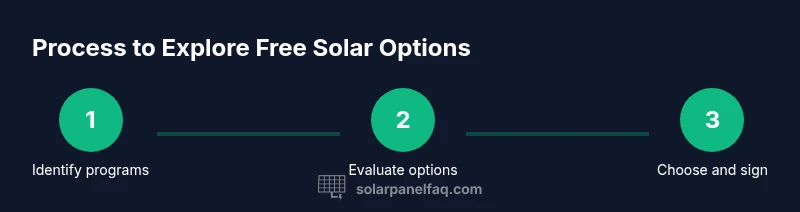
Identify program types
Research whether leases, PPAs, community solar, or donor-funded options are available in your area. Note how each type affects ownership, maintenance, and long-term costs.
Tip: Start with your utility’s website and local government energy pages to list available programs. - 2
Check eligibility requirements
Review income limits, home type, and location restrictions that may apply to donor-funded or community solar programs. Gather documents like your utility bill and proof of ownership.
Tip: Create a checklist of required documents to speed up applications. - 3
Gather documents and data
Collect recent energy usage, roof condition, and property information to support inquiries. This helps installers or program coordinators give accurate quotes.
Tip: Obtain several recent utility bills for baseline comparisons. - 4
Request proposals or enrollment offers
Ask for formal proposals from providers offering leases, PPAs, or community solar subscriptions. Ensure offers include all fees, term lengths, and escalation terms.
Tip: Ask for a sample contract to review before any in-person meeting. - 5
Compare terms side-by-side
Use a simple matrix to compare upfront costs, monthly payments or credits, contract length, and ownership transfer options at the end of the term.
Tip: Prioritize programs with clear escalation caps and transfer rights if you sell your home. - 6
Make a choice and sign only when comfortable
Choose the option that maximizes savings and minimizes risk. Read the contract in full and consider a legal review if the terms are complex.
Tip: Never sign a contract you don’t fully understand or can’t quantify in your budget.
Frequently Asked Questions
Can solar panels really be obtained for free?
In practice, 'free' typically means no upfront cost but a contract or subscription is required. Ownership varies by program, and long-term costs or obligations often apply. Always review the full contract terms.
In most cases, you won’t own the panels outright upfront, and there are long-term commitments to review.
What is the difference between a solar lease and a PPA?
A lease pays a fixed monthly amount to rent the system, while a PPA charges for the electricity generated, often at a discounted rate. Both typically last many years and may offer ownership transfer options.
A lease is a fixed payment for renting; a PPA charges for generated electricity, usually with a lower rate than the utility.
What is community solar and who can join?
Community solar lets you subscribe to a shared solar facility and receive bill credits. It’s ideal for renters or homes that can’t host panels, but availability and terms vary by utility and location.
Community solar pools solar generation and lets you benefit via credits, even if you can’t install panels at home.
Are donor-funded programs reliable?
Donor-funded programs can reduce upfront costs but depend on program continuity and eligibility rules. Verify program longevity, reporting requirements, and maintenance responsibilities.
They can cut upfront costs, but confirm how long the program will last and what you must do to stay eligible.
How long do I need to stay enrolled in a lease or PPA?
Leases and PPAs typically run 15–25 years, with options to renew or transfer ownership. Understand transfer rights if you move before the term ends.
Most agreements last 15 to 25 years; check transfer options if you relocate.
If I can’t find a no-cost option, what should I consider?
Explore incentives, rebates, or community solar as alternatives. Compare cost-benefit scenarios and consider phased approaches to solar adoption.
If no no-cost option exists, look at incentives and gradual adoption still using a financial plan.
Watch Video
Top Takeaways
- Understand that 'free' often means zero upfront costs with ongoing commitments.
- Leases, PPAs, and community solar shift costs, not eliminate them.
- Always compare total projected savings and contract terms.
- Verify eligibility and beware of scams; read contracts carefully.