Will Solar Panels Charge in Shade? A Practical Guide for Homeowners
This guide explains how shading affects solar panels, the different shade types, and practical strategies to minimize losses. Learn how to design, install, and maintain a shade-tolerant system with data-backed guidance from Solar Panel FAQ.


If you ask will solar panel charge in shade, the answer is yes—panels can still produce power, but the output drops dramatically. According to Solar Panel FAQ, depending on shade type and system design, you may see substantial losses or near-zero production during heavy shading. To mitigate, use microinverters or power optimizers, optimize string wiring, and place panels to minimize shading from trees or buildings.
How Shade Impacts Solar Panels
Shade alters the current-voltage (I-V) characteristics of photovoltaic modules. When a portion of a panel is shaded, the shaded cells conduct less current, which drags down the string voltage and overall power output. Modern PV systems use bypass diodes to limit damage from shading, but the net effect is still a reduction in energy production. The degree of loss depends on shading density, the number of shaded cells, and whether the shaded portion is on a high-efficiency cell zone. For homeowners wondering will solar panel charge in shade, the practical answer is that partial shade generally yields measurable output, whereas heavy or full shading can nearly eliminate generation from affected strings. Good shading analysis before installation helps predict these losses and informs design decisions.
Types of Shade and Their Effects
Shade comes in multiple forms, and each type affects performance differently. Direct shade from a tree branch or chimney tends to have a larger, localized impact, especially if it sweeps across a portion of the panel during peak sun. Diffuse shade from clouds or atmospheric conditions reduces irradiance more uniformly but also lowers total energy. Edge shading, such as from a rooftop vent or antenna, can be particularly problematic if it repeatedly covers a small area during the day. Intermittent shade, caused by moving clouds or nearby moving objects (like leaves fluttering in wind), creates rapid fluctuations in output that can stress inverters if not properly managed. When considering will solar panel charge in shade, it’s important to distinguish between transient shading and persistent shading, as the strategies to mitigate each differ.
Real-World Scenarios and How They Affect Output
In suburban neighborhoods, shading often results from nearby trees, chimneys, or other roof features. A common scenario is a tall deciduous tree that blocks sun for several hours during winter or early morning; another is a neighboring building whose height creates long shadows in the late afternoon. Even small obstructions can cause noticeable losses if they intersect the critical sun hours. In some cases, a long string of panels can lose a disproportionate amount of energy simply because one module under shade reduces the current for the entire string (or a significant portion of it). Understanding these dynamics helps homeowners decide whether to pursue string-level designs, microinverter-based configurations, or more comprehensive site alterations before buying solar.
Design Principles to Minimize Shade Loss
The foundational step is to perform a shade analysis with tools like sun-path diagrams, shadow charts, and in-person measurements at different times of day and year. Key principles include: selecting a roof area with the least shade during peak sun, optimizing panel tilt and orientation for the prevailing sun vector, and staggering panel placement to avoid overlapping shade. If you anticipate shading from trees or architecture, design the system with shorter strings and consider per-panel optimization. Additionally, plan for future shade changes (such as tree growth) by reserving space where panels can be moved or replaced without major rebuilds. These strategies collectively reduce the risk that will solar panel charge in shade becomes a limiting factor for long-term performance.
Hardware That Helps in Shade
Not all shade management relies on layout alone. Inverters and power electronics play a crucial role in preserving energy production under shade. Microinverters enable every panel to produce independently, so shading on one panel does not drag down the entire string. Power optimizers do a similar job while allowing a centralized inverter to manage the array. Bypass diodes protect shaded strings from hot spots and prevent cascading losses. Some panel technologies offer improved low-light performance and shading tolerance, such as modules with advanced cell designs. When combined with smart monitoring, these hardware choices help maintain higher overall output when the sun is intermittently blocked.
Placement Strategies: Roof Orientation, Tilt, and Spacing
Optimizing placement begins with a site-specific assessment. In the Northern Hemisphere, south-facing roofs typically deliver the best year-round results, but local shading patterns may favor east or west orientations if the sun’s path aligns away from obstructions. Tilt angle should reflect latitude but be adjusted to account for seasonal sun height and shading risk. Spacing between rows minimizes mutual shading during winter when panels are closer to the horizon. In shaded environments, designers may opt for shorter strings and more panel-level optimization, ensuring that a shaded module does not pull down others. These strategies directly influence how much will solar panel charge in shade in real-world installations.
Calculating Payback When Shade Is a Factor
Shade reduces energy yield, which can extend the payback period. A practical approach is to estimate annual energy production with and without shading for a given orientation and tilt, then apply local electricity rates and installation costs. Sensitivity analysis helps quantify how different shading scenarios affect payback. For example, if shade reduces output by 25-40% during peak hours, you can recalibrate the expected savings and adjust equipment sizing accordingly. Keep in mind that many regions offer incentives that can offset initial costs, and the value of uninterrupted monitoring can prevent missed performance gaps in shaded configurations.
Maintenance and Monitoring in Shaded Setups
Shaded systems require routine checks to ensure components operate at peak efficiency. Regular cleaning of modules, tree trimming to minimize future shading, and periodic inverter/optimizer firmware updates help sustain performance. Monitoring platforms should flag unusual dips in output that coincide with known shading events or equipment issues. Calibration of shade analysis tools over time improves accuracy, making it easier to adapt layouts if persistent shade concerns arise. In short, proactive maintenance and monitoring are essential when addressing will solar panel charge in shade in your home system.
Common Misconceptions About Shade
A common assumption is that any shade makes solar panels useless. In reality, partial shade rarely renders a system ineffective; many installations still produce meaningful energy, especially when modern hardware and good design practices are in place. Another myth is that all panels perform the same under shade—cell technology and module construction vary, influencing tolerance to low light. Finally, some think shrubs or vines growing close to the array will naturally boost energy; in truth, vegetation typically increases shading risk and can reduce performance if not carefully managed.
Shade impact scenarios
| Scenario | Expected Output Range | Notes |
|---|---|---|
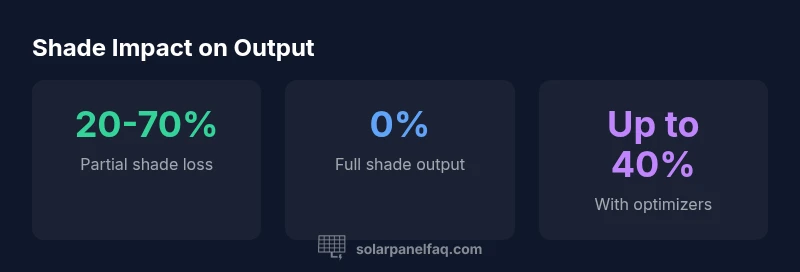
| Partial shade (edge) | 20-70% | Depends on shade edge position and string length |
| Intermittent shade (moving clouds) | Variable output, moderate losses | Fluctuates with sun angle and cloud cover |
| Full shade (dense obstruction) | 0% | Only minimal if reflective surfaces contribute; otherwise negligible |
| Shade-tolerant hardware | Higher relative output under shade | Microinverters/optimizers help |
Frequently Asked Questions
Will shaded solar panels still produce electricity?
Yes, shaded panels can still generate power, but the output is significantly reduced. The extent of loss depends on shade density, location, and system design. Real-world shading may cause visible drops in energy production and fluctuating output.
Yes—shaded panels can make power, but not as much as in full sun; expect lower, variable output.
Do microinverters help with shading?
Absolutely. Microinverters optimize each panel individually, so shading on one panel does not drag down the entire array. This makes shading losses less severe and improves overall energy harvest.
Yes, microinverters help a lot by letting each panel perform independently.
How can I estimate shade impact on my roof?
Use shade analysis tools, sun-path diagrams, and on-site measurements at different times of day and year. Consider neighboring structures, trees, and roof geometry. This helps forecast energy losses and informs placement decisions.
Use shade analysis tools and on-site checks to estimate the impact.
Is there a shading scenario where solar doesn’t make sense?
Very dense, persistent shade often reduces solar viability, but even then some configurations may still be viable with clever design. In extreme cases, a shaded roof may require alternative energy or storage solutions.
If shade is constant and heavy, it may not be cost-effective.
What maintenance helps preserve shade performance?
Regularly trim obstructing branches, keep panels clean, and monitor performance data for anomalies. Timely adjustments ensure shade-related losses stay within expected ranges.
Keep the area around panels clear and monitor output regularly.
“Shade tolerance is a design choice as much as a hardware choice. With proper layout and the right optimizers, shade reduces, rather than eliminates, energy production.”
Top Takeaways
- Actively analyze shade before installation
- Choose hardware that optimizes per-panel performance
- Plan layout to minimize shading interactions
- Regularly monitor performance and trim nearby vegetation
- Recalculate payback if shade is a persistent constraint