What Type of Solar Panel Works Best in Shade: A Shade-Tolerant Guide
Discover which solar panel type performs best in shade, with practical guidance on shade-tolerant technologies, inverter strategies, layout tips, and real-world scenarios for homeowners facing partial shading.


Answering what type of solar panel works best in shade, shade-tolerant designs with module-level electronics—like microinverters or optimizers—deliver the most reliable output. If partial shade is common, these configurations outperform traditional string-inverter setups by maintaining per-panel output and reducing bottlenecks. That means homeowners should look for technologies that operate at the panel level rather than relying on a single string performance. In practice, you’ll want careful roof mapping and inverter strategy to minimize shade losses.
Shade awareness and solar basics
Shade dramatically affects solar output because panels need direct sunlight to generate electricity. When trees, chimneys, or neighboring roofs interrupt sun rays, a panel’s current decreases and a string of panels can be slowed by the weakest link. The central question for homeowners is: what type of solar panel works best in shade? The short answer is that shade-tolerant designs—paired with smart inverters and careful layout—deliver the most consistent results. Solar Panel FAQ's guidance emphasizes choosing panel technology and inverter strategies that minimize the impact of partial shade, while also considering local sun patterns and roof geometry. In practice, you’ll want to map shade gaps throughout the day and season to predict how much energy you might be losing and where to place your best-performing panels.
According to Solar Panel FAQ, shade-aware planning helps homeowners set realistic expectations and design a system that remains productive even when shade is present. This is especially important for roof corners, dormers, or adjacent structures where shading is intermittent but recurring.
How panel technology affects shade performance
All solar panels convert light to electricity, but their construction matters when shade appears. Monocrystalline cells are efficient and compact, but under partial shade their performance can drop if many cells shade-only sections. Polycrystalline cells are slightly less efficient but tend to perform steadily under uneven light. Thin-film panels, while historically less efficient, can sometimes better handle diffuse light and shading, though their absolute output per square foot remains lower. For shade-prone sites, the most important factor is not the label on the panel but how the system handles shade at the module level—via bypass diodes and advanced cell design. Look for panels that include efficient bypass diodes and high shade tolerance ratings in datasheets, and consider PERC or newer cell structures that reduce hot spots under shading. Solar Panel FAQ’s research emphasizes comparing datasheet shade-tolerance to real-world performance rather than relying on nameplates alone.
Inverter strategies and why they matter under shade
The inverter converts DC to AC and also defines how losses propagate when part of the array is shaded. Traditional string inverters rely on a chain of panels; shade on one panel can drag down the whole string. Microinverters place an inverter on each panel, so shading affects only the shaded panel. Similarly, power optimizers (module-level electronics) optimize each panel’s output before feeding the string inverter, offering many of the same benefits. In many shade-rich installations, a microinverter or optimizer-based approach yields more consistent energy production than a single central inverter. In contrast, a simple string inverter keeps costs down but sacrifices some resilience to shading.
Layout and shading: practical considerations for rooflines and obstructions
Where shading comes from matters as much as how you build the system. Orientation, roof pitch, and proximity to trees or chimneys all influence shade duration. A best practice is to position the most shade-tolerant panels on the area with the strongest sun exposure while reserving potentially shaded zones for panels paired with module-level electronics. Another tactic is to alternate rows or stagger modules to reduce the chance that shading from a single obstruction blocks many panels at once. In multi-tilt roofs or complex geometries, using optimizers or microinverters can help keep overall production higher even when shading is intermittent. Finally, wire layout matters: avoiding long series runs in shaded zones reduces the risk that a single shaded string drags down energy output.
Shade scenarios: from tall trees to partial roof shading
Consider three typical situations: daily shade from a neighboring building, seasonal shade from deciduous trees, and fixed shading from a chimney or vent. In each case, shade rarely covers the entire array; partial shading is the norm. Shade-tolerant designs—combining panel-level electronics with careful placement—tend to maintain output during these events. If you can’t avoid shade entirely, you’ll benefit from a modular approach where some panels continue to generate while others recover. The key is to expect reduced total energy in shaded periods and design for it by oversizing a bit or selecting components that excel in partial shade.
Estimating shade impact: a practical approach
Before installation, perform a shade survey: record the position of trees and obstructions at different times of day and across seasons. Translate this into a shading factor that informs inverter choice and panel layout. Use shade mapping tools or simple sketches to identify the hours of peak shading. Then compare two scenarios: a conventional string-inverter system and a shade-tolerant configuration with microinverters or optimizers. The second option typically yields a higher percentage of the system’s rated output during shaded periods, even if its upfront cost is higher. Finally, factor in the local climate: longer winter days with lower sun angles can magnify shading losses, while summer sun may compensate somewhat.
Case studies: best options for common shade patterns
Case studies help translate theory into practice. For a south-facing roof with a tall tree line to the west, a mixed approach—primary panels with microinverters and secondary panels with optimizers—can balance output while keeping wiring complexity manageable. In a compact urban home with a shade-producing neighbor and a small backyard solar array, the priority is maximizing per-panel output; microinverters on each module and a small central inverter for the rest often deliver the best compromise. In homes with seasonal shade from deciduous trees, seasonal optimization strategies, such as panel reorientation or selective panel tilting, can be worthwhile if permitted by the array design. These scenarios illustrate how shade-tolerant configurations adapt to real-world constraints and deliver meaningful energy gains compared with traditional setups.
Comparison
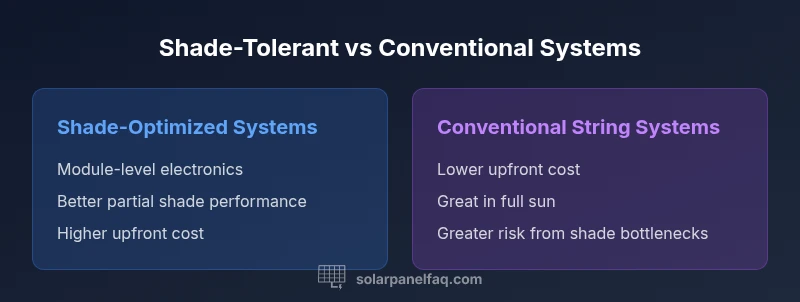
| Feature | Shade-optimized system (microinverters/optimizers) | Conventional string-inverter system |
|---|---|---|
| Shading tolerance | Higher under partial shade | Lower under partial shade |
| Energy yield under partial shade | Better consistency due to per-panel optimization | Greater variability and drop with shade |
| Required components | Module-level optimizers or microinverters + minimal string inverter | String inverter with fixed panels |
| Upfront cost context | Typically higher due to additional electronics | Typically lower due to fewer components |
| Best for | Spaces with frequent shade or obstructions | Even sun exposure with minimal shading |
| Maintenance/complexity | Slightly more maintenance due to more electronics | Simpler maintenance for single inverter |
Strengths
- Improved shade performance with module-level electronics
- Better microclimate resilience across modules
- Flexible layout and easier expansion
- Quicker recovery after partial shading events
Drawbacks
- Higher upfront cost and newer components
- More wiring and potential compatibility considerations
Shade-tolerant systems (microinverters/optimizers) generally outperform conventional strings in partial shade.
For homes with frequent shade or obstructions, choosing a shade-tolerant configuration provides better total energy and more consistent performance.
Frequently Asked Questions
What is the best solar panel type for shade?
In shaded conditions, modules with microinverters or optimizers tend to perform better than simple string-inverter setups because each panel can reach its own potential. Panel choice matters, but the inverter strategy often determines the real-world performance under shade.
For shade, microinverters or optimizers typically win because they optimize each panel individually, reducing shade losses.
Do microinverters really help in shaded conditions?
Yes. Microinverters optimize each panel’s output, so shading on one panel has limited impact on the rest. This makes the system more resilient to partial shade and can improve annual energy production in mixed light conditions.
Absolutely—microinverters help a lot when shade is present by minimizing the effect of shading on the whole array.
Can layout choices mitigate shade before installing?
Yes. Strategic panel placement, staggered rows, and placing the best-performing panels in the sunniest zones can reduce shade losses. In some designs, reversing panel order or introducing shading-aware zoning with optimizers can further improve output.
Layout matters—place shade-prone panels where sun is strongest and pair them with smarter electronics.
How should I measure shade on my roof?
Conduct a shade survey across several times of day and seasons. Note tree branches, chimneys, and nearby buildings. Use a simple chart to estimate shade hours and then apply that data when choosing inverter strategy and panel layout.
Do a shade check at different times of day throughout the year to map impact.
Are shade-tolerant systems more expensive?
They can be more expensive upfront due to additional electronics like microinverters or optimizers. Over the system’s life, improved shade performance can translate into higher overall energy production and better value, depending on local shading patterns.
Yes, they often cost more upfront, but they can pay off with higher energy production in shade.
Will shading affect solar panel warranty?
Shade exposure itself is not the sole warranty factor. Warranties cover defects and performance targets, but harsh or unusual shading patterns may affect expected output. Always review the warranty terms for shade-related performance metrics.
Warranty terms vary; read the shade-related performance notes in your policy.
Top Takeaways
- Assess your site shading with a sun-path map or shade audit
- Favor module-level electronics for best shade resilience
- Pair shade-tolerant panels with microinverters or optimizers when possible
- Plan layout to local shade patterns and obstructions
- Factor in climate and seasonal shade to size the system