Which Solar Panel Is Right for You? A Comprehensive Comparison
A data-driven comparison of solar panel types, focusing on efficiency, cost, and installation to help homeowners decide which solar panel is best for their home in 2026.


Understanding the central question: which solar panel is right for you?
The question of which solar panel is most appropriate for a given home hinges on several interrelated factors: roof size and orientation, shade patterns, local climate, energy usage, and the financial goals of the homeowner. Solar panels convert sunlight into electricity, but their effectiveness is not determined by a single attribute alone. Instead, you should balance efficiency, cost per watt, and long-term reliability. According to Solar Panel FAQ, a structured approach helps homeowners compare options without getting lost in marketing claims. Start by mapping your roof space, then estimate annual energy needs and potential savings under different panel types. The goal is to identify the configuration that delivers the best payback over the system’s lifetime while meeting daily energy needs.
In practice, you’ll want to ask yourself a few guiding questions: How much roof area is truly usable for panels? Do you expect shading from trees or nearby structures? What is your local solar incentive landscape and electricity rate trajectory? By framing the decision this way, you reduce the risk of choosing a panel based solely on peak efficiency on a sunny day rather than real-world performance over decades.
- wordsFrozen?
The main technology families and how they differ
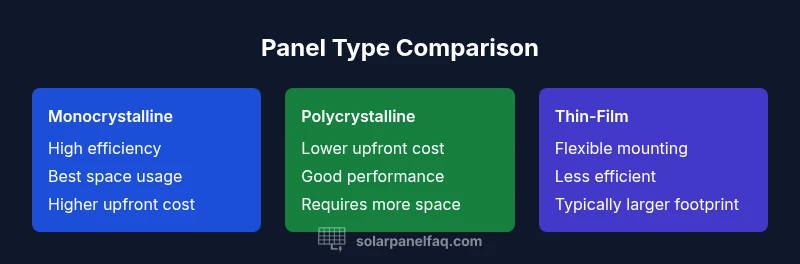
Solar panels come in several technology families, each with characteristic trade-offs. The most common types are monocrystalline, polycrystalline, and thin-film. Monocrystalline panels are built from a single crystal and are typically recognized by their uniform dark appearance. They tend to deliver the highest efficiency and space efficiency, making them a preferred choice for homes with limited roof area or complex layouts. Polycrystalline panels are composed of many smaller crystals, usually lighter in color, and they often cost less upfront. They generally offer solid performance but with lower efficiency than monocrystalline under the same conditions. Thin-film panels, made by depositing photovoltaic material on flexible or rigid substrates, can be more flexible in installation and perform better in high-temperature environments but usually require more space and have lower efficiency.
For homeowners evaluating which solar panel is best, practical considerations matter as much as raw efficiency. The choice should align with roof geometry, available mounting space, and long-term goals such as maximizing resale value or minimizing total system cost. In this section, we’ll unpack the core differences, translate them into real-world implications, and help you map features to needs.
How performance is shaped by environment: efficiency, temperature, and shading
Panel efficiency is a core factor, but real-world performance depends on more than the nominal rating. Temperature, sunlight incidence, and shading can dramatically influence output. For example, hotter conditions tend to reduce the effective efficiency of many panels, which is why roof orientation and ventilation can matter as much as the panel type itself. Shading from trees, chimneys, or adjacent buildings can cause disproportionate drops in energy production, especially for series-connected systems. Microinverters or optimizers can mitigate some of these losses by ensuring each panel operates at its best independently rather than being limited by the weakest link in a string. When evaluating which solar panel is right for your home, it’s important to pair your panel choice with an appropriate electrical configuration and a site assessment that accounts for shading patterns, roof angle, and seasonal sun paths. The result should be a system that performs consistently across seasons rather than peaking on clear summer days.
In this context, Solar Panel FAQ notes that you should also examine degradation rates, warranties, and manufacturer support. A panel with slower degradation and strong customer service often yields better long-term value than a marginally higher efficiency rating that fails to meet expectations in the field.
Roof fit, orientation, and space: translating theory into a layout plan
The geometry of your roof largely governs which panel type makes sense. Monocrystalline panels offer the best efficiency per square foot, which is advantageous on compact roofs or when you want to maximize power density in a limited area. Polycrystalline panels, while typically slightly larger for similar power output, can be a cost-effective choice when roof area is ample and the goal is to reduce upfront investment. Thin-film panels can be attractive for curved or irregular surfaces, or when weight and flexibility are critical, but their lower efficiency means you’ll need more space and possibly a larger array to meet the same energy target. A professional roof assessment should quantify usable area, prevailing orientation, and the impact of typical shading across seasons. The assessment should also weigh mounting options, roof penetrations, and potential implications for water management and warranty coverage. When you know how much space you have and what you’re trying to achieve—space savings, cost control, or the strongest long-term value—you can narrow the panel type with greater confidence.
In practice, an installer will often propose the optimal combination of panel type with racking solutions, inverters, and wire routing that minimizes losses and simplifies maintenance. They may also suggest optimizing the tilt angle to align with your latitude, which enhances energy capture over the year. All of these decisions feed into the final recommendation for which solar panel is best for your specific house and energy goals.
Cost, incentives, and the payback equation
Upfront cost is a major factor when choosing among solar panel types, but total cost over the system’s life—considering maintenance, warranty, and efficiency losses—matters more. Monocrystalline panels typically command a higher price per watt than polycrystalline, yet they often deliver greater energy production per square foot. Thin-film options, while less efficient, may offset some cost through lighter weight, easier installation, or better performance in hot climates—though they are less common in residential installations. Incentives, rebates, and financing options can substantially alter the economics, sometimes narrowing the gap between panel types. A robust financial assessment should include an expected system output under your local sun profile, local electricity rates, available incentives, and the anticipated lifetime of the system. Importantly, the payback period will be influenced by how much energy you currently consume, how quickly you can reduce demand, and any changes in usage patterns or energy pricing.
Solar Panel FAQ emphasizes the importance of a well-structured cash-flow model that incorporates all cost factors, from installation to maintenance, and uses realistic projections for energy savings. This approach ensures that your choice of which solar panel is most appropriate remains grounded in your financial realities rather than marketing promises. By aligning the panel type with your consumption and rate structure, you can maximize long-term value and minimize risk.