Solar Panel Types and Differences: An Analytical Guide
Explore the main solar panel types, their performance differences, and how to choose the right technology for your roof, budget, and climate.


According to Solar Panel FAQ, the most practical differentiation for homeowners is efficiency, cost, and space. In brief: monocrystalline panels offer the highest efficiency and best space utilization, polycrystalline provide a lower-cost alternative with decent performance, and thin-film suits unusual roofs or shade but trades off efficiency. For typical homes with adequate roof area, monocrystalline vs polycrystalline is the common choice.
Overview of Solar Panel Types and Differences
Solar panels are not a one-size-fits-all technology. Broadly, you can categorize panels into crystalline types (monocrystalline and polycrystalline) and thin-film varieties, with several advanced variations layered on top. Crystalline panels are built from silicon wafers and dominate the residential market due to their durability and efficiency. Thin-film panels use other semiconductor materials deposited on flexible substrates, offering advantages in weight and shading tolerance. Within crystalline, you’ll encounter niche architectures like PERC (passivated emitter and rear contact) and newer cell technologies (e.g., HIT/IBC) that push efficiency higher without dramatically changing form factor. Differences among these types translate into real-world effects on roof space, performance under heat, and total lifetime value. When homeowners compare options, they typically weigh efficiency per square foot, initial cost, temperature behavior, and roof integration concerns. A thoughtful comparison also includes reliability, warranty terms, and the compatibility of a given panel with mounting hardware and inverter choices. This guide focuses on “solar panel types and differences” so you can map your roof, budget, and climate to the most sensible technology.
Monocrystalline panels: efficiency and space efficiency
Monocrystalline panels are made from high-purity silicon crystals, which gives them the highest efficiency among common residential options. Because of their efficiency, they deliver more power from a smaller footprint, which is especially valuable for small or shaded roofs. The manufacturing process yields a consistent, dark appearance with uniform cells. In practice, monocrystalline panels are favored for urban homes, multi-story installations, and projects where maximizing output per square foot matters. They tend to be pricier than alternatives, but the superior space efficiency often justifies the premium when roof area is at a premium or aesthetics are a concern. Temperature performance is strong overall, though all silicon-based panels lose some efficiency in extreme heat. Warranties typically cover 25 years or longer for product and performance, providing long-term confidence for homeowners.
Polycrystalline panels: a balance of cost and performance
Polycrystalline panels use multiple silicon crystals in each cell, which lowers production costs and reduces energy yield slightly compared with monocrystalline. They present a distinctly bluish hue and a slightly larger module footprint for the same wattage. The cost advantage makes polycrystalline a popular choice for budget-conscious projects or retrofit jobs where roof space is not severely constrained. Temperature response tends to be solid but not quite as favorable as monocrystalline under high heat. Durability and warranties align closely with monocrystalline, typically offering long-term coverage, but the long-term energy yield per dollar depends on local climate and site conditions.
PERC and advanced cell architectures: pushing efficiency without extra bulk
PERC technology adds a passivated layer at the back of silicon cells to reduce recombination losses, boosting efficiency without increasing panel size. Advanced architectures like HIT (heterojunction) or IBC ( interdigitated back contact) further improve performance, particularly at higher temperatures or under low-light conditions. For homeowners, PERC and related designs can mean better performance in warm climates and on rooftops with limited space, while staying within familiar form factors. The cost premium varies by brand and system size, but the efficiency gains can translate into meaningful output gains over the panel’s lifetime.
Thin-film panels: flexibility, shade tolerance, and weight trade-offs
Thin-film technologies—such as amorphous silicon (a-Si), CdTe, and CIGS—offer advantages in weight, flexibility, and aggressive shading scenarios. They can be laminated onto curved surfaces or integrated into building materials (BIPV). However, their raw efficiency per module is typically lower than crystalline panels, which means more roof area is needed to reach the same power output. Thin-film panels also age differently, with performance responding to temperature and light exposure in distinct ways. For locations with partial shade, unusual roof geometry, or slope constraints, thin-film can be a compelling option, provided space and long-term degradation expectations align with project goals.
Specialized and emerging types: bifacial, HIT, and building-integrated PV
Bifacial panels capture light from both front and back sides, increasing energy yield on reflecting surfaces or elevated installations. Building-integrated PV (BIPV) integrates solar cells into roofing materials or façades, reducing visual impact but sometimes affecting performance optimization and cost. HIT and other hybrid cell technologies blend material choices to reduce losses and improve low-light response. While these types can deliver compelling value, they often require careful design and installation planning, and they may entail higher upfront costs. For homeowners exploring aesthetic or architectural considerations, these options can offer a favorable blend of performance and appearance when properly matched to climate and roof design.
How to compare solar panel types: practical criteria for homeowners
To choose effectively, compare panels on key criteria: efficiency per square foot, total installed cost, space requirements, temperature coefficient (how performance changes with heat), durability and warranty, and aesthetic fit with your roof. Consider roof orientation, shading patterns, and climate—these factors influence whether high-efficiency monocrystalline or space-expanding thin-film or bifacial solutions are most appropriate. It’s also wise to evaluate system-level factors such as inverter compatibility, mounting hardware, and maintenance needs. Real-world performance depends on many site-specific factors; the best approach is a site-specific assessment with a reputable installer who can model expected output for your home. In all cases, prioritize reliability and long-term value over initial price alone.
Real-world considerations: climate, roof design, and future plans
Climate affects panel choices because temperature and sun exposure alter real-world output. In hot climates, panels with lower temperature coefficients can outperform those with higher gains at cooler temperatures. Roof design, including orientation and pitch, determines how much usable roof area you have and whether space-efficient monocrystalline options are worth the premium. If you anticipate solar add-ons such as storage or electric vehicle charging in the future, verify that your chosen panel type aligns with inverter sizing and storage compatibility. Finally, consider the installation timeline and local incentives—though incentives vary by region, a well-planned selection now can compound savings over the life of the system.
Case studies: when to choose which type in common home scenarios
Scenario A: Small urban roof with limited space and partial shade — Monocrystalline or PERC designs with careful shading analysis often maximize output per square foot. Scenario B: Budget retrofit on a larger roof area — Polycrystalline panels with a clear cost-benefit path can deliver strong performance without premium upfront costs. Scenario C: Unique architecture or curved surfaces — Thin-film or BIPV solutions may provide better integration and weight advantages, albeit with a larger footprint for the same wattage. Scenario D: Climate with high heat and reflective roofs — Select modules with low temperature coefficients and robust performance in bright sun. These examples illustrate how the panel type interacts with site constraints to shape outcomes.
Selection workflow and next steps: translating analysis into action
- Perform a roof assessment to quantify available space and shading. 2) Define goals: maximize space efficiency, minimize upfront cost, or optimize long-term value. 3) Compare at least two panel types using a site-specific performance estimate from a trusted installer. 4) Review warranty terms, expected degradation rates, and maintenance requirements. 5) Confirm compatibility with inverters, racking, and potential future storage. 6) Choose a final option and plan installation logistics, ensuring the project aligns with local codes and any incentives. These steps help translate theoretical differences into a practical decision tailored to your home.
Feature Comparison
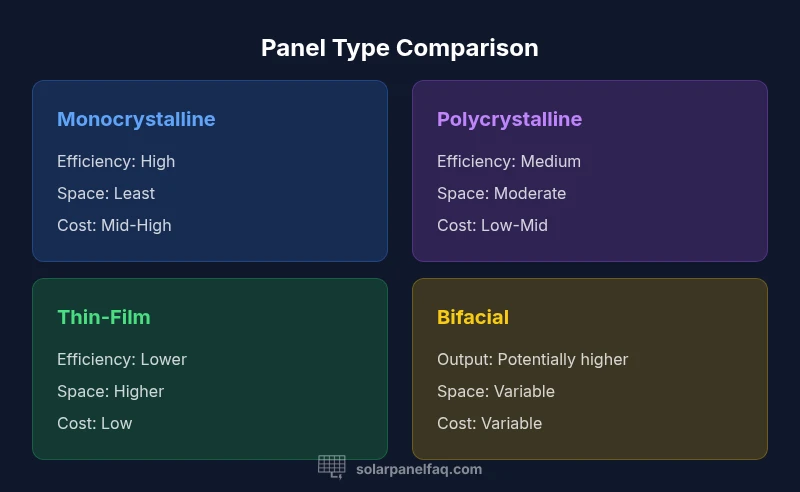
| Feature | Monocrystalline | Polycrystalline | Thin-Film | Bifacial |
|---|---|---|---|---|
| Efficiency | high | medium | low | high (in optimized setups) |
| Cost Range | mid-to-high | low-to-mid | low | mid |
| Space Needed (per watt) | least | more | greatest | variable |
| Temperature Tolerance | excellent | good | moderate | excellent |
| Durability / Warranty | longest per-watt value | strong | variable | strong |
Strengths
- High efficiency per area for monocrystalline
- Cost-effective options with solid performance (polycrystalline)
- Flexible installation possibilities with thin-film
- Potential for higher energy yield with bifacial designs
- Broad availability and established ecosystems
Drawbacks
- Higher upfront cost for the highest-efficiency options
- Requires adequate roof space for same-output targets
- Thin-film can age with different degradation patterns
- Bifacial and BIPV can have complex installation and warranties
Monocrystalline generally offers the best balance of efficiency, footprint, and long-term value for typical homes.
Solar Panel FAQ analysis shows monocrystalline panels maximize output on limited roof space and perform well in varied climates. The Solar Panel FAQ team’s verdict is that for most homeowners, monocrystalline remains the default starting point, with polycrystalline as a strong budget-friendly alternative when space is not at a premium.
Frequently Asked Questions
What are the main types of solar panels for homes?
The main categories are crystalline (monocrystalline and polycrystalline) and thin-film. Crystalline panels dominate residential installations due to strong efficiency and proven performance; thin-film offers flexibility, lighter weight, and shade tolerance. Within crystalline, PERC and other advanced cells improve performance without changing form factor.
The main types are crystalline panels, including monocrystalline and polycrystalline, plus thin-film for flexible or shaded spaces.
Is monocrystalline always the best choice?
Monocrystalline is typically the go-to due to higher efficiency and better space use. However, polycrystalline can be a viable cost-saving option when roof area is ample and budget is a primary concern.
Monocrystalline is usually best for space efficiency, but polycrystalline can work well if budget is the main constraint.
What should I consider besides panel type?
Important considerations include temperature performance, degradation rate, warranty terms, inverter compatibility, roof orientation, shading, and local incentives. The installer can model expected output for your specific site.
Look at temperature tolerance, warranties, and roof conditions, plus local incentives.
What is PERC technology and why does it matter?
PERC stands for passivated emitter and rear contact; it reduces losses and improves efficiency. It is a common upgrade in modern crystalline modules and can offer better performance in hot climates or partial shade.
PERC is a cell architecture that boosts efficiency, especially in challenging conditions.
Do thin-film panels perform well in heat or shade?
Thin-film panels generally perform better in heat and partial shade relative to some crystalline panels, but their overall efficiency is lower. They can be advantageous on large, unshaded areas or unusual roofing geometries.
Thin-film handles heat and shade better, but is usually less efficient overall.
Are bifacial panels worth it for a typical home?
Bifacial panels can yield more energy if installed over highly reflective surfaces or elevated mounting. They require careful site assessment for cost-effectiveness and may involve higher initial costs.
Bifacial can add value if the site supports extra reflected light.
Top Takeaways
- Prioritize efficiency if roof space is limited
- Consider polycrystalline for cost-conscious projects
- Thin-film suits shading or curved surfaces, but needs more area
- Bifacial can boost yield with reflective surfaces
- Always verify warranties and installation compatibility