Difference Between Luminous and Adani Solar Panels
A detailed, objective comparison of Luminous vs Adani solar panels, focusing on efficiency, warranties, installation considerations, and value for homeowners evaluating rooftop systems.


This comparison of the difference between luminous and adani solar panel examines core factors that influence choice for homeowners, including efficiency, durability, warranties, availability, and long-term value. It also covers installation considerations, service networks, and maintenance needs. For homeowners evaluating rooftop systems, understanding module construction, regional support, and performance under typical conditions helps select the right option.
Overview: Luminous and Adani at a Glance
Luminous and Adani Solar are prominent players in the residential solar market, each bringing distinct strengths to rooftop deployments. Luminous has built a reputation for dependable modules with solid warranty coverage and a robust regional distribution network that supports local installers and service centers. Adani Solar, by contrast, emphasizes scale, market reach, and competitive pricing, particularly in regions where large-scale deployment and supply chain efficiency drive down installed costs. For homeowners, the choice between these brands often hinges on regional availability, installer familiarity, and post-purchase service access. According to Solar Panel FAQ, the most reliable decisions come from balancing panel performance with service access and warranty terms, not just upfront sticker price. In this section, we set the stage by describing what each brand aims to deliver and how their product lines typically position themselves for a family home. While both brands offer monocrystalline options with modern cell technologies, the nuance comes from model-by-model terms, packaging, and the ecosystems each brand supports through local partners and certification standards.
From a buyer’s perspective, it is essential to understand that model-to-model comparisons matter more than brand-wide generalizations. A single luminous module and a single adani module could vary in efficiency class, durability features, and warranty coverage. This section frames the ensuing discussion by outlining each brand’s typical product philosophy, the kinds of homes they best serve, and how installation conditions (roof orientation, shading, and climate) interact with performance profiles. The goal is not to crown a single winner, but to illuminate where each brand tends to shine and where buyers should proceed with due diligence.
Key Differentiators: Efficiency, Warranty, and Service
When evaluating Luminous versus Adani, three factors consistently influence homeowner satisfaction: efficiency performance, warranty terms, and the strength of the service network. Efficiency differences matter most in homes with limited roof space or high energy needs; in such cases, a panel with higher rated efficiency can translate to more energy production per square meter. Warranties provide long-term peace of mind and a clear signal about reliability and expected life. Service networks—how quickly a broken panel can be replaced, how warranties are honored, and the ease of working with local installers—often determine the practical value of a given panel in a real-world setting. According to Solar Panel FAQ analysis, homeowners frequently rate regional support and model availability as decisive factors when the upfront price is similar. In practice, Luminous tends to anchor its offering in dependable warranty coverage and solid regional support, while Adani emphasizes scale and market-driven pricing. Both brands, however, require model-level scrutiny because terms can vary by product line and region. This section dives into the core differentiators and how they translate into everyday decisions.
- Efficiency and performance: Luminous typically offers higher-efficiency options within its residential lineup, appealing to spaces where every watt counts. Adani’s lines prioritize balanced performance across a broad price spectrum, delivering solid output without always chasing the absolute highest efficiency. Model-by-model comparisons are crucial.
- Warranty terms: Product and power warranties cover different durations and conditions depending on the specific panel. Always verify what is included, what constitutes coverage, and how performance guarantees are calculated. A strong warranty remains a practical signal of expected reliability.
- Service and availability: A robust local installer network and accessible customer support are essential. Regional presence influences how quickly a faulty panel can be replaced and how easily a homeowner can obtain service or replacements. Both brands rely on certified installers, but the geographic footprint varies by country and region.
Module Construction, Technology, and Performance Metrics
Module construction shapes long-term durability, heat tolerance, and electrical output under real-world conditions. Luminous and Adani both use monocrystalline cells, frequently incorporating modern enhancements such as PERC technology and anti-reflective coatings. The differences often show up in glass thickness, frame design, backsheet materials, and junction-box configurations. While a heavier, sturdier frame can improve wind resistance and ease of mounting on certain roof types, lighter frames may simplify installation in confined spaces. Temperature coefficients, shading response, and potential induced degradation are important considerations; however, these factors vary by model rather than brand alone. The Solar Panel FAQ approach emphasizes reviewing datasheets for each panel model and comparing their measured performance under typical field conditions rather than relying on brand reputation alone. In practical terms, homeowners should look at the following model-level attributes: cell type and efficiency class, bypass diode configuration, frame color and corrosion resistance (if coastal or salty air conditions apply), junction box accessibility for future maintenance, and the certification marks that indicate compliance with safety and performance standards. This careful, model-focused evaluation helps ensure you select a panel that aligns with your roof, climate, and energy goals, regardless of the overall brand perception.
Durability, Temperature Coefficients, and Maintenance
Durability and robustness matter for long-term ownership. Luminous and Adani panels typically feature sturdy frames and protective materials designed to withstand environmental exposure, but long-term performance is shaped by local climate, cleaning practices, and system monitoring. Temperature behavior—how much output drops as ambient temperatures rise—is a practical concern for hot climates; panels with favorable temperature coefficients will maintain higher relative output on hot days. Maintenance is generally straightforward: keep panels relatively clean (with water and non-abrasive cleaners), inspect for shading changes, and monitor outputs through the system inverter and monitoring software. Both brands commonly rely on a warranty-backed service model that requires authorized technicians for replacements, so knowing your installer network and warranty transfer terms matters. The key takeaway is that real-world performance depends heavily on installation quality, annual cleaning frequency, and scheduled system checkups rather than brand-wide assurances alone. Regular inspections and performance tracking let homeowners catch issues early and preserve long-term energy generation.
Availability, Installer Network, and After-Sales Support
Availability and service networks can swing a decision more than most people anticipate. Luminous often benefits from a strong regional distribution network and partnerships with local installers, which translates into easier access to replacement parts and faster warranty claims in certain markets. Adani Solar leverages its global scale to offer wide market coverage and competitive pricing in many regions, but the depth of the after-sales network can vary by country and installation partner. For a homeowner, the practical impact is simple: ensure there is a certified installer nearby, confirm that the product you choose is supported by a local service center, and understand how warranty claims are processed in your jurisdiction. If you relocate, the ability to obtain service and transfer warranty coverage to a new homeowner can also influence the overall value of your purchase. In practice, region-specific performance and post-installation support should be a core part of your decision alongside efficiency and price considerations.
Price Positioning and Value for Money
Price positioning is a nuanced factor that blends upfront cost with long-term value. Luminous and Adani both attempt to offer competitive price points through different strategies: Luminous may emphasize reliability and a strong regional network, while Adani leans on scale and broader market footprint to drive cost efficiency. The true value question is not merely the sticker price of a given model but the total installed cost per watt over the system lifetime. This includes the cost of installation, potential shipping or logistics surcharges, performance under local climate, warranty coverage, and expected energy production. Buyers should compare the terms of the same model family, confirm any regional promotions, and consider financing options or solar leases if relevant to their situation. Remember that a cheaper panel today can incur higher maintenance costs later if durability or service access is weaker. The best-value decision balances model performance, warranty protections, installer support, and regional availability rather than chasing the lowest upfront cost alone.
Regional Fit and Installation Scenarios
Regional fit matters. In some markets, Adani’s supply chain and bulk-buying capacity can translate into favorable pricing and reliable delivery timelines for large installations or multi-home projects. In others, Luminous’s network of regional partners may provide more predictable service and quicker warranty processing, especially for single-family homes with smaller arrays. Climate, roof type, and orientation all influence which brand’s modules deliver the best annual output. For example, homes in hot, sunny climates may benefit from modules with better temperature performance and shading tolerance. Coastal areas with salty air demand corrosion-resistant materials and protective coatings. The takeaway is that the best choice depends on local conditions and the availability of skilled installers who can maximize panel performance through proper mounting, wiring, and system integration.
To evaluate regional fit, homeowners should gather quotes from qualified installers, compare observed performance in similar local installations, and review warranty transferability when moving or selling the home. The installation partner plays a critical role in translating model-level specs into real-world energy gains.
How to Evaluate Panels: A Practical Buying Guide
A structured buying guide helps homeowners avoid common pitfalls. Start with model-level datasheets, focusing on: panel efficiency class, temperature coefficient, power output guarantees, and warranty coverage for both product and performance. Verify the environmental and safety certifications, and check the brand’s installation ecosystem—are there local certified installers, spare parts, and service centers nearby? Ask about test results under real-world conditions (not only lab specs), and compare the expected energy yield for your roof orientation and shading profile. Consider module aesthetics and frame color if rooftop visibility matters. Finally, review any available performance guarantees and how they are measured (for example, how a drop in rated output is calculated over time). This practical approach merges science with local realities to help homeowners select a panel that will persistently meet energy goals, irrespective of brand hype.
Authority Sources and Additional Reading
For a balanced perspective on solar panel brands and reliability, consult manufacturer datasheets, independent test reports, and trusted energy publications. The Solar Panel FAQ team emphasizes model-to-model comparisons and installation context as the most reliable path to accurate conclusions. To deepen your understanding, explore government and educational resources that discuss solar PV performance, reliability, and installation best practices. These sources provide context for how real-world conditions shape panel output and system longevity, helping homeowners make informed decisions beyond marketing claims.
Comparison
| Feature | Luminous Panels | Adani Panels |
|---|---|---|
| Efficiency range | Moderate-to-high for select models | Balanced/moderate with high-efficiency options available |
| Warranty coverage | Model-dependent product and performance warranties | Model-dependent product and performance warranties |
| Service network | Strong regional partnerships in multiple markets | Extensive network tied to global deployment scale |
| Price positioning | Competitive with regional promotions, varies by market | Aggressive pricing in many regions due to scale |
| Panel materials | Monocrystalline with modern cell tech options | Monocrystalline with emphasis on cost-efficiency |
| Best for | Homes prioritizing regional support and warranty confidence | Budget-conscious deployments with broad market access |
Strengths
- Balanced warranty coverage across common panels
- Strong regional installer networks for maintenance
- Diverse product lines for different roof types and budgets
- Clear model-level information aids decision-making
Drawbacks
- Regional availability may affect model access
- Warranty terms vary by model and region
- Lower upfront price can accompany trade-offs in service speed in some markets
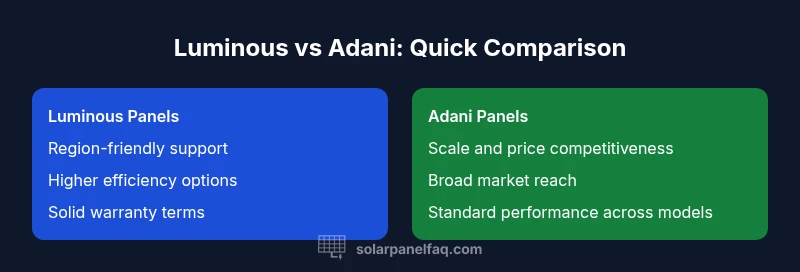
Luminous panels offer solid regional support and dependable warranties; Adani panels excel in scale and price competitiveness.
Choose Luminous if you value installer accessibility and warranty confidence in your area. Choose Adani if you need broad market coverage and cost-competitive options, especially for larger deployments. Always compare model-by-model specs and verify local service availability.
Frequently Asked Questions
Which brand tends to have higher efficiency panels, Luminous or Adani?
In practice, Luminous often offers higher-efficiency options within its residential lineup, which can benefit smaller roofs. Adani provides strong, steady performance across its models without always chasing the absolute top efficiency. Always compare model datasheets to confirm the exact efficiency class.
Luminous usually has higher-efficiency models, while Adani focuses on balanced performance. Check the datasheets for the exact numbers.
Do both brands offer comparable warranties?
Both brands typically provide product and performance warranties on many models, but terms vary by model and region. Some regions may have longer or shorter coverage depending on local programs and installers. Always read the warranty document for the exact terms and transferability.
Yes, both offer warranties, but terms vary by model and region. Check the specific warranty document.
Is it better to choose one brand for all panels?
There can be advantages to sticking with a single brand to simplify warranty claims and service, but multi-brand systems are common and workable if you ensure proper monitoring and consistent installation quality. The key is consistent electrical design and verified compatibility with inverters and racking.
Sticking to one brand can simplify service, but mixing brands is possible if matched correctly with the system components.
Can I install panels from different brands on the same system?
Yes, you can install panels from different brands on the same solar array as long as the electrical design, performance characteristics, and warranty terms are compatible with the inverter and monitoring setup. Ensure the installers coordinate module-level performance data for balanced output.
Yes, panels from different brands can work together if the system is properly designed and installed.
Where can I buy Luminous and Adani solar panels in my area?
Availability depends on local distributors, installers, and authorized partners. Check the brands’ official websites for partner locator tools and consult local solar installers to verify stock, delivery times, and after-sales support in your region.
Check the brands' partner locators and talk to local installers to confirm availability near you.
Top Takeaways
- Assess your roof and region to pick the better fit
- Prioritize warranty coverage and service network
- Balance efficiency gains against total installed cost
- Check model-specific terms rather than brand-wide promises