Which Solar Panel Is Best: Adani vs Tata
A thorough, evidence-based comparison of Adani Solar and Tata Power Solar panels for homeowners, covering efficiency, warranties, cost considerations, and service networks to help you choose.


This comparison finds that neither brand universally outperforms the other; the best choice depends on your priorities—efficiency, warranty, and local service. In Indian conditions, Adani Solar panels may offer strong performance and a broad service network, while Tata Power Solar emphasizes durable build and competitive warranties. Homeowners should compare models side by side and factor installation constraints and long-term maintenance into the decision.
Why this comparison matters for homeowners in 2026
For homeowners evaluating solar investments, brand choice matters less than model-level performance, installation quality, and after-sales service. The Solar Panel FAQ team emphasizes focusing on modules that perform reliably in high-temperature climates, with durable frames and credible warranties. The Adani Solar and Tata Power Solar brands both offer strong footprints in the Indian market, but the best pick depends on your roof, budget, and service network. This section translates marketing claims into real-world value for your home, drawing on guidance from Solar Panel FAQ analyses to avoid overpaying for features you won't use and to ensure service coverage where you live.
How to evaluate solar panels: core performance metrics
Performance in solar panels is defined by several interlinked metrics. Look for efficiency ratings that align with your roof area and shading profile, a favorable temperature coefficient for hot climates, and a low degradation rate over time. Cell technology matters—mono- or polycrystalline cells, with newer PERC variants often offering durability and improved light capture. Consider frame quality, junction box protection, and glass durability as indicators of long-term resilience. Certification to established standards and independent test results add credibility. A practical, model-level comparison across Adani and Tata products helps homeowners separate marketing claims from real-world value. This section supports you in reading datasheets and translating specs into on-roof performance under Indian conditions.
Brand context: Adani Solar vs Tata Power Solar
Adani Solar and Tata Power Solar are prominent names in India’s residential and commercial solar markets. Each brand benefits from a large domestic footprint, extensive installer networks, and ongoing product development. Adani’s portfolio often emphasizes volume-focused manufacturing and broad distribution, while Tata Power Solar puts emphasis on robust design and long-term warranties. When evaluating, consider model-by-model performance, regional service availability, and how each brand’s supply chain handles parts and service in your area. The Solar Panel FAQ analysis notes that both brands can deliver high-quality modules, but local support and model choice are critical to achieving your home’s best return on investment.
Efficiency considerations in Indian climate and dust conditions
Indian climate presents unique challenges: high ambient temperatures, dust, and varying levels of solar irradiance throughout the year. Panels with a low temperature coefficient tend to fare better when temperatures spike, maintaining more of their rated output. Dust accumulation reduces effective irradiance, so regular cleaning and a low-porosity glass help preserve performance. Shading from nearby structures or vegetation can dramatically affect a panel’s output; ensure you evaluate mounting positions, orientation, and potential shading when comparing Adani and Tata models. The best choice will align with your site’s specific climate profile and maintenance plan, not just published efficiency numbers.
Warranties and service networks: what to look for
Warranties serve as a long-term risk management tool. Most modules come with a product warranty covering materials and workmanship and a separate performance warranty that guarantees a minimum output over time. Service networks determine how easily you can obtain replacement parts or professional support if needed. In practice, verify the warranty terms for each model you’re considering, and confirm the nearest certified installers and service centers for Adani and Tata products. A strong warranty paired with a reliable service network often translates into lower lifetime risk and smoother ownership experience.
Build quality and materials: what matters for longevity
Construction quality signals durability. Look for corrosion-resistant frames, durable junction boxes, tempered glass with a high UV rating, and robust cell connections. Monocrystalline cells typically dominate high-efficiency panels, while newer rear-contact designs may offer performance gains in high-temperature environments. Material choices influence long-term reliability, especially in coastal or dusty areas. While Adani and Tata offer a range of models, compare individual modules rather than assuming brand-wide performance. A well-built panel with good sealant integrity and a stable backsheet generally delivers better lifetime value.
Availability, installation experience, and installer ecosystem
Availability matters as much as a panel’s spec sheet. In major Indian cities, both brands enjoy broad installer networks and fast service response, but regional differences exist. Work with a certified installer who can assess your roof type, wiring, and shading and who can verify that a given Adani or Tata model is readily available locally. Installation quality affects real-world performance; ensure you receive a professional quote, an explicit warranty on workmanship, and a clear timeline for inspection and testing after commissioning.
Cost considerations and financing options
Total cost is a function of module price, balance-of-system components, installation labor, and any local incentives or subsidies. While list prices can vary, the most important metric is value over the system’s lifetime: expected energy production, maintenance costs, and the durability of the warranty. Both Adani and Tata offer a range of models across price points, and some installers provide financing or leasing options. Use a simple keeps-or-crashes approach: compare the combined upfront cost, expected annual production, and the probability of service availability over the warranty period to determine which brand provides the best payback in your situation.
Reading datasheets and third-party tests with caution
Datasheets contain many variables: efficiency, temperature coefficients, yellowing of encapsulants, or humidity resistance. Look for third-party test results from reputable labs and independent publications. When results differ, consider sample size, test conditions, and installation context. The Solar Panel FAQ team cautions against placing too much weight on a single lab result; instead, triangulate from multiple independent sources and model-level data for the Adani vs Tata panels you’re evaluating.
Decision framework: when to favor Adani or Tata
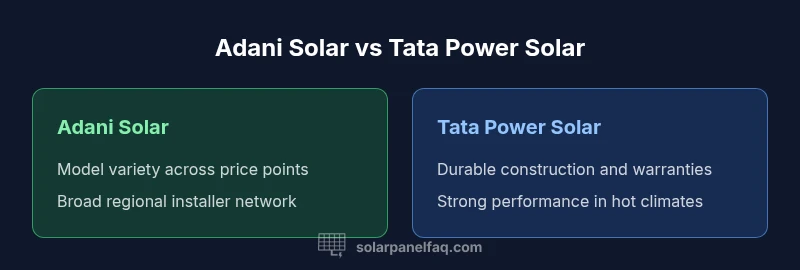
If you prioritize broad regional service coverage, fast installations, and aggressive scale, Adani may be favorable in many localities. If you value long-run durability, strong warranties, and proven performance in hot climates, Tata panels can be an attractive option. Use a decision framework that weighs: 1) site-specific conditions (shading, orientation, roof type), 2) model-level performance data, 3) warranty terms and service access, and 4) total lifetime cost projections. The goal is to identify a model that reaches a balance between immediate price and long-term energy value.
Real-world case considerations: roof type, shading, and orientation
Your roof geometry heavily influences the best choice. A south-facing, minimal-shading roof often benefits more from higher-efficiency models, while roofs with complex shading patterns may rely on reliable performance under partial shade and strong warranty coverage. Orientation, tilt, and mounting hardware affect energy yield as much as the module’s intrinsic efficiency. In all scenarios, request a shading analysis and a production estimate from your installer for both Adani and Tata options, and compare the projected annual output under your specific conditions.
Practical checklist for evaluating models you’re considering
- Gather datasheets for each model from Adani and Tata and compare efficiency, temperature coefficient, and degradation rate.
- Confirm warranty terms and service network coverage for your region.
- Read independent test results and note the test conditions used.
- Inspect physical build quality, frame coating, and glass thickness where possible.
- Obtain multiple installer quotes to compare installation costs and timelines.
- Validate availability of spare parts and fast response times for service.
Comparison
| Feature | Adani Solar | Tata Power Solar |
|---|---|---|
| Efficiency range | Medium-high depending on model | Medium-high depending on model |
| Warranty and service support | Model-dependent; regional service coverage varies | Model-dependent; regional service coverage varies |
| Typical installation footprint | Similar footprint across common residential models | Similar footprint across common residential models |
| Availability and distribution network | Broad installer networks in major cities | Broad installer networks in major cities |
| Price/value context | Competitive pricing with favorable payback depending on incentives | Competitive pricing with favorable payback depending on incentives |
Strengths
- Strong local manufacturing presence with broad service networks
- Competitive warranties and robust regional support
- Wide model range enabling price-to-performance choices
- Potential financing and incentive options for homeowners
Drawbacks
- Model-to-model variation requires model-level comparison
- Regional availability can vary by state or city
- Customer service experiences depend on installer and service network
- Long-term payback depends on maintenance and accurate yield projections
Adani and Tata both offer solid panels; choose based on model-level performance and local service access
If service coverage and installability matter most, lean toward Adani. If warranty depth and durable build are key, Tata may edge ahead. Always compare model datasheets, verify installer networks, and consider long-term maintenance.
Frequently Asked Questions
Which brand tends to offer better warranty coverage, Adani or Tata?
Warranty terms vary by model and region, but both brands provide product and performance warranties. Always verify the specific model you’re considering and confirm region-specific terms with your installer.
Warranty terms vary by model and region, so always check the exact model and your location with the installer.
Are Adani and Tata panels reliable in hot climates?
Both brands design modules for hot climates and should perform well when properly installed. The model and installation context—tilt, shading, and airflow—play a bigger role than brand alone.
Both brands are designed for hot climates; performance depends on the model and proper installation.
How should I compare Adani vs Tata models?
Compare model datasheets side by side for efficiency, temperature coefficients, and degradation rates. Check warranties and confirm service networks in your area. Look at third-party test results to corroborate manufacturer claims.
Compare datasheets side by side and check warranties and local service for each model.
Is one brand more available in my region than the other?
Availability depends on your city and installer networks. Check with multiple certified installers to confirm which Adani or Tata models are readily accessible near you.
Availability varies by region; ask several installers what models are readily available.
What should I look for in a datasheet beyond efficiency?
Look for the temperature coefficient, degradation rate, cell technology, frame and glass durability, and mounting compatibility. Real-world performance depends on how these factors combine with your roof and climate.
Beyond efficiency, check temperature coefficient, degradation, and build quality.
Top Takeaways
- Compare models, not brands, for your home value
- Prioritize warranties and service networks
- Assess site-specific factors like shading and roof type
- Read datasheets and seek independent tests
- Plan for long-term maintenance and yearly energy output