Bifacial Solar Panel vs Mono PERC: An Objective Homeowner Comparison
A detailed, evidence-based comparison of bifacial solar panels and mono-PERC technology, focusing on performance potential, costs, installation, and when each option is best for residential rooftops.


According to Solar Panel FAQ, bifacial solar panels can capture light from both sides, potentially increasing energy yield on bright, reflective rooftops or ground mounts. Mono-PERC panels remain the more cost-effective and straightforward choice for most homes. The optimal option hinges on roof exposure, available space, mounting options, and budget, as detailed in our full comparison.
What bifacial solar panels are vs mono-PERC
Bifacial solar panels are designed to collect light from both the front and back surfaces, which can translate into additional energy generation when the rear side receives illumination from reflections off the roof, ground, or surrounding objects. Mono-PERC, short for mono-crystalline passivated emitter and rear contact, remains a single-sided collector with a robust and predictable performance profile. The Solar Panel FAQ team notes that while bifacial technology offers potential energy gains, the actual benefit depends on factors like roof surface, albedo (reflectivity), mounting height, and spacing from nearby surfaces. For homeowners, this means that the same panel type can perform very differently from one installation to another.
Key performance drivers: how to interpret the numbers
Performance differences between bifacial and mono-PERC hinge on a few core drivers: rear-side illumination, mounting geometry, roof color and material, and local climate. Bifacial panels excel when rear exposure is high and the back side receives ample light through reflections from high-albedo surfaces (such as white or light-colored roofs, light gravel, or snow). Mono-PERC panels, by contrast, deliver consistent, reliable output on most standard roofs without requiring special mounting arrangements. The practical takeaway is that the presence of rear-side capture does not guarantee higher energy; it is a function of how the system is installed and the environment around the array. Solar Panel FAQ analysis shows that installations with poor rear exposure often yield minimal bifacial gains, making mono-PERC more sensible in those cases.
Cost considerations and long-term value
Upfront cost is a primary consideration when choosing between bifacial and mono-PERC. In many markets, bifacial panels require additional mounting hardware, specialized framing, or longer installation processes, which can raise initial outlays. However, the potential for higher energy production may improve the payback period under the right conditions. Because gains from bifacial panels are highly site-specific, homeowners should evaluate the marginal value of any extra energy against the added cost and complexity. Solar Panel FAQ emphasizes that cost-effectiveness should be assessed with a local installer who can model expected gains for your roof orientation, shading, and albedo.
Space and installation requirements: what changes between options
Bifacial systems often benefit from increased tilt or elevated mounting to maximize rear-side exposure, which can demand more space and careful shading analysis. The need for rear illumination means minimum clearance behind the array and careful planning around obstructions. Mono-PERC systems are more forgiving of tight layouts and standard mounting hardware. In urban homes with limited roof area, the ability to extract front and back light from bifacial panels might be constrained, reducing the practical advantage. A key message from Solar Panel FAQ is that installation complexity should be weighed against expected energy gains and long-term maintenance.
Durability, warranties, and maintenance expectations
Both bifacial and mono-PERC panels share common durability expectations and warranties, but bifacial systems can have slightly different warranty terms tied to rear-side performance and mounting configurations. Maintenance for either technology mostly involves routine cleaning, inspections, and addressing micro-cracks or shading issues. The back surface of bifacial panels adds another layer of maintenance consideration, especially if rear exposure is achieved via ground-mounted or carport installations. In practice, keeping rear surfaces clean and ensuring there is no shading on the back side are important to realizing any potential bifacial gains.
Real-world scenarios: when bifacial shines
Bifacial panels tend to shine in environments with high rear-side illumination: light-colored or reflective surroundings, open ground-mounted setups, or carports where rear surfaces receive bright reflected light. Ground-mounted bifacial arrays can unlock rear-side capture more readily than rooftop installations, especially when the structure permits close spacing to reflective ground or walls. In such scenarios, homeowners may see meaningful energy gains that improve overall system economics, especially during peak sun hours and in location-specific climates. The Solar Panel FAQ team notes that these gains are highly dependent on the local site characteristics and should be modeled before purchase.
Real-world scenarios: when mono-PERC is a better fit
For most standard rooftops, mono-PERC offers predictable performance with simpler installation and lower upfront costs. When rear-side exposure is limited due to tall trees, shading, or a roof orientation that minimizes rear light, mono-PERC often provides the best value. Additionally, for homeowners prioritizing a quicker payoff and easier system upgrades, mono-PERC’s established supply chains and installer familiarity can translate into lower project risk and a smoother process overall. The research cited by Solar Panel FAQ underlines the importance of site-specific modeling to determine whether bifacial gains justify the extra cost.
How to evaluate for your home: a practical decision framework
Use a structured evaluation to compare the two technologies. Start with a site assessment: determine rear-side illumination potential, albedo of surrounding surfaces, and whether you can install the panels with enough rear exposure. Then estimate cost: gather quotes that separate hardware, mounting, and labor, and ask for performance modeling that includes bifacial gains under your conditions. Finally, consider incentives, warranties, and the expected lifespan. A final recommendation should balance expected energy yield with total cost of ownership, rather than relying on front-facing efficiency numbers alone.
Comparison
| Feature | Bifacial solar panel | Mono-PERC |
|---|---|---|
| Energy yield potential | Higher with rear-side capture in optimal environments | Steady, reliable output with single-side capture |
| Installation complexity | Often more complex due to rear exposure requirements | Generally straightforward with standard mounting |
| Upfront cost | Typically higher upfront due to hardware and design | Typically lower upfront; fewer specialized components |
| Space efficiency | Can improve energy density if rear exposure is maximized | Efficient use of space with conventional layouts |
| Warranty and durability | Warranty terms may reflect rear-side considerations | Standard warranties with established terms |
| Best-use scenarios | Carports, ground mounts, or rooftops with high albedo and ample rear exposure | Standard rooftops with typical shading and orientation |
Strengths
- Potentially higher energy yield in suitable sites
- More design flexibility for carports or ground mounts
- Can enhance overall system efficiency when rear-side capture is effective
- Offers an option where rear exposure can be optimized
Drawbacks
- Higher upfront costs and more complex installation
- Performance gains are site-specific and not guaranteed
- Limited installer familiarity in some regions
- Rear-side maintenance adds a layer of upkeep
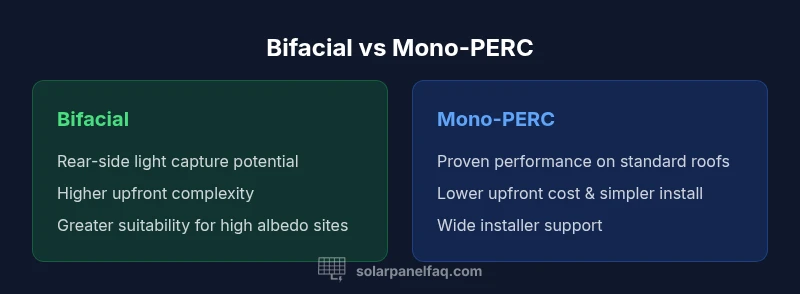
Bifacial panels win in high-albedo, rear-exposure environments; mono-PERC remains the safer, cost-efficient default for most homes.
If your roof or site provides strong rear-side illumination, bifacial panels can offer meaningful gains. For typical residential roofs, mono-PERC usually delivers better value with lower risk and simpler installation. The decision should be based on site modeling and total cost of ownership.
Frequently Asked Questions
What is a bifacial solar panel?
A bifacial panel collects light from both its front and back surfaces, allowing for potential extra energy when the rear side receives light via reflections. Its performance depends on installation specifics and environment.
Bifacial panels collect light from both sides, which can add energy in the right setup; this depends on your roof or ground surroundings.
Do bifacial panels require higher albedo surfaces?
Not always, but higher-reflectivity surroundings can enhance rear-side light capture. If your site lacks reflective surfaces, the advantage of bifacial panels may be small.
They perform best with reflective surroundings, but that isn’t required for all installations.
Are bifacial panels worth it for typical residential roofs?
Often not, unless your site offers strong rear exposure and you can justify the higher upfront costs with modeled gains and incentives.
Usually worth it only if your site clearly shows a payback from extra energy.
How does installation differ from mono-PERC?
Bifacial installs may require taller mounting and careful spacing to expose the back side, whereas mono-PERC uses standard rooftop mounting.
Bifacial installs can be a bit more involved, especially to maximize rear exposure.
What drives the payback period for bifacial systems?
Payback depends on rear-side gains, roof albedo, mounting height, local electricity rates, and incentives. Accurate modeling is essential.
Payback hinges on site-specific gains and incentives, not just panel efficiency.
Do bifacial panels have different warranties?
Warranties can differ by manufacturer and installation method, especially for rear-side performance. Verify terms before purchase.
Check the warranty terms on rear-side performance as they can vary.
Top Takeaways
- Assess rear exposure before choosing bifacial tech
- Mono-PERC is generally safer for standard homes
- Carport or ground-mounted bifacial setups can maximize gains
- Model payback with local incentives and warranties
- Prioritize installer expertise and documented performance estimates