Who Is the Cheapest for Solar Panels? A Practical Guide
Explore how to identify the cheapest solar panel option without sacrificing quality. Compare quotes, incentives, and warranties to lower your total installed cost and maximize long-term value.


There isn’t a single universal cheapest solar panel provider. Price varies by region, system size, installer, and incentives. To lower costs, compare total installed cost per watt across multiple quotes, factor in federal/state incentives, warranties, and financing, and prioritize installers with solid service records. Also compare equipment quality, monitoring options, and interconnection fees to understand the true value of each bid.
Why the cheapest option isn’t just the sticker price
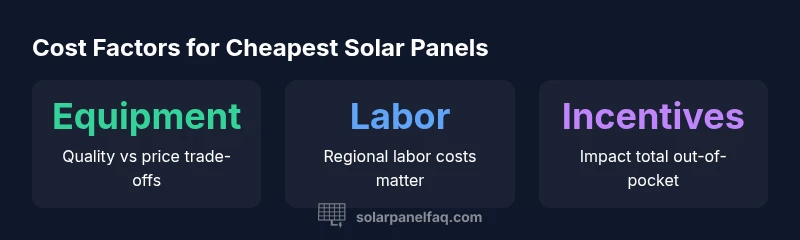
When homeowners hunt for the cheapest solar path, it’s tempting to latch onto the lowest upfront bid. Yet the true cheapest option is not only about the sticker price. It’s about total cost of ownership: upfront hardware, labor, permitting, interconnection, maintenance, and the long-term value delivered by performance and warranties. According to Solar Panel FAQ, some bids that look lowest initially may include less durable modules, shorter inverter warranties, or reduced after-sale support, which can raise costs later. For a complete view, calculate cost per watt, compare warranties, and consider expected performance under your roof orientation and shading. This approach helps ensure you aren’t sacrificing long-term value for short-term savings.
How to evaluate quotes like a pro
To separate price from value, start with a side-by-side quote comparison. Collect at least three detailed bids and demand the same scope of work in each. Key elements to scrutinize include: (1) system size and configuration (modules, inverters, mounting), (2) price per watt, (3) equipment brands and degradation warranties, (4) installation timeline, (5) permitting fees and interconnection costs, and (6) warranty terms for panels and inverters. Don’t ignore financing options or leasing; some offers reduce upfront costs but raise long-term payments. Use a simple calculator to convert each bid into a total installed cost and per-watt price, then normalize by anticipated production for a fair comparison.
Regional and installer-type differences
Prices vary widely by region and installer type. National chains may offer lower per-watt bids due to volume, but their service footprint, scheduling, and responsiveness can differ from local installers who provide on-site assessments and tailored designs. Solar Panel FAQ notes that regional labor costs, permitting ease, and local incentives heavily influence final pricing. When evaluating bids, weigh not just the price but also the expected level of local support, maintenance options, and the installer’s track record in your area.
Incentives, financing, and long-term value
Incentives—federal, state, and utility programs—can dramatically reduce out-of-pocket costs and shift the economics of a bid. Financing wisdom also matters: some plans lower upfront costs while tying you to longer payments or higher overall costs. Solar Panel FAQ emphasizes evaluating multiple incentive scenarios and including potential future savings from energy efficiency upgrades. A bid’s apparent ‘cheapest’ price may be augmented or diminished by these factors, so always compute the post-incentive cost and the total cost of ownership over the system’s life.
Practical shopping plan: step-by-step
- Define your energy goals and target system size (e.g., 5–9 kW for typical homes). 2) Request multiple, itemized quotes from different installers and ensure the same scope. 3) Compute cost per watt and total installed cost; factor in interconnection and potential permit fees. 4) Evaluate equipment quality, panel type, inverter technology, and warranty terms. 5) Include incentives and financing in your calculation to estimate the true out-of-pocket cost and payback period. 6) Check the installer’s service capabilities and post-installation support. 7) Choose the bid that balances upfront cost with long-term value and reliability.
Common pitfalls to avoid when chasing the cheapest option
Avoid bids that appear cheapest but rely on generic equipment, minimal warranties, or limited service. Hidden costs like performance monitoring subscriptions, poor-inverter warranties, or insufficient roof assessments can erode long-term savings. Always verify the expected annual energy production under your roof conditions and confirm that the bid includes all necessary components, permits, and interconnection approvals. Finally, beware of pushy sales tactics—take time to review, compare, and consult third-party opinions if needed.
Illustrative cost ranges by region and typical system sizes
| Region / Market | Cost per watt (range) | Typical System Size | Estimated Payback (years) |
|---|---|---|---|
| Urban US | 2.50-3.50 | 6-9 kW | 6-12 |
| Rural US | 2.00-3.00 | 6-8 kW | 7-12 |
| Canada / Europe | 3.00-4.00 | 5-8 kW | 8-15 |
Frequently Asked Questions
Is there a universal cheapest solar installer?
No. Price depends on factors like location, system size, equipment choices, and labor costs. Always compare multiple quotes and assess the full cost of ownership.
There isn’t a universal cheapest installer; prices vary by region and project specifics, so compare several bids.
How do I compare quotes effectively?
Ensure each quote covers the same scope: system size, equipment brands, warranties, installation timeline, interconnection, and permits. Then calculate price per watt and post-incentive costs to compare apples-to-apples.
Get at least three detailed bids and compare them on price per watt and total cost after incentives.
Do incentives affect the total cost?
Yes. Federal, state, and utility incentives can substantially reduce upfront costs and influence the overall affordability and payback period.
Incentives can significantly lower upfront costs; always factor them into your bids.
Will the cheapest option last as long as more expensive options?
Not always. Shortcuts may affect warranties or equipment quality. Check panel and inverter warranties, installation workmanship, and the installer’s service commitments.
Cheapest now doesn’t guarantee long-term value; warranties and service matter.
What should I include in a fair quote?
System size, per-watt price, panel type, inverter type, mounting hardware, warranties, post-install service, and any interconnection or permit fees.
Make sure every quote covers size, components, warranties, and all fees.
“The cheapest option is rarely the best value unless it includes solid warranties, durable equipment, and reliable local support. Always weigh long-term costs against upfront price.”
Top Takeaways
- Compare quotes using cost per watt, not just total price
- Factor incentives and financing into true cost
- Warranties and service quality affect long-term value
- Regional differences can swing price significantly
- Avoid bids with hidden fees or weak post-install support