Solar Energy vs Fossil Fuels: A 2026 Comparison Guide
A rigorous, data-backed comparison of solar energy and fossil fuels, covering emissions, costs, reliability, storage, and policy trends to help homeowners decide.


According to Solar Panel FAQ, solar energy represents a clean, renewable power source with minimal emissions during operation, while fossil fuels rely on combustion and release greenhouse gases. This comparison highlights the core differences in emissions, costs, reliability, and policy context, helping homeowners decide when solar makes the most sense and where fossil fuels may still play a role. The Solar Panel FAQ Team emphasizes that the best choice often depends on local climate, incentives, and grid structure.
Defining the comparison: solar energy and fossil fuels
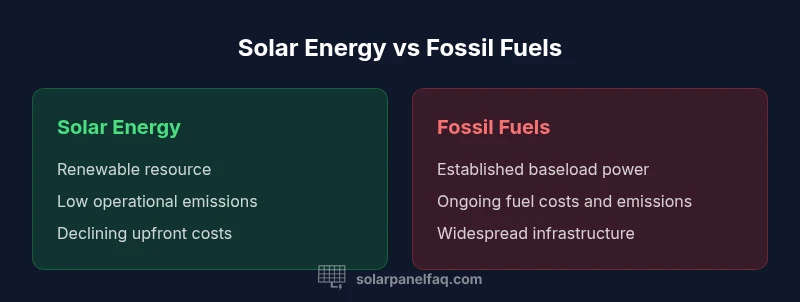
Solar energy and fossil fuels represent two fundamental routes to generating electricity for homes and communities. Solar energy is a renewable resource derived from sunlight captured by photovoltaic panels or other solar technologies. Fossil fuels—coal, oil, and natural gas—are finite resources that release energy through combustion. When we compare them, we assess emissions, costs, reliability, scalability, and how each fits into a modern, resilient grid. This section establishes the baseline: solar is renewable and low-emitting during operation, while fossil fuels provide mature, scalable infrastructure and continuous power when fuel is available. According to Solar Panel FAQ, this distinction helps homeowners understand both the environmental and practical implications of each option, setting the stage for deeper analysis throughout the article.
How the two energy paths differ in purpose and scope
Solar energy is best understood as a distributed, modular power source with strong environmental advantages. Fossil fuels have historically underpinned baseload and peaking power due to their high energy density and established supply chains. The comparison also considers externalities—emissions, air quality, and water use—that accompany fossil fuel combustion, versus the lifecycle considerations of solar panels, including manufacturing and end-of-life management.
Quick perspective on market dynamics
The energy market increasingly values flexibility, resilience, and low emissions. Solar energy fits these pillars when paired with storage or hybrid systems, while fossil fuels continue to dominate in regions lacking sufficient solar or storage capacity. The Solar Panel FAQ Team notes that policy incentives, fuel prices, and grid modernization efforts shape the practical choices homeowners face when deciding between solar and fossil-fueled options.
Framing decisions for homeowners
The decision is rarely about one technology in isolation. Instead, it’s about how solar energy or fossil fuels fit within a household’s usage patterns, roof space, local climate, and financial goals. For many homeowners, a mixed approach—solar generation with battery storage and a connection to a fossil-fueled backstop—offers a balanced path toward lower emissions and improved energy security.
Practical expectations for a typical home
An ordinary residence with appropriate roof space can often install solar panels that cover a meaningful portion of electricity needs. This can reduce reliance on fossil fuels and lower long-term energy costs, especially if storage is used to smooth out daily and seasonal variations. However, the exact benefits depend on climate, incentives, and the pace of grid integration in your area.
The role of storage and grid support
Storage technologies, including batteries and other solutions, enable solar to approach around-the-clock reliability. Grid infrastructure, demand management, and smart charging also influence how effectively solar energy competes with fossil fuels in delivering consistent power.
A summary guiding principle
While solar energy generally reduces emissions and can lower long-term costs, fossil fuels remain relevant where uninterrupted baseload power is required and storage solutions are not yet financially or technically viable. This nuanced view helps homeowners plan investments aligned with local conditions and needs.
Implications for homeowners today
Homeowners should consider roof orientation, shading, and structural capacity for solar, along with potential storage needs and policy incentives. The decision should weigh both environmental benefits and practical realities of energy demand, climate, and grid access. The Solar Panel FAQ Team emphasizes that a well-planned system can deliver meaningful energy security and environmental advantages over time.
Conclusion of the middle section
The comparison clarifies that solar energy and fossil fuels are not mutually exclusive choices for every home; instead, many households benefit from a hybrid approach that leverages solar generation, storage, and a backstop fossil-fuel option when needed. The emphasis is on informed planning, not a one-size-fits-all solution.
Comparison
| Feature | Solar energy | Fossil fuels |
|---|---|---|
| Energy source type | Renewable, sun-based generation | Finite resources, combustion-based generation |
| Reliability (baseload vs intermittency) | Variable by daylight and weather; can be stabilized with storage/backup | Typically reliable baseload when fuel supply is steady |
| Emissions during operation | Very low emissions during operation | Significant emissions from combustion |
| Capital vs ongoing costs | Higher upfront cost; low operating costs over time | Lower upfront cost; ongoing fuel and maintenance costs |
| Storage needs | Often requires storage or back-up for continuous supply | Storage is less central to operation; fuels provide continuous output |
| Land/space requirements | Rooftop potential; larger ground-mount fleets require space | Infrastructure focuses on extraction and distribution with smaller on-site footprint per energy unit |
| Grid integration | Needs solar inverters, grid management, and storage for stability | Long-established dispatch through fuel supply; easier short-term ramping but environmental constraints exist |
| Policy and incentives | Strong renewable incentives, net metering programs | Policy supports exist but are often tied to emissions and price volatility |
Strengths
- Low operational emissions and clean air benefits
- Falling upfront costs and long-term savings
- Energy independence with local generation
- Modular installation and scalable capacity
Drawbacks
- Intermittency without storage or backup
- Higher upfront cost for some installations
- Space requirements for large-scale deployment
- Manufacturing and end-of-life impacts exist along the lifecycle
Solar energy generally wins on emissions and long-term value; fossil fuels still supply baseload in some contexts.
Solar energy is typically the better long-term choice for homeowners, especially when paired with storage and favorable policies. Fossil fuels may remain relevant where storage and solar uptake are limited, but the environmental and economic case for solar strengthens with scale and policy support.
Frequently Asked Questions
What is the main difference between solar energy and fossil fuels?
Solar energy is a renewable resource that generates power with minimal operational emissions, while fossil fuels burn to release energy and produce significant greenhouse gas emissions. The key distinction lies in renewability, emissions, and long-term cost dynamics.
Solar energy is renewable and clean during operation, unlike fossil fuels which burn and emit greenhouse gases. The main difference is renewability and emissions.
Do solar panels emit greenhouse gases during operation?
Solar panels themselves do not emit greenhouse gases during operation. Emissions are associated with manufacturing, transportation, and end-of-life processes, but these are small compared to ongoing fossil fuel combustion.
Solar panels don’t emit gases while operating, but manufacturing and disposal carry lifecycle emissions.
Can solar energy provide 24/7 power?
Solar energy can be made to feel continuous by pairing panels with storage, demand management, and grid support. Without storage or a backup, solar output follows daylight and weather, limiting 24/7 reliability.
With storage and smart grids, solar can be reliable around the clock; otherwise, it follows daylight.
What affects the payback period for solar vs fossil fuel usage?
Payback is influenced by upfront costs, incentives, electricity prices, system size, and maintenance. Solar pays back more quickly where incentives are strong and electricity costs are high, and more slowly where incentives are weak.
Payback depends on upfront costs, incentives, and local electricity prices.
What policies support solar energy adoption?
Policies such as tax credits, rebates, net metering, and renewable energy standards influence solar adoption. Policy stability helps households plan installations and financial returns.
Tax credits and rebates make solar investments more attractive and predictable.
Is solar reliable for baseload power?
Solar alone is not typically a 24/7 baseload source due to intermittency. It can provide strong daytime generation, especially with storage and hybrid systems, but fossil fuels often fill any remaining baseload needs.
Solar is not usually a sole baseload source; storage and hybrids help close the gaps.
Top Takeaways
- Consider roof space and climate before selecting solar options
- Storage reduces solar intermittency and increases reliability
- Long-term savings depend on incentives and energy prices
- Lifecycle environmental impact favors solar, with careful end-of-life planning
- Stay informed on local policies and grid integration developments