Solar panel vs fossil fuels: A balanced comparison
Explore how solar panels compare to fossil fuels in emissions, reliability, costs, and policy. This guide helps homeowners weigh environmental benefits, grid implications, and practical adoption factors for a smarter energy mix in 2026.


Solar panel vs fossil fuels: Solar offers cleaner electricity with daytime generation and potential long-term savings, while fossil fuels provide reliable baseload power but emit greenhouse gases and face price volatility. For many homes, solar paired with storage or grid-tied operation reduces daytime grid dependence and strengthens resilience, though performance hinges on sun, roof orientation, and incentives.
Context: The energy transition and the baseline for comparison
The shift toward sustainable energy places solar panels and fossil fuels on opposite ends of a spectrum with shared goals: reliable power, reasonable cost, and a smaller environmental footprint. When homeowners compare solar panel vs fossil fuels, they weigh how each option aligns with daytime energy needs, climate goals, and local incentives. According to Solar Panel FAQ, the practical decision hinges on sun exposure, roof feasibility, and the local policy landscape, all of which shape real-world outcomes. The broader narrative is not about choosing one system forever, but about creating a flexible mix that reduces emissions and balances cost over time. This chapter sets the stage by clarifying what each path delivers in ordinary home energy use and how these signals appear in 2026.
Key takeaway: The comparison begins with an honest inventory of existing energy demand, roof conditions, and policy context, then maps how solar and fossil fuel use interact across daily cycles and seasons.
How solar panels generate electricity and what fossil fuels do
Solar panels convert sunlight into direct current electricity through photovoltaic cells, then invert it for household use. The energy you produce depends on panel quality, system size, orientation, and local irradiance. Fossil fuels—gas, oil, coal—produce electricity by burning fuel in a generator, delivering continuous power but at the cost of emissions and fuel logistics. A pivotal distinction is intermittency: solar energy rises and dips with the sun, while fossil fuel plants can run continuously to meet demand. In practice, most homes use a combination — solar for daytime usage and grid power or storage for evenings and cloudy days. This hybrid pattern highlights how solar panel vs fossil fuels play out in real-world bills, reliability, and carbon footprints.
Practical note: In regions with strong sun and supportive incentives, solar can significantly reduce daytime electricity needs; in cloudier climates or high-income households with large daytime loads, thoughtful storage and grid interaction become essential.
Environmental impact across lifecycle
Lifecycle analysis considers manufacturing, transportation, installation, operation, and end-of-life management. Solar panels produce electricity with minimal emissions during operation, which substantially lowers lifecycle greenhouse gas emissions compared with fossil fuels. However, manufacturing panels involves energy use and material inputs, and end-of-life recycling is an emerging priority. Fossil fuels, by contrast, emit greenhouse gases during operation and rely on continuous fuel supply chains, resulting in a different lifecycle profile that often correlates with higher overall emissions. When you compare solar panel vs fossil fuels, the environmental story favors solar, especially when paired with responsible recycling and local production when feasible. The Solar Panel FAQ team highlights these lifecycle considerations as central to informed choices for homeowners.
Bottom line: Emissions and waste streams matter, but the relative advantage of solar grows with efficient manufacturing and robust recycling pathways.
Reliability and grid integration
Reliability hinges on both generation predictability and grid support. Solar generation is predictable on a clear day but absent at night, which can be mitigated by storage or a grid connection. Fossil fuel plants offer consistent baseload power, and grid operators balance variability with diverse sources and demand response. For typical homes, solar plus storage or a hybrid with the grid provides resilience against outages and price swings. The key decision factor is how much daytime load you have and whether you can tolerate variability. In practice, a well-designed solar system with modern inverters and load management can smooth daytime consumption, while storage adds a buffer for evening and peak periods. The result is a more resilient energy profile that adapts to weather, occupancy, and seasonality.
Takeaway: Reliability depends on storage options, system design, and local grid policies; solar shines when backed by thoughtful integration strategies.
Cost considerations and financing (non-pricing specifics)
Cost discussion centers on upfront investment, ongoing maintenance, and long-term value rather than sticker price alone. Solar installations typically involve a higher initial outlay than a simple fossil-fuel bill, but the long-term energy cost can be competitive due to virtually inexhaustible sunlight as an energy source. Financing options, tax incentives, and net metering policies can shift the overall economics. It’s important to evaluate total cost of ownership, including installation, maintenance, inverter replacements, and potential storage, alongside the expected lifespan of equipment. Fossil fuel systems often require ongoing fuel purchases and maintenance for engines and controls, with costs that shift with energy markets. For homeowners, the key is to map annual energy use, available incentives, and potential storage to understand overall value in a solar panel vs fossil fuels scenario without assuming exact payback timelines.
Implication: Financing structures and policy environments can dramatically influence perceived value, making it essential to compare apples-to-apples across options.
Regional and building factors that shift the balance
Location shapes solar viability and fossil fuel reliance. Roof orientation, shading, and available roof space determine how much solar you can install and how quickly you approach energy independence. Climate affects panel output and storage needs: sunnier regions tend to benefit more from solar, while regions with high heating or cooling demand may still rely on grid or fossil fuel backup. Building type, insulation, and energy efficiency measures also impact how many solar panels you need and how much energy you can offset. Beyond physical factors, local incentives, permit processes, and interconnection rules can shift the economics of solar installation. When comparing solar panel vs fossil fuels, homeowners should assess structural suitability, climate patterns, and policy support to estimate practical outcomes.
Guidance: Conduct a site assessment, check local incentives, and factor in potential energy-saving retrofits to maximize solar performance before drawing conclusions.
Technology trends: efficiency, inverters, storage, and demand response
The technology behind solar energy is evolving: higher-efficiency cells, smarter inverters, and advanced battery storage are expanding what’s feasible for homeowners. Inverters convert DC to AC, and advanced models enable better monitoring, safety, and grid services. Storage technology improves time-shifting of energy use, reduces peak demand, and enhances resilience during outages. On the fossil-fuel side, cleaner-burning fuels and more efficient generators contribute to lower emissions per unit of energy, though the fundamental emissions challenge remains. When weighing solar panel vs fossil fuels, you should consider available technology, your willingness to adopt storage, and how far you want to pursue energy autonomy. Emerging microgrids and demand-response programs may further tilt the balance toward solar-powered resilience.
Bottom line: Technology advances progressively widen the gap in performance and value, favoring solar in well-supported environments while preserving the option of fossil-fuel-based backstops where needed.
Policy landscape and incentives
Policy plays a major role in the solar vs fossil fuels decision. Incentives for solar installation, net metering rules, and eligible credits can lower the effective cost and shorten payback periods, though these programs vary by locality and can change over time. Fossil fuel policies often involve subsidies, environmental regulations, and market-based mechanisms that influence affordability and access to energy. Understanding the local policy context is essential for homeowners to gauge potential savings and risk exposure. Solar policy can also affect storage and grid interaction, including incentives for battery systems and demand-response participation. As you evaluate options, align your expectations with current and near-future policy signals to optimize the solar panel vs fossil fuels decision in your region.
Practical homeowner scenarios and decision guidelines
Consider a suburban home with good sun exposure and a moderate daytime energy load. In this scenario, solar panels, optionally paired with storage, can meaningfully reduce daytime grid usage and align with decarbonization goals. For homes with extensive nighttime or year-round high energy demand, a hybrid approach—solar with battery storage and a robust connection to the grid or a backup fossil fuel system during extreme conditions—may be the most balanced path. Urban homes with limited roof space might rely more on community solar or off-site generation, while rural properties could capture greater value from larger installations. The decision framework should weigh: energy needs, roof suitability, climate, incentives, storage options, and tolerance for intermittency. Evaluating a few configurations (solar-only, solar with storage, and grid-tied solar with backup) helps identify the best fit for your household.
Common misconceptions and how to interpret data
Many homeowners assume solar panels instantly eliminate fossil fuel use. In reality, solar reduces daytime emissions and grid dependence, but the balance with fossil fuels depends on storage, demand, and policy. Another common belief is that all solar installations are equally effective; in truth, site-specific factors like shading and orientation drastically affect output. Data interpretation matters: look beyond upfront costs and examine lifecycle emissions, reliability under typical weather, and the availability of storage or backup options. Finally, people often overlook end-of-life considerations; recycling and disposal impact the long-term sustainability story. By sorting fact from hype, you can form a nuanced view of solar panel vs fossil fuels that reflects your home’s realities and local conditions.
Comparison
| Feature | Solar Panels | Fossil Fuels |
|---|---|---|
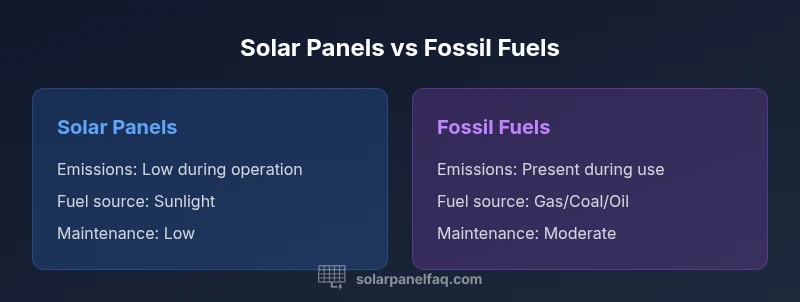
| Emissions during operation | Low or zero (when generating) | High (during combustion) |
| Fuel/energy source stability | Depends on sun; intermittent without storage or grid | |
| Upfront installation considerations | Site assessment and panel layout | Equipment and installation complexity |
| Maintenance needs | Low maintenance; periodic cleaning and inverter checks | |
| Lifespan and durability | Longer lifespan with proper maintenance | Depends on fuel source and equipment |
| Scalability and deployment | Modular, scalable with roof space | Often centralized and infrastructure-dependent |
Strengths
- Low operating costs after installation
- Emissions-free generation when sunny
- Modular and scalable for many homes
- Incentives can lower the effective cost
- Reduces daytime grid dependence
Drawbacks
- Intermittent generation without storage
- Higher upfront costs and possible financing hurdles
- Roof space and orientation limit output
- Reliance on weather and daylight affects reliability
Solar panels are generally the more sustainable and potentially cost-saving option for many homes, especially with sun and incentives, but they require storage or grid interaction to fully replace fossil fuel energy.
Choose solar when you have good sun exposure, access to incentives, and a plan for storage or grid backup. Fossil fuels still offer continuous power, but with emissions and price volatility. A hybrid approach often delivers the best balance for homeowners.
Frequently Asked Questions
What is the primary difference between solar panels and fossil fuels in energy generation?
Solar panels generate electricity from sunlight with low operational emissions, while fossil fuels burn fuel to create electricity, producing emissions. The key difference lies in emissions, intermittency, and fuel costs over time.
Solar panels use sunlight to create electricity with minimal ongoing emissions, unlike fossil fuels which burn fuel and emit pollution.
Can solar panels completely replace fossil fuels for a home?
Most homes will not rely solely on solar without some form of storage or grid connection. Solar reduces daytime usage and emissions, but a backup is often needed for nights and overcast days to ensure reliability.
Solar can significantly cut fossil fuel use, but most homes need storage or grid backup for full reliability.
What factors influence the payback period for solar installations?
Payback depends on sun exposure, roof size, electricity usage, and the availability of incentives. Location and climate shape how quickly energy savings accumulate, so timelines vary widely by home.
Payback varies with sun exposure and incentives; it isn’t the same for every home.
Are there environmental risks with solar panel manufacturing or disposal?
Manufacturing has energy use and material inputs, but lifecycle emissions are typically lower than fossil fuels. End-of-life recycling is improving, reducing waste over time.
Environmental risks exist in manufacturing and disposal, but solar generally offers lower lifecycle emissions.
How do incentives and policy affect solar adoption?
Policies like tax credits, rebates, and net metering can improve the economics of solar adoption. Rules vary by location and change over time, so check current programs.
Policies can significantly affect solar value; verify local incentives before deciding.
Top Takeaways
- Assess roof space and sun exposure before deciding
- Consider storage or grid ties to address intermittency
- Factor lifecycle emissions and recycling into the energy choice
- Incentives and local policy substantially influence value
- A hybrid solar + backup strategy often offers resilience