Compare Solar Panel Prices: A Practical Buying Guide
Learn how to compare solar panel prices effectively, including total installed costs, incentives, warranties, and what drives price variation for homeowners.


To compare solar panel prices, focus on the total installed cost, not just sticker price. Compare panel type, efficiency, warranties, inverters, mounting, permitting, and installation labor across multiple quotes. Size the system to your energy needs and track incentives to estimate payback. This approach reveals the best balance of upfront cost and long-term savings.
How price works in solar installations
Price in solar installations is not just the sticker price on the panels. The total installed cost includes the panels, the inverter, mounting hardware, wiring, permits, potential electrical upgrades, and labor for design and installation. When you set out to compare solar panel prices, you must evaluate all of these components on a common basis. According to Solar Panel FAQ, the most reliable comparisons start with a consistent system size and identical incentives across quotes. For homeowners, this means choosing a target system size that matches your annual energy consumption and then asking installers to quote that same configuration. The result is apples-to-apples pricing rather than apples-to-oranges. Another major factor is the balance of system or BOS costs, which can vary based on your roof geometry, shading, and local permitting rules. The price you see on a sticker often excludes BOS charges, so your true out-of-pocket can differ by thousands. Solar Panel FAQ analysis shows that failing to account for BOS tends to overstate potential savings and can lead to disappointment at the end of year one.
The major price drivers you should compare
When you compare solar panel prices, you must look beyond the panel cost itself. The price per watt is important, but it is only one piece of the puzzle. Inverters can vary widely in cost depending on technology and warranty terms. BOS items—beyond the panels and inverter—include mounting racks, wiring, conduit, racking layout, and balance-of-system materials. Labor costs reflect local market conditions and installer experience, while permitting and interconnection fees are subject to your municipality. Solar Panel FAQ notes that different installers may structure these charges differently, so you should request a bill-of-materials and a fully itemized quote for a true apples-to-apples comparison.
Incentives and their effect on the bottom line
Incentives can materially affect the final price you pay out of pocket. Federal tax credits, state rebates, and local incentives vary by location and time, so your quoted price should clearly reflect which incentives are included and how they are applied. The Solar Panel FAQ analysis shows that incentives can significantly reduce net cost in many markets, but the amount is highly location-dependent and tied to system size and eligibility. When you receive quotes, ask each installer to show the pre-incentive price, the expected incentive credit, and the post-incentive price side by side to avoid guesswork.
Panel types and pricing: economy vs premium
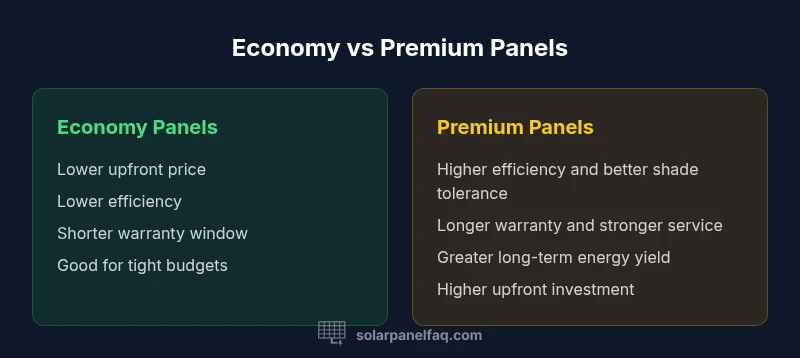
Panel type is a major price driver. Economy panels (often polycrystalline) tend to have lower upfront costs but lower efficiency and a shorter performance edge in hot or shaded conditions. Premium panels (often monocrystalline with higher efficiency and advanced coatings) command a higher price but can yield more energy per square foot and better performance over time. Consider your roof space, shading, and local sun exposure when weighing price versus performance. A higher initial investment may pay off with greater long-term energy production, or it may not, depending on your specific site and electricity rates. As you compare, ensure you’re comparing the same panel technology and efficiency class across quotes.
Warranties and service in price decisions
Warranties are a critical part of price, particularly when evaluating long-term value. Most installers offer 10–12 year workmanship warranties and 25-year performance warranties for panels, with inverter warranties often ranging from 10–20 years. Higher-priced packages frequently include longer or more robust coverage and responsive service networks. When prices seem similar, a longer warranty or stronger service support can translate into lower expected maintenance risk and better uptime over the system life. Document warranty terms precisely in each quote so you are comparing equivalent protection.
How to compare quotes like-for-like
To compare quotes reliably, insist on a standardized quote format. Use the same system size, identical panel type, inverter brand and model, and the same racking configuration. Ask installers to provide a single line item for the panel cost, separate line items for inverter, BOS, labor, permitting, and interconnection, and a total installed cost. Include an explicit measurement of expected annual energy production (or a conservative estimate) and the anticipated net metering benefits. If one quote omits a line item or uses different system sizing, request a revised version to maintain apples-to-apples comparisons. This disciplined approach reduces decision fatigue and increases price transparency.
Hidden costs that hurt price: roof, permits, upgrades
Some price differences come from factors installers rarely include in early quotes. Roof conditions may require repair or reinforcement, electrical service upgrades might be necessary for higher power levels, and local permitting can add time and cost. When you scan quotes, ask about roof assessments, whether any pre-installation repairs are included, and if there are upstream costs such as electrical panel upgrades. Hidden costs can erase apparent savings from lower panel prices, so guard against surprises by requesting a fixed scope of work and a firm price so you can confidently compare.
Case studies: typical scenarios
Scenario A: A homeowner with a standard asphalt roof and moderate energy needs in a sunny climate chooses economy panels to minimize upfront cost. The installer quotes a complete package with a neutral BOS cost and a reasonable inverter. Scenario B: A homeowner with limited roof space and high humidity environment invests in premium panels with higher efficiency and a more robust warranty. Although the upfront price is higher, the expected annual production is greater, boosting long-term ROI. In both cases, the key is to compare total installed costs and projected energy yields rather than panel sticker prices alone, as Solar Panel FAQ emphasizes.
Payback period and long-term value: a framework
Payback period is a useful guide but should be understood in context. It depends on the system size, panel efficiency, local sun exposure, electricity rates, and incentives. Instead of chasing the shortest payback, consider net present value and internal rate of return for the full system life. This broader view helps homeowners decide whether a slightly higher upfront investment for premium panels makes sense given local electricity costs and available credits. The framework remains: estimate production, subtract operating costs, and discount future savings to present value.
Practical steps to price-check today
Create a 3-step plan: (1) determine system size based on last 12 months of energy use; (2) request quotes with the same configuration from at least three installers; (3) compare on total installed cost, incentives, warranties, and expected production. Use a simple calculator to estimate payback with conservative assumptions and add a sensitivity analysis: how changes in energy prices or incentives could affect outcomes. By following these steps, you’ll avoid common traps and make a clearer buy-vs-lease or buy-vs-buy decision.
Common myths about solar panel pricing
Myth 1: Cheapest panel price always saves money. Reality: lower upfront price can come with higher BOS costs or shorter warranties. Myth 2: All quotes are the same because they quote the same system size. Reality: quotes often differ in BOS, labor, and interconnection fees. Myth 3: Incentives fully cover the cost. Reality: incentives vary and require careful calculation of eligibility and timing. Debunking these myths helps homeowners focus on the real value of a full system price.
Build your price comparison plan
Create a concrete plan: (1) define your energy goals and roof constraints; (2) obtain three fully itemized quotes; (3) compare total installed costs and annual production; (4) assess warranties and service levels; (5) factor in incentives and financing options. Keep a side-by-side spreadsheet and update it as you learn more. Following the plan ensures you compare solar panel prices in a way that reflects true value rather than surface-level sticker pricing.
Comparison
| Feature | Economy panels | Premium panels |
|---|---|---|
| Typical price per watt | $0.95–$1.20/W | $1.50–$2.20/W |
| Efficiency | ~15–18% | ~20%+ |
| Warranty length | 20–25 years | 25–30 years |
| Availability | Widely available in most markets | Region-dependent; broader in major markets |
| Aesthetics and options | Standard finishes | Multiple finishes and coatings |
| Performance in shade | Lower under shade | Better shade tolerance |
Strengths
- Lower upfront cost
- Quicker initial payoff in some markets
- More installer competition
- Faster procurement and installation windows
- Greater financing flexibility
Drawbacks
- Lower long-term energy savings
- Potentially smaller ROI in high-sun areas
- Shorter warranty or reduced service networks
- Higher BOS impact if mispriced
Economy panels are best for tight budgets; premium panels often deliver higher long-term value.
Choose economy panels when upfront cost is the main constraint. Choose premium panels if you have sufficient roof space, higher energy needs, and want stronger warranties and better long-term production.
Frequently Asked Questions
What is the best strategy to compare solar panel prices?
Start with a consistent system size and identical incentives across quotes. Ask installers for a fully itemized price that includes panels, inverter, BOS, labor, and permitting. Compare total installed costs and expected annual production to judge value.
Begin with the same system size, get three fully itemized quotes, and compare total installed costs and expected production to judge value.
Do incentives affect the price quotes from installers?
Yes. Incentives reduce net cost but vary by location and eligibility. Make sure quotes show pre-incentive and post-incentive prices and document the credits you expect to receive.
Incentives reduce the net cost and vary by location; ensure quotes show both pre- and post-incentive prices.
How long does it take to recoup the investment?
Payback depends on system size, energy use, and electricity rates. Use a simple payback estimate and compare it to a longer-term return metric like net present value for a full picture.
Payback varies with system size and energy costs; use both simple payback and longer-term value metrics for a full view.
Should I prioritize cost or warranties when choosing?
Balance upfront cost with warranty length and service quality. A lower price can come with reduced warranty coverage or slower service, which may raise costs later.
Balance upfront price with warranty length and service quality to avoid higher costs later.
Can I install solar panels myself to save money?
DIY installation is generally not recommended due to safety, permitting, and warranty concerns. Most homeowners should use licensed installers to ensure code compliance and warranty protection.
DIY solar is risky and often not allowed by codes or warranties; use a licensed installer.
What questions should I ask when getting quotes?
Ask about system size in kW, panel type and efficiency, inverter model, BOS costs, permitting, interconnection, warranties, service response times, and how incentives are applied. Request a written, itemized comparison.
Ask for system size, panel type, inverter, BOS, permits, warranties, service times, and how incentives are applied.
Top Takeaways
- Compare total installed cost, not just panel price
- Obtain three fully itemized quotes
- Consider warranties and service quality
- Account for incentives and financing
- Assess roof space and site shading for sizing