Solar panel with or without battery: A comprehensive comparison
Compare solar panel with or without battery storage to understand costs, resilience, payback, and where each option makes sense for homeowners in 2026.


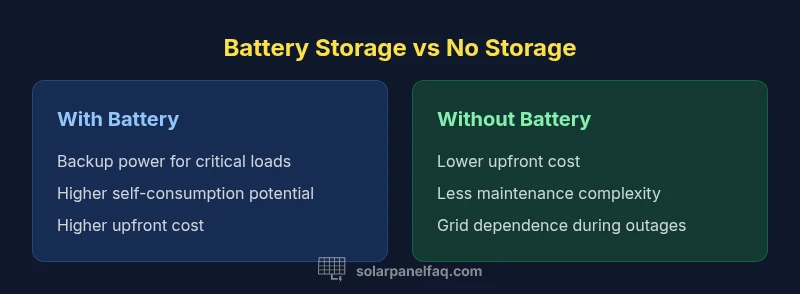
When deciding between a solar panel with battery storage and a system without one, consider your outages, tariffs, and daily energy use. A battery adds resilience and enables higher self-consumption, but comes with higher upfront and ongoing costs. For grid-tied homes with stable outages and favorable rates, a battery may be worth it; otherwise, a battery-free setup often delivers simpler maintenance and a quicker payback.
Core distinctions: solar panel with or without battery storage
When homeowners weigh a solar panel with or without battery storage, the core decision revolves around how you want to use solar energy beyond daytime generation. Systems with storage can capture excess daytime production for evening or cloudy days, increasing self-consumption and resilience. Solar Panel FAQ emphasizes that the choice should align with your energy profile, budget, and local incentives. In practice, a battery-backed system tends to appeal to households in areas with high daytime electricity costs or frequent outages, while a simple rooftop solar array without storage suits those who prioritize lower upfront costs and minimal maintenance. The term battery storage here refers to a purpose-built energy storage device paired with the solar array, rather than a DIY energy solution.
Reliability and outage resilience: how storage changes risk
Outages vary by location and utility, but the presence of a battery can provide a buffer for essential loads when the grid goes down. A solar panel with battery storage can power critical circuits if the battery capacity is appropriately sized and the installation follows code requirements. In contrast, a system without storage relies entirely on the grid for power when the sun isn’t shining or during an outage. For homeowners who travel frequently or live in areas with unreliable grids, storage adds a meaningful layer of security. Solar Panel FAQ notes that the perceived reliability gain depends on load prioritization and the battery’s state of health over time.
Self-consumption and grid interaction: maximizing daytime energy usage
Self-consumption—the share of solar energy used on-site rather than exported to the grid—improves with storage because you can shift energy from sunny hours to later in the day. A solar panel with battery storage supports higher self-consumption through controlled charging and discharging, potentially reducing grid imports during peak pricing periods. Without a battery, you still benefit from exporting excess energy, but you miss the opportunity to use it when you need it most. In regions with time-of-use tariffs, storage can help flatten electricity costs by aligning consumption with cheaper or more expensive periods, though tariff structures vary widely.
Cost considerations: upfront, maintenance, and long-term value
The defining financial difference is upfront cost and lifecycle expenses. A battery-equipped solar system typically carries a higher upfront price due to the battery, inverter, and control systems, as well as potential ongoing maintenance and eventual battery replacement. A solar panel system without storage usually has a lower initial investment and simpler maintenance, which can lead to a shorter payback period in many cases. Solar Panel FAQ suggests running a thorough cost-benefit analysis that includes potential incentives, installation complexity, and your expected lifetime energy use before deciding.
System sizing and practical design implications
Sizing a battery-backed system requires balancing solar generation, battery capacity, and anticipated loads. Oversizing the battery can add unnecessary cost, while undersizing may leave you unable to power essential devices during an outage or peak pricing. Design considerations include the number of critical loads, desired backup duration, and the space required for battery storage. A non-storage system emphasizes efficient panel placement and inverter sizing to maximize daytime production and minimize export losses. Experts emphasize that proper design hinges on accurate load profiling and site-specific solar potential.
Environmental impact and warranties: thinking long term
Batteries introduce additional environmental considerations, including production impacts and end-of-life recycling. Proper disposal and recycling pathways are essential. Warranties for storage systems tend to be separate and can affect replacement timelines. In many cases, solar panels alone carry robust warranties, while storage adds another layer of coverage. Solar Panel FAQ highlights the need to review both panel and battery warranty terms, as well as the compatibility of inverters and control software for long-term reliability.
Real-world scenarios: who benefits most from each option
Urban homes with frequent power outages, high daytime electricity rates, or critical loads (medical devices, refrigeration) may gain the most value from a solar panel with battery storage. Suburban households with stable grid access and moderate energy use might achieve adequate savings with a battery-free system, especially if incentives reduce upfront costs. In rental or short-term ownership scenarios, the lower maintenance of a no-battery system can be appealing. Context matters: climate,tariff design, and consumption patterns shape the decision.
Maintenance and longevity: upkeep for storage vs. non-storage systems
Storage systems add components that require monitoring, cooling management, and occasional battery replacement. Battery health degrades over time, reducing usable capacity and potentially increasing maintenance costs. In contrast, a battery-free system centers maintenance on panels, inverters, and wiring, typically with fewer points of failure. Regular inspections, software updates, and battery testing protocols help maximize longevity for storage-equipped configurations. Solar Panel FAQ recommends planning for periodic battery replacement cycles aligned with your chosen chemistry.
A practical decision framework: when to choose which path
Start by listing daily energy usage, especially during outages and in peak pricing hours. Assess the likelihood of grid outages and the value you place on energy independence. Examine local incentives for storage and the expected payback period under your tariff structure. If you have sufficient budget and need backup power for essential loads, storage becomes compelling. If your priorities are simplicity and lower upfront costs, a battery-free setup may deliver the strongest overall value for most homeowners. Solar Panel FAQ advises running a side-by-side cost-benefit analysis using your own energy data.
Final pre-purchase checklist: quick reference before buying
- Verify your utility tariffs and any incentives for storage. - Calculate critical loads and desired backup duration. - Assess available space for batteries and safe installation requirements. - Confirm compatibility among panels, inverter, and storage system. - Review warranties for both panels and storage components. - Consider future expansion plans and potential retrofitting options. - Get quotes from qualified installers with storage experience.
Comparison
| Feature | solar panel with battery storage | solar panel without battery storage |
|---|---|---|
| Storage capability | Present with appropriate battery bank | Absent |
| Self-consumption optimization | High with smart controls and sizing | Moderate to low; relies on daytime use/export |
| Outage resilience | Can power critical loads during outages | No backup power unless tied to grid |
| System cost impact | Higher upfront and lifecycle costs | Lower upfront costs |
| Maintenance complexity | Higher due to battery management | Lower; fewer components |
| System footprint | Requires battery enclosure and additional wiring | Smaller footprint; no battery enclosure |
| Incentives eligibility | Often eligible for storage subsidies in some regions | Typically less storage-specific incentives |
| Payback drivers | Fast if TOU tariffs and outages support value | Payback driven mainly by generation and exports |
Strengths
- Increased energy independence during outages
- Higher self-consumption with storage control
- Potential for reduced peak-demand charges in TOU regions
- Enhanced resilience for critical loads
Drawbacks
- Higher upfront and lifecycle costs
- Battery degradation and eventual replacement
- Increased installation complexity
- Uncertain value if outages and TOU incentives are limited
Battery storage generally offers better resilience and self-consumption, but only if your load profile and tariffs justify the extra cost.
Choose storage if you value outage protection and peak-shaving in a favorable tariff area. If you prioritize simplicity and lower upfront costs, a battery-free system may meet your needs more efficiently.
Frequently Asked Questions
What is the main difference between solar panels with and without battery storage?
The main difference is storage capability. Batteries allow you to store excess daytime energy for use later, increasing self-consumption and resilience; without storage, energy use depends on immediate generation and grid access.
The key difference is storage: with a battery, you can use energy after the sun goes down; without one, you rely on the grid and daytime generation.
Is battery storage worth it for typical households?
It depends on outages, electricity tariffs, and daily usage. For homes with frequent outages or high daytime rates, storage can offer meaningful savings and reliability; otherwise, a grid-tied system without storage is often more cost-efficient.
Storage pays off mainly if outages are common or daytime rates are high; otherwise, a non-storage system can be more economical.
Can I add a battery later to an existing solar installation?
Yes, retrofitting a battery to an existing solar system is common, but it requires compatible inverters and proper electrical design. An installer can assess feasibility and sizing.
You can usually add a battery later, but you’ll need a proper assessment to ensure compatibility and safety.
What incentives exist for battery storage?
Incentives vary by region and program. Some areas offer rebates or tax credits for storage systems, while others provide incentives focused on overall solar plus storage efficiency.
Incentives differ by location—check local programs for storage rebates or credits.
What maintenance is required for storage systems?
Storage systems require monitoring and periodic checks of battery health, temperature management, and inverter software. Batteries typically have a finite cycle life and may be replaced later.
Batteries need monitoring and occasional replacement; inverters and controls should be checked regularly.
How do I estimate how much storage I need?
Identify which loads to back up and for how long you want them powered. Use daily energy use data and outage duration goals to size the battery; consider a staged approach if exact needs aren’t clear.
Start with your essential loads, then size the battery to cover those for your desired outage duration.
Top Takeaways
- Assess outage risk and electricity tariffs before deciding
- Size storage to cover critical loads and desired backup duration
- Weigh upfront costs against long-term savings and incentives
- Verify warranties on both panels and storage components
- Plan for future retrofitting if needed