Which Solar Panel Battery Storage: A Comparative Guide
A clear, objective comparison of solar panel battery storage options for homes. Learn about chemistries, sizing, costs, and which storage fits your energy needs.


According to Solar Panel FAQ, choosing the right solar panel battery storage hinges on your daily energy use, backup needs, and budget. This quick comparison highlights common chemistries, typical system sizes for residential homes, installation considerations, and the trade-offs between upfront cost and long-term reliability to help homeowners decide quickly.
What does the question "which solar panel battery storage" mean for homeowners?
For most homeowners, the question is not about finding the single best battery, but about selecting a storage setup that aligns with daily consumption, backup expectations, and financial constraints. The Solar Panel FAQ approach emphasizes matching storage capacity to practical needs rather than chasing the latest tech. A well-chosen storage system can maximize self-consumption, smooth out power supply during outages, and improve resilience in regions with variable sun exposure. Understanding your own energy profile—when you use power, how often you lose grid access, and how much you’re willing to invest—drives the entire decision.
Battery chemistries 101
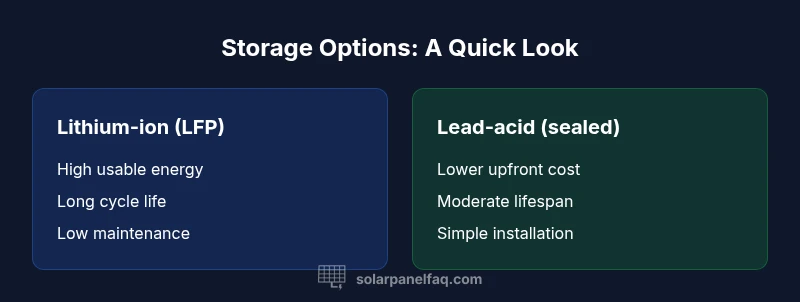
Battery chemistry determines performance, safety, and long-term cost. The main options for home solar storage are lithium-ion (commonly lithium iron phosphate, LFP), sealed lead-acid, and flow batteries. Lithium-ion (LFP) offers high energy density and strong cycle life with relatively low maintenance. Lead-acid is less expensive upfront and can be viable for smaller systems or backups, but has lower usable capacity and shorter lifespan in typical residential use. Flow batteries are modular and scalable, providing robust long-duration storage but at a higher upfront cost and more complex management. Choosing the right chemistry depends on your goals—instant power versus long backups, budget, and local safety considerations.
System sizing: how much storage do you actually need?
Sizing hinges on three core factors: daily energy usage, critical load prioritization, and autonomy goals (how many hours of backup you want during an outage). Start by identifying essential appliances and loads, then estimate your total daily electricity use. Next, decide how many hours of autonomous operation you want during a grid outage, and finally, factor in the inverter capacity and solar production pattern in your location. A practical method is to simulate a typical day with your solar production curve and your essential loads, then round up to account for variability in weather and usage.
Grid-tied storage vs off-grid or hybrid setups
Grid-tied storage systems allow you to store excess solar during the day and draw from the grid at night, often with backup capabilities during outages. Off-grid systems require a larger storage buffer and typically rely on a standalone inverter, battery bank, and sometimes a generator for extended cloudy periods. Hybrid configurations combine solar, storage, and the grid to optimize self-consumption and reliability. Your local utility policies and incentives can significantly influence whether a grid-tied or off-grid approach makes the most sense.
Costs and value: balancing upfront costs with long-term savings
Battery storage costs are driven by chemistry, capacity, and installation complexity. In general terms, expect higher upfront costs for higher energy density and longer lifespans, with potential long-term savings through reduced grid reliance and eligibility for incentives. It’s important to view storage as a lifecycle investment: upfront investment, ongoing maintenance, warranty terms, and the expected lifespan determine total value. Local programs, demand charges, and time-of-use rates can materially affect the financial case for storage.
Safety, warranties, and maintenance considerations
All home storage systems require attention to safety, ventilation, and thermal management. Lithium-ion systems rely on a well-designed battery management system (BMS) and proper enclosure; sealed lead-acid requires venting and regular checks. Flow batteries demand proper containment and monitoring infrastructure. Warranty terms, service availability, and the installer’s credentials are crucial for long-term reliability. A robust monitoring platform helps detect anomalies early and extend the life of the system.
Which storage makes sense for different home profiles
- High daily usage, frequent outages, or a city with tight blackout rules: Lithium-ion (LFP) storage often offers the best blend of performance and reliability.
- Tight budget or small backup needs: Sealed lead-acid can be workable if properly sized and maintained.
- Desire for long-duration backup and modular growth: Flow batteries provide scalable capacity, though with a higher upfront cost and ongoing management needs.
A practical planning checklist to start today
- Gather your last 12 months of electricity usage data. 2) List essential loads to keep on during an outage. 3) Check inverter compatibility with potential storage chemistries. 4) Review local incentives and utility policies. 5) Consult a qualified installer to validate site-specific constraints. 6) Compare warranties, service options, and maintenance needs. 7) Consider future expansion to meet growing energy needs. 8) Choose a system that balances reliability with total cost of ownership.
Feature Comparison
| Feature | Lithium-ion storage (LFP) | Lead-acid storage (sealed) | Flow battery storage |
|---|---|---|---|
| Chemistry | Lithium-ion (LFP) | Sealed lead-acid | Flow battery |
| Usable energy fraction | High usable energy with modern LFP | Lower usable energy due to design limits and aging | Moderate to high usable energy depending on design |
| Cycle life (qualitative) | Long lifespan with regular cycling | Moderate lifespan with tighter duty cycles | Extremely long cycle life with modular growth |
| Maintenance | Low maintenance | Low to moderate maintenance | Moderate maintenance with monitoring needs |
| Inverter compatibility | Standard, broad compatibility | Standard with occasional special requirements | Standard to specialized in some systems |
| Best for | Daily use + backup, space-constrained installs | Budget-conscious backups | Long-duration backups and scalable capacity |
Strengths
- Provides backup power during outages and improves self-consumption
- Quiet operation with no ongoing fuel costs
- Can increase home energy resilience and potential grid stability
- Modular options allow scalable capacity over time
Drawbacks
- Upfront cost can be substantial and varies by chemistry
- Maintenance and monitoring requirements differ by system
- Complex integration may require specialized installers
- Temperature sensitivity can affect performance in extreme climates
Lithium-ion storage (LFP) generally offers the best balance for most homes; flow storage suits long-duration needs, and lead-acid remains viable for budget-conscious, small-scale backups.
For typical homeowners, prioritize capacity that aligns with daily usage and provide a robust warranty. If budget is tight, sealed lead-acid is feasible for smaller setups; for future expansion and longer outages, consider modular flow options.
Frequently Asked Questions
Which solar panel battery storage is best for a grid-tied home with frequent outages?
For grid-tied homes with frequent outages, lithium-ion (LFP) storage often delivers reliable performance and fast response. It balances cost, efficiency, and reliability, while keeping backup power accessible during outages. Always confirm with a local installer about inverter compatibility and safety codes.
For grid-tied homes with outages, lithium-ion storage is typically the best balance of reliability and cost. Check inverter compatibility with your chosen storage and local safety rules.
How does cycle life affect long-term costs?
Cycle life directly influences how often you must replace the battery, affecting long-term ownership cost. Higher cycle life generally means lower replacement frequency, reducing total cost of ownership over time. Consider manufacturer warranties and expected degradation under your usage pattern.
More cycles usually mean longer life and lower replacement costs over time. Check warranties and how performance degrades with use.
What maintenance do sealed lead-acid batteries require?
Sealed lead-acid batteries require less routine maintenance than traditional flooded types but still need periodic checks of charge state and terminal cleanliness. Ensure proper ventilation and follow warranty guidelines. In many homes, a professional inspection every few years is advisable.
Sealed lead-acid needs less upkeep than flooded types, but still benefits from occasional checks. Keep them ventilated and rated for safe operation.
Can I mix different battery types in a single system?
Mixing battery chemistries in a single system is generally not recommended. It can complicate charging control, safety, and warranty terms. If you anticipate growth, plan a cohesive system with a single chemistry or a clearly modular approach approved by the installer.
Don’t mix chemistries in one system. It can complicate control and safety, so stick to one chemistry or coordinate modular additions with a pro.
Is a flow battery practical for residential homes?
Flow batteries offer scalable capacity and long lifespans suitable for long outages or high-need homes, but they typically involve higher upfront costs and more complex systems. They’re best evaluated when future expansion or very long backup is a priority.
Flow batteries are scalable and long-lasting, but cost and complexity are higher. Consider if long backups and growth are critical for you.
What incentives or subsidies apply to home battery storage?
Incentives vary by region and utility. Many programs support solar-plus-storage projects, reducing net costs and speeding payback. An installer can help identify applicable rebates, tax credits, and performance-based incentives in your area.
Check regional programs and utility incentives with a local installer to understand available rebates and credits.
Top Takeaways
- Assess daily energy use before choosing storage
- Match storage chemistry to backup needs and budget
- Plan for future expansion and warranty coverage
- Factor in local incentives and grid policies
- Prioritize safety, maintenance, and monitoring readiness