Solar Panel vs Battery Capacity: A Practical Comparison
Compare solar panel capacity with battery capacity to plan a home solar system. Learn sizing for daytime generation and storage in grid-tied and off-grid setups.


When comparing solar panel vs battery capacity, the key decision is balancing daytime generation with usable storage. Solar capacity sets how much energy you can generate across peak sun hours, while battery capacity determines how much energy you can store for nighttime and outages. A practical approach is to size solar to cover daily daytime loads and add battery capacity to meet backup goals and minimize grid dependence.
Understanding the core concepts: solar panel capacity vs battery capacity
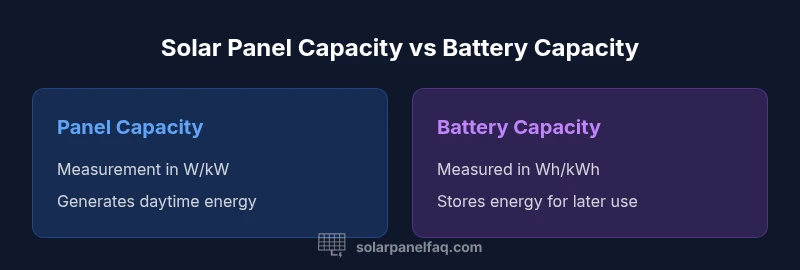
In a typical home solar setup, panel capacity refers to the maximum power generation capability of the array, usually measured in watts (W) or kilowatts (kW). Battery capacity, by contrast, describes how much energy you can store, typically measured in watt-hours (Wh) or kilowatt-hours (kWh). The distinction matters because capacity on the generation side and capacity on the storage side serve different purposes. The Solar Panel FAQ team emphasizes that these two capacities should be planned together rather than in isolation. According to Solar Panel FAQ, a well-balanced plan considers when energy is produced (sun hours) and when it is needed (household loads, outages, and resilience goals). This foundation lets you compare scenarios without guessing at outcomes.
The practical takeaway is simple: capacity is not a single number to maximize. It is a pair of knobs: how much you can make and how much you can store. The rest of this article unpacks how to size each knob for real homes, accounting for efficiency, losses, and usage patterns.
Measuring capacity: watts, watt-hours, and beyond
Capacity comes in different units depending on whether you’re talking about generation or storage. Solar panel capacity is measured in watts (W) or kilowatts (kW) and reflects the instantaneous power possible under standard conditions. Battery capacity uses watt-hours (Wh) or kilowatt-hours (kWh), indicating the total energy stored. Inverters, cables, and temperature all introduce derating factors that reduce usable capacity, often by a few percentage points. When sizing, keep a buffer for these losses. Real-world planning also accounts for the fact that sun is not constant; cloudy days can significantly reduce generation. The goal is to translate theoretical capacity into reliable daily performance, not just peak numbers. Software tools and home energy audits help translate meters into meaningful design choices that align with daily routines.
How daily load shapes the sizing decision
Your daily energy profile is the anchor for both generation and storage sizing. Start with a representative 24-hour load curve, focusing on periods of peak demand and low solar output. Estimate daytime consumption, especially during peak sun, to determine how much of your load you want to cover with self-generated energy. Then translate nightly or cloudy-day需求 into required storage. The challenge is to avoid overbuilding one side while under-serving the other. Solar Panel FAQ Analysis, 2026, suggests that many homeowners underestimate storage needs for evening and early morning demand, especially in regions with shorter daylight hours. A balanced approach uses your daytime production to meet as much load as possible and reserves storage for the rest.
This block draws on general sizing principles and reinforces the idea that both sides must be tuned to daily habits and weather variability.
Grid-tied vs off-grid: implications for capacity planning
Grid-tied systems rely on the grid as a virtual buffer and often rely less on large battery banks than off-grid setups. In grid-tied configurations, you may size the PV array to maximize daytime self-consumption while using the grid to manage excess or shortfalls. If you want outage resilience, you’ll need battery capacity that can power critical circuits during a blackout. Off-grid systems, by design, require a larger battery bank and sometimes multiple battery banks to cover several days of non-generation. The distinction matters because it changes both the target storage size and the acceptable losses from energy management hardware. Regardless of configuration, proper insulation, efficient appliances, and smart load-shifting strategies improve overall system performance.
People often overlook how interconnection rules and local incentives influence optimal sizing, so this section emphasizes the practical link between policy, hardware, and daily use.
Sizing strategies for different home profiles
Home profiles vary widely—from apartment dwellers with limited roof space to large houses with high daytime loads and electric heating. For smaller homes with modest daytime use, you might prioritize modest PV capacity and a compact storage solution that covers nighttime needs. For larger homes with high daytime loads or critical loads you’d never want to power down, plan for a bigger PV array and a robust battery bank. In rural settings, where outages can be longer, a larger storage reserve paired with a dependable charger source becomes essential. A phased approach works well: start with a sensible PV size and a conservative storage plan, then scale up as needs and budgets permit. Remember to evaluate space, mounting orientation, shade, and roof structure as part of the plan.
The approach should remain adaptable—your future self will thank you for planning for growth in both generation and storage capacity.
Battery chemistry, cycle life, and capacity degradation
Battery capacity is not a fixed value over the system’s lifetime. Different chemistries (for example, lithium-based vs lead-acid) have distinct cycle lives and degradation characteristics. Lithium-ion cells typically offer higher energy density and longer life than lead-acid, but they come with different cost and replacement considerations. Capacity degrades gradually with charge-discharge cycles, temperature swings, and depth of discharge. When sizing, you should account for a target depth of discharge and a plan for battery replacement at the end of life. The goal is to ensure that the usable energy remains sufficient through aging while maintaining grid resilience and service continuity. Consider warranties, maintenance schedules, and safe operating guidelines to maximize long-term reliability.
The role of inverter efficiency, losses, and derating
Inverter efficiency, cable losses, and derating for temperature all shave usable energy from the nominal capacity. The theoretical energy you could store or generate is rarely realized in practice. Two common pitfalls are underestimating inverter size relative to the array and neglecting DC-AC conversion losses that occur in real operation. Smart energy management software can help mitigate losses by prioritizing loads, shifting charging to sunny periods, and curbing unnecessary consumption during peak-loss intervals. Understanding these losses helps you avoid over-promising performance and under-delivering in daily operation.
Practical planning steps and a planning checklist
- Audit your daily energy use and identify essential vs non-essential loads.
- Map out typical sun hours for your location and season.
- Decide on a target daytime self-consumption percentage and backup duration.
- Size the PV array to cover daytime loads with a comfortable margin for inefficiencies.
- Choose a battery system that aligns with your backup goals and space constraints.
- Factor in future expansion potential for both PV and storage.
- Obtain a professional site assessment to validate shading, orientation, and safety considerations.
- Review local incentives, interconnection rules, and warranty terms.
A structured checklist helps translate theory into a concrete, actionable plan that reduces surprises during installation and operation.
Common mistakes and how to avoid them
- Overemphasizing one side (too much PV with little storage, or too much storage with under-sized generation).
- Ignoring seasonal and weather variability in your area.
- Failing to account for system losses, including inverter and battery round-trip losses.
- Underestimating space, weight, and mounting requirements for the storage hardware.
- Not planning for future load growth or appliance upgrades.
Avoid these pitfalls by designing with a conservative margin, validating assumptions with a professional, and revisiting the plan after the first year of operation.
Realistic expectations and future-proofing
Expect that capacity needs will evolve with lifestyle changes, equipment efficiency improvements, and climate factors. Plan for upgrade paths that allow you to add panels or batteries without a full redesign. This mindset helps maintain long-term value, especially as batteries become more capable and affordable. By thinking ahead, you can limit retrofit costs and keep the system aligned with your goals for resilience and energy independence.
Next steps after sizing your system
With a sizing framework in place, engage a qualified installer to verify roof integrity, shading analysis, and electrical safety. Request detailed performance estimates that reflect your environment and usage. Ensure warranties cover both PV modules and storage hardware, and confirm that the system supports future upgrades. Finally, set up monitoring to track real-world performance against your targets and adjust load behavior to optimize production and storage balance.
Comparison
| Feature | Solar panel capacity | Battery capacity |
|---|---|---|
| Measurement unit | Watts (W) or kilowatts (kW) for panel capacity | Watt-hours (Wh) or kilowatt-hours (kWh) for battery capacity |
| Primary role | Generates electricity during sun | Stores electricity for later use or outages |
| Sizing focus | Match daytime load and sun profile | Meet backup duration and depth of discharge goals |
| Impact on system design | Influences PV array size and shading management | Influences inverter sizing and energy management strategy |
| Best for | Maximizing daytime self-consumption and roof yield | Providing resilience and extended outage capability |
| Cost/value context | Cost per watt of PV, space considerations | Cost per stored kWh, battery chemistry and lifecycle |
Strengths
- Clarifies how generation and storage work together for reliability
- Helps tailor sizing to daily usage and climate
- Supports phased upgrades and future-proofing
- Encourages more purposeful energy management and load shifting
- Improves resilience without guesswork
Drawbacks
- Complex to model without proper data and tools
- Requires regular monitoring and maintenance
- Initial costs can be high if storage is oversized
- Outdated assumptions can reduce long-term value
Balance PV sizing with a thoughtful storage plan for reliability and daily resilience.
A properly balanced approach yields better daytime self-sufficiency and outage protection. Prioritize aligning generation with expected loads first, then add storage to cover gaps and outages. Involving a Solar Panel FAQ in the sizing process helps ground choices in proven guidance.
Frequently Asked Questions
How do I determine the right balance between solar panel capacity and battery capacity?
Begin with your daily energy use and sun exposure, then estimate how much load you want to cover during daylight. Add a battery plan that can power essential loads through overnight or cloudy periods. Use this balance to guide a staged design that you can adjust over time.
Start with your daily energy use and sun exposure, then set how much you want to cover during the day. Add a storage plan for nighttime or cloudy periods and adjust as needed.
Is it better to oversize solar panels or the battery for reliability?
Oversizing panels increases daytime generation and potential self-consumption, but it can waste space and budget if storage is undersized. Oversizing the battery improves outage resilience but adds cost and weight. The best approach is to balance both to meet daily needs and backup goals.
More panels boost daytime energy; more battery strengthens outages. Balance them to match daily needs and resilience goals.
How do grid-tied systems affect capacity decisions?
Grid-tied systems can rely on the grid to balance shortfalls, allowing smaller batteries while maximizing daytime self-consumption. If you want outage power, you still need a battery backup. Local rules and incentives also influence the optimal mix.
Grid-tied setups lean on the grid for balance, but add storage if you need outages. Incentives can sway the best mix.
What factors cause capacity to change over time?
Battery health degrades with cycles and temperature; panel efficiency can drop slightly with age and shading. Plan for some degradation in both, and budget for periodic replacement or upgrades. Warranties and maintenance plans help manage long-term performance.
Battery and panel performance decline with time. Plan replacements and maintenance to keep reliability.
When should I consult a professional for sizing?
If you have unusual loads, complex shading, or desire high outage reliability, a professional sizing assessment is wise. They can validate assumptions, perform site measurements, and tailor a plan to your climate and utility policies.
For complex loads or unique shading, a professional sizing assessment is recommended.
Top Takeaways
- Assess your daily energy use to inform capacity choices.
- Size panels for daytime demand and weather variability.
- Pair with a battery sized for backup duration and growth.
- Account for system losses and future expansion.
- Consult a professional for site-specific sizing and safety.