How Big Are Solar Panel Batteries? A Practical Guide for Homeowners
Discover how big solar panel batteries are in practice, covering physical footprint, usable capacity, and practical sizing guidance for homeowners evaluating storage options.


How big are solar panel batteries? In residential systems, size refers to both physical footprint and usable capacity. Most home batteries provide roughly 5-20 kilowatt-hours of usable energy, with physical footprints ranging from compact wall-mount units to floor-standing cabinets the size of a small refrigerator. The exact size depends on chemistry, form factor, and expansion options.
Understanding how the question "how big are solar panel batteries" is answered depends on whether you're asking about physical size or energy capacity. For homeowners, size is a dual concept: the physical footprint and the usable storage it provides. According to Solar Panel FAQ, the answer varies widely by technology, form factor, and whether the system is expandable. This article uses practical ranges to help you size your next battery correctly. By the end, you’ll grasp why a 10 kWh battery might take noticeably less space than a 20 kWh system, and how expansion options can influence your installation footprint.
Physical footprint: dimensions, weight, and enclosure options. In most residential installations, the footprint ranges from compact wall-mount modules to floor-standing enclosures. Wall-mount units are popular for tighter spaces, while floor-standing cabinets offer room for future expansion. The footprint is influenced by the energy density of the chemistry and the number of modules in the stack. For homeowners evaluating space, a useful rule of thumb is to compare the footprint to common household appliances and plan access for maintenance and cooling.
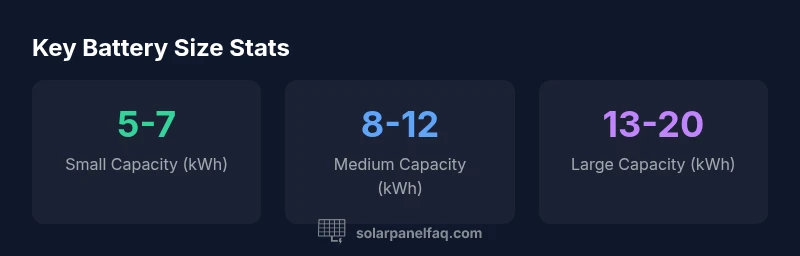
Usable energy capacity: what 5–20 kWh means for daily use. The usable capacity determines how long you can run essential loads without grid power. A smaller system (5–7 kWh usable) suits daily backup for a few critical circuits, whereas larger packs (13–20 kWh) support longer autonomy or higher daily usage. Realistic sizing also depends on your household electricity profile, inverter sizing, and what you count as ‘essential loads.’ For context, a higher-kWh system generally requires more installation space, but advances in chemistry and modularity help compress footprints when multiple modules are stacked.
How chemistry and form factor affect size. Different chemistries (for example, lithium-ion variants) offer different energy densities, which means the same usable kWh can occupy different physical volumes. Form factors — whether the system is modular and expandable or a single integrated unit — also play a big role. If you anticipate growth, modular systems can minimize upfront footprint and allow you to add capacity incrementally without replacing the whole unit.
Estimating space for your home: a simple sizing method. Start by listing your essential loads and typical daily usage. Then select a target autonomy (for instance, aiming to cover 1 day of essential use). Convert that to kWh, compare against common small, medium, and large size classes, and observe the footprint implications. Remember to factor in ventilation and clearance around the unit for cooling and service access. The goal is a balance between usable capacity and a footprint you can accommodate.
Case studies: small, medium, and large residential setups. A small system might rely on 5–7 kWh usable capacity with a compact footprint suitable for apartments or tight spaces. A medium system (8–12 kWh) commonly fits in a floor-standing cabinet that occupies a modest footprint but allows some expansion. Large systems (13–20 kWh) are typically floor-standing or multi-cabinet configurations designed for homes with higher energy use or longer outages. Each scenario highlights how capacity and footprint scale together and why modular options often matter.
Modular vs integrated systems: choosing what fits. Modular designs add capacity without heavy up-front space penalties. They enable staged installation and easier maintenance, while integrated systems may offer a cleaner look but less future scalability. Consider your roof orientation, export limits, and electrical room when deciding. A modular approach often yields a better balance of space, cost, and resilience over the product life cycle.
Battery size classes and rough footprints
| Size Class | Usable Capacity (kWh) | Estimated Footprint (rough) | Notes |
|---|---|---|---|
| Small | 5-7 | Compact wall-mount | Good for basic backups |
| Medium | 8-12 | Floor-standing cabinet | Balanced footprint and capacity |
| Large | 13-20 | Larger floor unit | Room for expansion |
Frequently Asked Questions
What is meant by the size of a solar panel battery?
Size refers to both physical dimensions and usable capacity. A battery's footprint affects where it can be installed, while its kWh rating determines how long it can power essential loads. Both factors should be considered when sizing for your home.
Size is about how much space the battery takes and how much energy it stores, so you can plan where it fits and how long it will last.
How much space does a typical residential storage system require?
Residential systems vary widely, but most setups are designed to fit within a closet, garage corner, or utility room. If space is tight, consider modular units that can be expanded as your needs grow.
Most homes fit a cabinet in a garage or utility room, with modular options if you need more later.
Does larger capacity always mean a bigger physical size?
Not always. Advances in chemistry can increase energy density, allowing more usable energy in a smaller package. However, larger capacity generally means more modules and floor space.
Sometimes bigger energy storage fits into a smaller footprint thanks to better chemistry, but more energy usually means more space.
Are modular systems worth the extra management hassle?
Modular systems offer flexibility to add capacity later and can reduce upfront space. They often simplify expansion and maintenance, though they may require more planning at initial installation.
Modular systems are flexible and scalable, making future upgrades easier and sometimes more space-efficient.
What factors besides size affect installation?
Ventilation, cooling, electrical clearances, and local codes all influence installation. A larger unit may need more space for airflow and accessibility, while location may impact electrical routes and permitting.
Cooling, ventilation, and codes play big roles in where you put the battery.
“Sizing a home battery is about aligning daily energy needs with available space, not chasing the biggest unit. Don’t forget expandability and cooling in your design.”
Top Takeaways
- Size means both footprint and usable energy.
- Expect 5–20 kWh usable capacity for residential storage.
- Modular systems offer scalable space efficiency.
- Plan for cooling and maintenance access in your footprint.