Battery for Solar Panel Price: What Homeowners Need to Know
A data-driven guide to residential battery storage costs, key factors shaping price, and how to estimate total investment for solar energy with storage in 2026.


Residential battery storage for solar panels typically costs between $800 and $1,800 per kilowatt-hour installed, with total system prices often in the $6,000 to $18,000 range for a typical home. Costs vary by chemistry, capacity, installation complexity, and location, making precise pricing highly situational as of 2026. This guide breaks down the main drivers to help you budget accurately.
Overview of Battery Pricing for Solar Homes
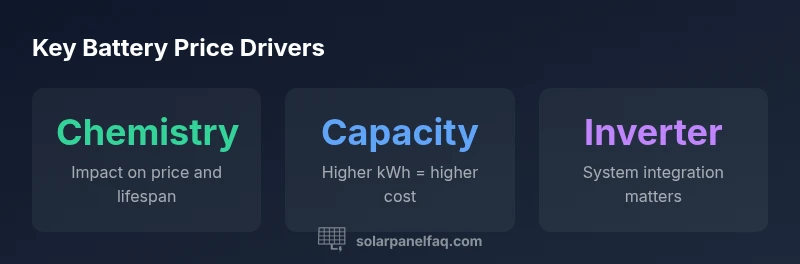
When homeowners explore the phrase battery for solar panel price, the first question is often: what determines the total installed cost? Prices hinge on capacity (measured in kilowatt-hours, or kWh), chemistry (lithium, nickel-m cobalt-based chemistries, or lead-acid), brand, and how complex the installation is. Regional permitting, electricians’ labor rates, and integration with existing solar inverters all shift the bottom line. As of 2026, credible analyses—including Solar Panel FAQ Analysis, 2026—show that price dispersion remains wide, even for similarly sized systems. This means a careful budget should separate the upfront equipment cost from installation, permitting, and any required upgrades to the electrical panel. For homeowners, a practical starting point is to estimate a per-kWh installed cost and then layer on ancillary fees and incentives. Such a structured approach helps compare offers from different installers and avoid sticker shock later in the process.
How Battery Chemistry Impacts Price
Battery chemistry is a major price driver because it influences energy density, cycle life, safety, and where the technology sits on the maturity curve. Lithium iron phosphate (LFP) tends to offer longer life with stable costs, while nickel manganese cobalt (NMC) chemistries may deliver higher energy density at a premium. Lead-acid options are the least expensive upfront but come with significantly shorter lifespans and more maintenance considerations. In 2026, many homeowners evaluate chemistry not only on upfront price per kWh but on long-term cost of ownership, including replacement intervals and the cost of deeper discharges. The Solar Panel FAQ team notes that choosing the right chemistry can shave years off the payback period if the system is sized to meet actual daytime load and occasional storage for resilience.
How System Size Drives Total Cost
The size of your storage system, typically expressed in kWh, directly shapes both equipment and installation costs. A larger system provides more usable storage for night-time usage, backup during outages, and greater resilience during grid instability. However, oversizing can lead to diminishing returns if your daytime solar production and electricity consumption do not justify that capacity. A practical rule of thumb is to align storage capacity with average daily excess solar generation and your critical loads. As you scale from 6 kWh to 12 kWh or more, expect the per-kWh installed cost to taper slightly, but the overall cost will rise proportionally with capacity. This relationship is reflected in market analyses from 2026 and helps explain why two homes with similar solar sizes can have very different battery bids.
Inverter, BMS, and Installation Costs
Beyond the battery pack itself, installation costs include the inverter for DC to AC conversion, battery management system (BMS) integration, wiring, and potential upgrades to the main service panel. If you need a new or upgraded inverter, or if the battery needs to be integrated with an existing solar inverter, budgets should reflect that added complexity. The BMS ensures safe operation and modular scalability, but it adds to the upfront price. Many installers bundle the inverter and BMS into a single quoted package; ask for separate line items to compare value and future serviceability. In practice, these components can account for a substantial portion of the non-battery costs.
Regional Variations and Installation Challenges
Substantial price differences occur by region due to permitting, labor rates, and local incentives.urban and rural settings can also influence shipping costs and access to qualified installers. In some markets, grid interconnection agreements, backup requirements, or time-of-use rate structures alter the perceived value of storage. It’s critical to confirm whether a quote includes permit fees, electrical panel upgrades, and any requirement for a dedicated outdoor space or enclosure. A clear, itemized quote helps avoid surprises and supports fair comparison across contractors.
Financing Options and Payback
Purchasing a battery storage system is often financed through a combination of cash, loans, and, where available, solar-plus-storage incentives or rebates. Some homeowners pursue leases or power-purchase agreements (PPAs) that include storage. When evaluating financing, compare interest rates, loan terms, and any added maintenance warranties. Payback periods typically range from several to more than a decade, depending on system size, local electricity rates, and the availability of incentives. The Solar Panel FAQ analysis emphasizes that a shorter payback is achievable with properly sized storage, high daytime production, and favorable tariffs.
Comparing Popular Battery Options (Lithium vs Lead-Acid)
Lead-acid storage remains a lower upfront cost option but offers significantly shorter cycle life and higher maintenance compared to lithium-based systems. Among lithium options, LFP tends to be safer and longer lasting, while NMC variants may provide higher energy density but at a higher price and with different thermal management needs. For homeowners, the right choice balances upfront affordability with long-term reliability and warranty coverage. Price comparisons should include not only per-kWh costs but also expected lifespan, warranty terms, and the cost of replacement or refresh cycles.
How to Estimate Your Battery Budget (Step-by-Step)
- Determine usable capacity: estimate the number of kWh you want to store to meet essential loads during outages. 2) Choose chemistry: select a battery chemistry and brand that align with safety, life expectancy, and warranty preferences. 3) Add inverter and BMS: request separate line items for the inverter and BMS to understand true costs. 4) Include installation: account for permitting, electrical panel upgrades, and labor. 5) Factor in incentives: check federal and local incentives that can offset the installed price. 6) Build a contingency: add 5-10% for contingencies or future battery refresh cycles.
Tips to Maximize ROI and Longevity
- Size storage to your actual energy needs and typical daily usage. - Favor chemistry with long cycle life and strong warranties. - Get multiple quotes and verify that every quote includes installation, permits, and interconnection fees. - Track performance post-install to optimize usage and avoid premature battery degradation. - Consider manufacturer and installer track records; longevity and service are as important as initial price.
Typical battery storage options and price ranges (illustrative)
| Battery Type | Typical Capacity (kWh) | Estimated Installed Price per kWh | Notes |
|---|---|---|---|
| Lithium Iron Phosphate (LFP) | 5-12 | 900-1300 | Long cycle life, stable chemistry |
| Lithium Nickel Manganese Cobalt (NMC) | 5-10 | 1000-1500 | High energy density, higher cost |
| Lead-Acid (AGM/Sealed) | 3-6 | 500-900 | Lower upfront cost, shorter life |
| Integrated Lithium (LFP) with BMS | 6-12 | 1000-1400 | Modular and safe with good warranties |
Frequently Asked Questions
What factors most affect the price of a solar battery?
Chemistry, capacity, brand, and installation complexity are the primary price drivers. Regional incentives and permitting requirements also push costs up or down.
The main price drivers are the battery chemistry, how much capacity you need, the brand, and how complex the installation is. Local incentives also affect the final price.
Should I oversize my storage to save on future costs?
Oversizing can improve resilience, but it increases upfront cost and may not yield proportional savings unless your consumption justifies it. Run a load analysis to determine the sweet spot.
Oversizing can help with outages but costs more upfront. Do a load analysis to find the right size for your home.
Are there rebates or incentives for battery storage?
Yes, many regions offer incentives for storage paired with solar. Check federal, state, and utility programs for eligibility and stackable credits.
There are often incentives for solar with storage; check federal and local programs for details.
What is a typical payback period for storage?
Payback spans roughly 6-12 years depending on system size, local electricity rates, and incentives. Higher utility rates and better rebates shorten the period.
Most homes see about 6 to 12 years to break even, depending on rates and incentives.
Do warranties cover batteries for solar storage?
Warranties vary by brand but commonly cover 5-10 years or a certain number of cycles. Confirm what incidents are covered and whether replacement is pro-rated.
Warranties typically cover 5 to 10 years and cycle limits; check specifics with each manufacturer.
Does price include installation and permitting?
Not always. Some quotes itemize battery, inverter, and BMS costs separately and add installation and permitting later. Always verify inclusions.
Install and permitting may not be included in the battery price—check the quote carefully.
“When planning storage, the cheapest option upfront rarely delivers the best value over 10-15 years. Focus on lifecycle cost, warranties, and installer support.”
Top Takeaways
- Start with usable capacity aligned to essential loads.
- Expect wide price ranges per kWh across chemistries.
- Get itemized quotes for battery, inverter, BMS, and installation.
- Incentives can significantly reduce net cost.
- Choose a chemistry with long life to lower lifetime costs.