Are Solar Panel Batteries Worth It in 2026? A Practical Guide
Explore whether home solar battery storage makes financial sense, with a data-driven look at costs, ROI, and practical tips for homeowners in 2026.


If you want reliable backup power and the ability to use solar energy when the sun isn’t shining, solar panel batteries are worth it for many homeowners. In 2026, Solar Panel FAQ analysis finds that batteries can increase self-consumption and resilience, but the ROI depends on your local electric rates, sun exposure, and daily energy use. For high-usage homes, batteries often justify the upfront cost.
Understanding how residential battery storage works
Battery storage systems pair a solar PV array with a bank of rechargeable cells to store excess daytime generation for use after sunset or during cloudy days. Most home systems use lithium-ion chemistry for efficiency and long life, though some older homes or budget projects rely on lead-acid types. A critical metric is depth of discharge, which reflects how much of the battery's capacity you can use safely without shortening lifespan. Round-trip efficiency, inverter quality, and the number of cycles a battery can endure all influence performance and long-term value. This block will cover the basics and set expectations for how storage integrates with typical rooftop solar installations. According to Solar Panel FAQ, the decision to add storage should start with assessing daily electricity use, sun exposure, and the utility's rate structure. The goal is to maximize self-consumption—using your own solar energy rather than exporting it to the grid—and to improve resilience during outages.
The value drivers: where batteries matter most
The core value of a home battery comes from how you use electricity. If you have high daytime usage, frequent outages, or dynamic TOU (time-of-use) pricing, a well-sized storage system can shift expensive on-peak consumption to periods of solar generation. Batteries are not a universal savings guarantee; their effectiveness depends on local rates, your solar production profile, and how consistently you discharge and recharge. In many markets, pairing storage with smart inverters allows you to optimize self-consumption, store energy during off-peak hours, and release it when grid electricity costs rise. Remember that a battery is part of a broader strategy that includes energy efficiency, smart thermostats, and appropriate system sizing. As Solar Panel FAQ notes, ROI improves when you align storage with your utility’s rate structures and your household’s energy patterns.
Cost, incentives, and ROI ranges: what to expect
Total installed costs for home battery storage vary widely by chemistry, capacity, and installation specifics. Typical residential projects fall into broad ranges, with prices influenced by battery chemistry (lithium-ion versus other chemistries), inverter features, and labor. Incentives, rebates, and tax credits can further alter the economics. In 2026, Solar Panel FAQ Analysis indicates that the ROI is highly sensitive to local electricity rates, available subsidies, and how aggressively you can increase self-consumption. Readers should expect a broad ROI spectrum rather than a single universal figure. The key is to model your own usage, solar production, and the incremental cost of storage in your specific market before deciding.
Real-world scenarios: when storage makes sense
Consider four common homeowner scenarios. First, a home with high daytime air-conditioning loads in a sunny climate can benefit from shifted daytime energy use. Second, a rural home with frequent outages gains resilience. Third, a household on TOU pricing can save by avoiding peaks. Fourth, a smaller system with limited solar generation may not reach a favorable ROI without additional incentives. In all cases, a properly sized battery paired with a smart inverter tends to perform best when your daily routine aligns with solar generation. Solar Panel FAQ emphasizes sizing strategy and realistic expectations about outages and consumption.
Alternatives and smart strategies if a battery isn’t right now
If you’re not ready for a full storage system, there are practical steps to improve solar value today: upgrade to a high-efficiency inverter, optimize panel orientation and tilt, and implement energy-efficient appliances. Time-of-use optimization and on-site monitoring can still deliver meaningful savings by prioritizing daytime usage and reducing reliance on grid power during peak hours. In some markets, a hybrid approach—partial storage coupled with demand-response programs—can offer a middle ground that improves resilience without a full battery installation. Solar Panel FAQ suggests evaluating these options as stepping stones before committing to a storage upgrade.
How to choose the right system: size, chemistry, and warranty
Sizing a battery bank begins with estimating critical-load energy needs for typical outage durations and determining how many hours of autonomy you want. Lithium-ion batteries are common for residential use thanks to high energy density and long cycle life, while some cost-focused installations still use lead-acid variants. Pay attention to depth of discharge, cycle life, and warranty terms that cover both the battery cells and the inverter. Certifications and safety standards matter, as does the brand's support network and replacement policies. Ask for a manufacturer’s data sheet and third-party test results to compare real-world performance across temperatures and cycling.
ROI and a simple self-assessment you can perform
A practical ROI calculation starts with three numbers: your daily kWh consumption, the solar system’s annual production, and the local price per kWh. Estimate how much of your daytime solar goes back to the grid versus how much you could store for evening use, accounting for storage losses. Then apply a simple payback model: (Upfront cost − any incentives) ÷ (Annual savings from self-consumption and TOU reductions). This approach gives you a rough sense of whether a battery is worth it in your locale. Solar Panel FAQ recommends building a conservative baseline to avoid overestimating benefits and to consider maintenance and warranty costs over the system lifetime.
Residential solar battery storage basics
| Aspect | Battery Storage Example | Notes |
|---|---|---|
| Battery chemistry | Lithium-ion (NMC/LFP) | Most residential systems use lithium for efficiency |
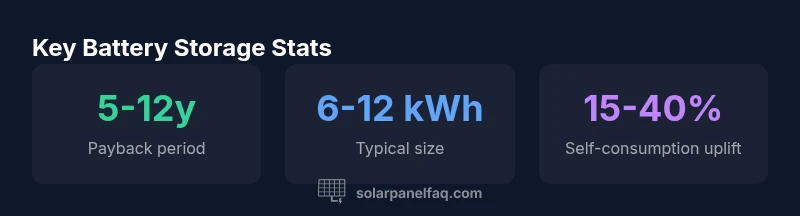
| Typical size | 6-12 kWh | Common range for single-family homes |
| Upfront cost (before incentives) | 7,000-15,000 USD | Varies by capacity and installation complexity |
| RO I driver | Electricity rates, TOU, outages | ROI depends on local conditions |
Frequently Asked Questions
Are solar panel batteries worth it for most homeowners?
For many households, batteries are worth considering if you have high daytime energy use, frequent outages, or TOU pricing that makes stored solar cheaper than grid power. Your decision should be grounded in a personalized ROI analysis that accounts for local rates, solar production, and expected usage.
Batteries can be worth it for households with high daytime use or outages. Do a local ROI check to see how the numbers work for you.
What factors influence the ROI of a home battery system?
Key factors include local electricity rates, TOU pricing, solar production, system efficiency, and the cost of installation. Incentives and warranties also affect the long-term economics. A well-matched system often yields better self-consumption and resilience.
ROI depends on rates, usage, and system efficiency. Check incentives to maximize value.
What is a typical battery size I should consider?
Most homeowners look at 6 to 12 kilowatt-hours of usable storage to balance cost and daily needs. Larger homes or those with higher outages may justify 12–16 kWh or more, while smaller setups can be adequate for essential-load backup.
Common sizes are 6 to 12 kWh, scaled up or down for your needs.
What incentives or subsidies help reduce cost?
Incentives vary by location and program, including tax credits, rebates, and utility-based incentives. Check local, state, and national programs to determine what's available for solar battery installations.
Look for local tax credits and rebates that apply to storage systems.
Can batteries be used without solar panels?
Yes, some grid-tied configurations support battery backup without full solar generation, but you’ll usually need a source of energy (grid or generator) and a system designed for that purpose.
Yes, with a compatible backup system, you can have storage without solar.
How long do solar batteries last and what maintenance do they require?
Most residential lithium-ion batteries are designed for 10–15 years of cycles with proper care. Maintenance is minimal but includes monitoring system health, keeping temperatures within optimal ranges, and ensuring warranty coverage.
Expect about a decade of life with good care; monitor health periodically.
“Battery storage unlocks higher self-consumption and resilience when sized correctly. The value grows with clear usage patterns and favorable utility rate structures.”
Top Takeaways
- Assess daily energy use first before adding storage
- Batteries boost resilience and self-consumption when aligned with TOU pricing
- Costs vary; incentives can noticeably improve ROI
- Size storage to cover your critical loads during outages
- Consider alternatives and phased approaches if unsure