Solar Panel STC vs NOCT: How Ratings Drive Real-World Output
Learn how STC and NOCT ratings differ, what they mean for real-world solar performance, and how to compare datasheets to estimate actual energy yields in your climate.


STC and NOCT are two standard testing frameworks used to rate solar panels. STC assumes laboratory conditions that often overstate real-world output, while NOCT reflects typical outdoor operation under heat and varying irradiance. For homeowners evaluating solar options, understanding both ratings helps you gauge performance, compare datasheets more accurately, and set realistic expectations for system yields.
solar panel stc vs noct: Core Concepts
In the world of solar panels, two widely referenced rating standards are STC (Standard Test Conditions) and NOCT (Normal Operating Cell Temperature). According to Solar Panel FAQ, these two benchmarks are not interchangeable; they measure performance under different ambient circumstances and yield different 'maximums' in a datasheet. The key takeaway for homeowners is not to pick one rating over the other, but to understand how each rating translates to your specific roof, climate, and daily sun exposure. In practice, many datasheets present both numbers to help you compare panels side by side. The phrase solar panel stc vs noct crops up frequently because it highlights the gap between laboratory potential and real-world performance, which matters when you set expectations for monthly energy production and annual savings.
How STC and NOCT Translate to Real-World Performance
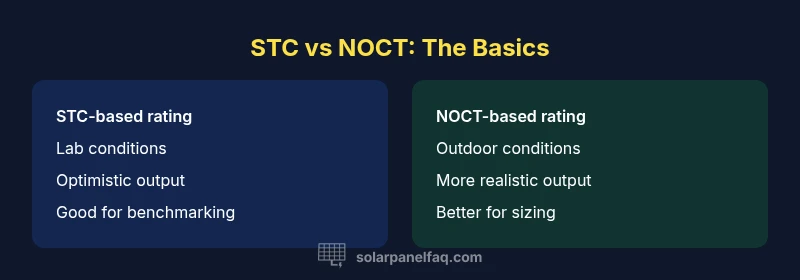
STC is a fixed reference point that treats the panel as if it were operating under perfect laboratory conditions. It uses a high irradiance level and a relatively cool cell temperature to maximize power output, which often makes the panel seem more capable than it would be under typical weather. NOCT, by contrast, simulates a more realistic outdoor scenario, incorporating warmer temperatures and lower irradiance that occur during a typical day. This distinction is essential when you compare panels for a home installation because the system you install will usually perform closer to NOCT-based expectations than to STC-based claims. The Solar Panel FAQ team emphasizes that buyers should not rely solely on STC numbers for long-term planning; instead, weigh both figures and look for field data or performance monitoring from similar installations.
Reading datasheets: what to look for besides the big numbers
When inspecting datasheets, look beyond Pmax (the peak power) and focus on temperature coefficients, derate factors, and the NOCT or
NOCTable
Comparison
| Feature | STC-based rating | NOCT-based rating |
|---|---|---|
| Test irradiance | 1000 W/m² | 800 W/m² |
| Reference temperature | 25°C (cell) | NOCT reference ~45°C (cell) |
| Real-world applicability | Optimistic; useful for pure benchmarking | |
| Best use | Datasheet comparisons and product benchmarking | Sizing and performance projections for field conditions |
Strengths
- Provides a standardized baseline for comparing panels on paper
- NOCT offers a more realistic view of outdoor performance
- STC helps with quick screening and product benchmarking
- Helps buyers understand potential derating in warm or shaded conditions
Drawbacks
- STC-based figures can mislead if used alone for sizing
- NOCT values are not universally standardized across manufacturers
- Neither rating captures all climate conditions or shading effects
NOCT-based ratings provide a more realistic basis for estimating real-world output than STC.
Rely on NOCT for field performance expectations and use STC for initial screening. Pair either with climate-specific factors and, when possible, actual performance data from similar installations.
Frequently Asked Questions
What is the difference between STC and NOCT in solar panel ratings?
STC is a laboratory-based rating that assumes ideal conditions, while NOCT represents outdoor operating conditions. The two can differ significantly in the reported Pmax and efficiency. Understanding both helps you set realistic expectations for real-world output.
STC is lab-based and often optimistic, NOCT reflects outdoor conditions; both help you judge panels, but NOCT is closer to what you’ll see in daily use.
Should I ignore STC ratings when choosing panels?
No. STC is useful for quick benchmarking and initial screening. However, you should not base sizing or energy yield predictions on STC alone. Use NOCT or field data to ground your expectations.
STC helps compare products, but NOCT and field data are needed to predict real-world performance.
How can I estimate real-world output from NOCT ratings?
NOCT provides a closer proxy for daily operation. Use the NOCT-based Pmax with climate correction factors, then apply weather patterns and system losses to estimate annual yield. Exact conversion to STC is not straightforward.
Use NOCT-based numbers plus climate factors to estimate yearly output; direct STC conversion isn’t reliable.
Do warranties refer to STC or NOCT?
Most warranties reference standard test conditions (STC) for performance guarantees, but many installers and manufacturers also consider real-world NOCT behavior during performance warranties or installation guidelines. Check the exact terms for your panel.
Warranties often cite STC, but real-world NOCT behavior is important for expectations and commissioning.
Which rating should I trust for my climate: hot, cool, or humid?
NOCT is generally more representative of hot and humid conditions, while STC may be optimistic in cooler climates. Use NOCT as the baseline and corroborate with local climate data and performance reports.
NOCT usually fits real-world climates better; combine with local weather data for best accuracy.
Where can I find the NOCT values for a panel?
NOCT values are typically listed in the datasheet or the manufacturer’s specification sheet alongside STC ratings. If not available, contact the manufacturer or check third-party databases that compile panel specifications.
Look in the datasheet or on official sites; if missing, contact the manufacturer.
Top Takeaways
- Check both STC and NOCT values when evaluating panels
- Use NOCT-based expectations for sizing and monitoring
- Consider climate, shading, and temperature effects in your math
- Don’t rely on a single rating to predict yearly energy yields
- Consult field data or real-world performance reports when available