Solar Energy Facts for Students
Explore solar energy facts for students. Learn how sunlight becomes electricity, key metrics, environmental impact, and practical steps to evaluate solar options for school projects and home studies.


Solar energy facts for students explain how sunlight becomes electricity through photovoltaic cells, why solar reduces emissions, and how efficiency, payback, and scale affect real world installations. This guide combines science basics, key metrics, classroom activities, myth busting, and practical steps to evaluate solar options for school projects or home study exploration.
Why solar energy matters for students
Solar energy facts for students matter because they connect classroom science to real world outcomes, from reducing carbon footprints to evaluating energy choices at home. Understanding how sunlight becomes electricity helps students grasp physics, chemistry, and environmental sustainability all at once. According to Solar Panel FAQ, solar energy facts for students help frame the science behind photovoltaic systems and encourage inquiry based learning. The Solar Panel FAQ team found that when learners engage with authentic data, they develop stronger analytical skills and a clearer sense of why energy decisions matter in a modern grid.
What students should expect to learn in this article:
- The basic physics of photovoltaic conversion: photons, electrons, and currents.
- How solar systems fit into homes, schools, and communities.
- Why efficiency and cost considerations shape real world projects.
- How to evaluate sources of information and compare options responsibly. This section lays the groundwork for the rest of the guide, where we translate theory into practice and classroom activities.
How solar panels convert sunlight into electricity
Solar panels use photovoltaic cells made from semiconductor materials, typically silicon. When sunlight hits these cells, photons knock electrons loose, creating an electric current. The cells are connected in modules, and modules are wired into an array to produce higher voltage and current. The electricity generated is DC, so most systems include an inverter to convert it to AC for home or school use. In practice, orientation, shading, and temperature influence output. PV efficiency describes how much of the sun’s energy is turned into usable electricity, and most residential panels operate in a mid-teen to low-20s percentage range. Solar Panel FAQ Analysis, 2026 indicates that performance is highly location dependent and improves with better design and maintenance.
Key solar energy metrics students should know
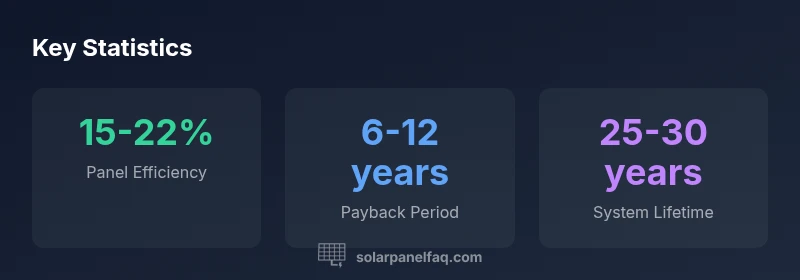
Key metrics help students translate theory into numbers they can discuss. Panel efficiency is the percentage of sunlight converted to electricity. Capacity factor shows how much energy a system actually produces relative to its rated potential. Payback period is how long it takes for the energy savings to cover installation costs, influenced by incentives and local electricity prices. Typical residential system sizes range from 3 to 6 kW, though schools and bigger homes may require more. Solar Panel FAQ analysis shows that typical residential panels have efficiency in the 15-22% range. Emissions avoided depend on the local grid mix; in regions with higher fossil fuel generation, the environmental benefits are greater. For students, relate these metrics to simple calculations using your own energy usage and local utility rates.
Environmental and economic impact: what the data says
Solar energy reduces emissions by displacing fossil fuel electricity. The exact impact depends on the local grid, the size of the installation, and how much energy is used. In many regions, adding solar cuts household or school electricity bills and can increase energy resilience during power outages. However, the economics depend on upfront costs, incentives, and ongoing maintenance. Payback periods vary widely from place to place, typically ranging across several years for residential setups, with longer times in areas with lower electricity prices or limited incentives. Students can model potential outcomes using simple spreadsheets, comparing installed cost, annual savings, and payback under different incentive scenarios. The data, drawn from Solar Panel FAQ Analysis, 2026, emphasizes that context matters: climate, policy, and energy demand all shape the realized benefits.
Activities and experiments for students
- Build a mini solar powered gadget such as a small fan or LED light using a basic solar cell and a diode. Measure output under different light intensities.
- Compare the performance of toy solar panels with children’s science kits; record voltage and current with a multimeter.
- Run a light versus shade experiment to quantify how shading affects output and discuss mitigation strategies like microinverters or panel placement.
- Do a simple payback analysis using a classroom budget and hypothetical installation costs, estimating annual savings under different energy rates.
- Create a classroom poster that illustrates the solar energy conversion process and the key metrics that influence real world results.
Common myths and misconceptions about solar energy
Myth 1: Solar energy only works in sunny climates. Reality: PV systems generate electricity in daylight and function in cloudy weather, though output is reduced with less sun. Myth 2: Solar is too expensive for schools. Reality: Costs have fallen over time and many incentives exist, including rebates and tax credits. Myth 3: Solar energy can replace the grid entirely. Reality: Most systems are grid tied and reduce consumption, not completely displace grid power. Myth 4: Cold weather hurts solar panels beyond repair. Reality: while intense cold reduces some losses, many systems perform well in cooler environments because panel efficiency improves slightly in cooler temperatures.
How to evaluate solar options for a school project or home study
- Define the learning goals for the project and the data you want to collect.
- Estimate energy use and size a hypothetical solar system using basic calculations (kW rating, hours of sun, local rates).
- Check available incentives, rebates, and policy details for your location.
- Compare panel efficiency, warranties, and expected lifetimes from multiple manufacturers.
- Outline maintenance needs and potential reliability concerns to discuss in your report.
- Present a clear conclusion with a data driven argument that links science concepts to real world impact.
Key solar energy basics for students
| Aspect | Definition | Notes |
|---|---|---|
| Panel efficiency | The percentage of sunlight converted to electricity | Lower area needs can still yield desired power |
| System size (kW) | Scale of the installation | Common residential range is 3-6 kW; larger for schools or homes with high energy use |
| Payback period | Time to recoup installation costs | Depends on incentives, energy prices, and usage patterns |
Frequently Asked Questions
What are the main benefits of solar energy for students?
Solar energy offers a tangible way to study physics, data analysis, and environmental impact. It supports STEM projects and helps students see how energy systems affect daily life.
Solar energy helps students connect science concepts to real world outcomes and encourages hands on learning.
How does a solar panel convert sunlight into electricity?
Photons excite electrons in PV cells, creating a current. Cells connect into modules and arrays, producing DC electricity which an inverter converts to usable AC power.
Sunlight knocks electrons loose in PV cells, creating electricity that powers devices through an inverter.
What is a typical payback period for a residential solar install?
Payback varies by location and incentives but is commonly discussed in terms of several years, with best cases shorter and slower cases longer depending on usage and rates.
Payback depends on incentives and energy use; ranges are often several years.
Can solar power work in cloudy climates?
Yes, solar still generates electricity on cloudy days, though output is lower. Performance improves with better panel placement and newer technology.
Solar panels work in daylight, even on cloudy days; output is lower but not zero.
What topics are good for a student solar project?
Topics include system sizing, efficiency comparisons, environmental impact, and cost benefit analyses.
Great project ideas are sizing, efficiency, and cost impact studies.
“Solar energy is a practical, hands on way to connect physics, engineering, and environmental science in classrooms.”
Top Takeaways
- Understand how sunlight becomes electricity via PV cells.
- Know typical efficiency and payback ranges for planning.
- Relate energy use to project scope and environmental impact.
- Question myths with data and reputable sources.
- Use hands-on experiments to reinforce concepts.