How to Charge Solar Panel Without Sunlight: A Practical Guide
Learn practical strategies to keep a solar power system prepared when daylight is scarce. This guide covers energy storage, alternative charging sources, safety, and maintenance for homeowners seeking reliable solar performance even on cloudy days.


You can’t actively charge a solar panel in total darkness, because solar cells generate electricity only when exposed to light. In practice, you maintain power by charging a battery bank or supercapacitors from daylight or an alternate energy source, then using that stored energy during cloudy days or at night. Efficient energy management and correct storage sizing are key when sunlight is scarce.
How to charge solar panel without sunlight: practical realities
In many homes, residents face days or weeks with limited sun. The core concept behind how to charge solar panel without sunlight hinges on energy storage and smart load management. According to Solar Panel FAQ, the most reliable approach is to size a robust battery bank and ensure it can be charged from daylight or an alternate energy source, then draw from that stored energy when sunlight is unavailable. The goal is not to conjure energy from darkness, but to shift the timing of energy production and consumption so your home remains powered during extended no-sun periods. This requires accurate load forecasting, storage sizing, and a plan for backup charging. By thinking in terms of stored energy you can keep lights, refrigeration, and essential circuits running even when the sky is gray.
The role of energy storage in no-sun scenarios
Energy storage acts as the bridge between daylight and darkness. A well-designed battery bank absorbs excess daytime energy and delivers it when the sun isn’t shining. For homeowners, the key considerations are capacity (how much energy you need to store) and depth of discharge (how much energy you can safely use before recharging). Solar Panel FAQ analysis shows that the right balance minimizes battery wear while maximizing usable energy. Using storage also smooths out fluctuations from cloudy periods, reducing the risk of sudden power drops. In practice, a daytime surplus can significantly ease night-time demands, but only if the storage size and health of the batteries are appropriate for the expected load.
Alternative charging sources when sun is scarce
If daylight is unavailable, you can recharge storage using another power source. Options include tying into the grid when permitted, or using a generator as a temporary charging source. When integrating these sources, a managed charging approach is essential: never feed unregulated power into a battery bank, always go through a charge controller and proper isolation. This ensures safety and protects both the storage and the solar array. For off-grid setups, a generator can be scheduled to replenish batteries during predictable low-sun days, keeping your day-to-day energy demands met without interrupting solar operation when sun returns.
Battery sizing for cloudy days
Sizing a battery bank means estimating your critical loads and creating a buffer for days with limited sun. Start by listing essential appliances and their wattage, then determine how many hours you need to sustain them without solar input. A conservative approach is to select a bank that can cover at least one full night of operation for critical devices. Avoid over-sizing beyond practical needs to prevent excessive upfront cost. Regularly reassess your loads and update the storage capacity as family size, appliance efficiency, and climate patterns change. The balance between reliability and cost hinges on realistic usage data and proper health-check routines.
Charge controllers and safe wiring for no-sun charging
A charge controller is essential whenever you’re charging storage from any source other than the solar array itself. MPPT controllers optimize charging efficiency, while PWM controllers are simpler and more economical. The wiring topology should keep the battery bank isolated from the solar array during non-sun charging to prevent backflow and potential damage. Use appropriate gauge cables, proper fusing, and weatherproof enclosures for outdoor installations. Documentation and labeling help prevent mistakes during maintenance. If you’re unsure about connections, consult a qualified installer to avoid safety hazards and equipment damage.
Step-by-step: setting up your off-sun charging system
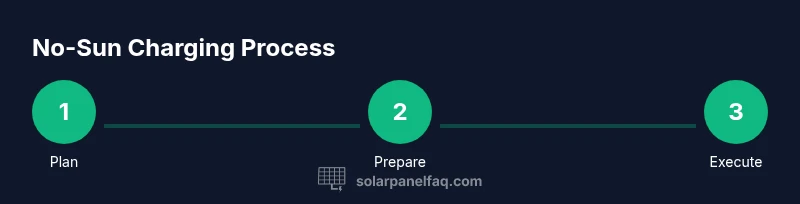
This section outlines a practical sequence for preparing backup charging when the sun is not available. Start by verifying your energy needs and ensuring your battery health is within safe operating limits. Then, choose a reliable alternate charging source (grid or generator) and install it with a dedicated charge controller. Connect the controller to the battery bank, set the desired charging profile, and verify voltages with a multimeter. Finally, test the system under controlled conditions to confirm safe operation and document the results. The goal is a smooth, safe transition between sun-powered and backup charging, with clear monitoring and maintenance routines.
Energy management strategies for low-light periods
Effective energy management reduces reliance on any single source. Schedule high-energy tasks for daylight hours when possible, and use smart load management to stagger non-critical loads during cloudy periods. Consider a power-shift approach: run the most energy-intensive appliances first when daylight is available, then rely on stored energy during no-sun spells. Implementing a simple energy dashboard can help you spot trends, adjust usage, and extend battery life. Routine monitoring also helps you detect ageing components and plan timely replacements before performance deteriorates.
Safety considerations and warnings
Safety should be your top priority when modifying or expanding a solar storage system. Always disconnect power before handling wiring, use insulated tools, and wear protective gear. Never connect multiple charging sources in a way that bypasses the controller or creates a backfeed into the grid. Use properly rated breakers and enclosures, and follow local electrical codes. If you’re uncertain about any step, consult a licensed electrician or solar installer. Proper labeling and documentation reduce the risk of accidental mishandling and help future maintenance.
Real-world scenarios and setup examples
Consider a home that relies on a 6-8 kWh battery bank and experiences several no-sun days each month. By combining a properly sized storage system with a backup generator, the family can maintain essential loads with minimal disruption. In another scenario, homeowners on a grid-tied system use the grid as a backup charging source during extended cloudy spells, while solar continues to power the house when sun returns. These examples illustrate how a well-planned storage and backup strategy can improve reliability without sacrificing safety or long-term battery health.
Maintenance, testing, and documentation
Regular maintenance ensures your no-sun charging plan stays reliable. Schedule quarterly voltage checks, inspect connections for corrosion, and test the backup charging path to confirm proper operation. Keep a log of battery capacity tests, cycle counts, and any anomalies observed during testing. Documenting the charging profiles, source selection, and load schedules helps you optimize performance and simplifies future upgrades. A routine review helps catch issues before they become failures and keeps your Solar Panel FAQ-guided plan on track.
Future-proofing your solar storage during nights and cloudy periods
As weather patterns shift and technology advances, revisit your storage strategy periodically. Consider upgrading to higher-efficiency panels or more capable storage with better depth of discharge and cycle life. Explore smarter energy management software and remote monitoring to optimize charge timing and usage. By planning ahead and aligning equipment with your actual needs, you improve resilience and ensure your home remains powered even when the sun isn’t shining.
Tools & Materials
- Battery storage bank (deep-cycle)(Capable of storing enough energy to cover expected no-sun periods)
- Charge controller (MPPT or PWM)(Prevents overcharging; connect between source and battery)
- Alternative energy source (grid tie or generator)(Used to recharge storage when sun is unavailable)
- Wiring and fusing(Correct gauge and protective devices for safe operation)
- DC-DC converter or voltage regulator(Optional to match battery voltage in some setups)
- Safety gear (insulated gloves, goggles)(Personal protective equipment for all handling steps)
- Multimeter or battery monitor(Helpful for monitoring voltages and health)
Steps
Estimated time: 2-6 hours
- 1
Assess energy needs and storage
List essential loads and estimate daily energy consumption. Use this to determine the minimum battery capacity and acceptable depth of discharge. This baseline helps ensure your no-sun charging plan can sustain critical devices during cloudy periods.
Tip: Document baseline loads first; you can refine estimates with real usage data over a week. - 2
Choose an alternate charging source
Select a backup charging source (grid or generator) that complies with local codes and can deliver steady charging current to the battery bank. Add a safety interlock to prevent backfeeding when solar is active.
Tip: If using a generator, prefer units with auto-idle and quiet operation to reduce noise and wear. - 3
Install a proper charge controller
Mount and wire the charge controller between the backup source and the battery bank. Set charging profiles appropriate for the battery chemistry to optimize life and performance.
Tip: Label all connections and keep the controller within reach for settings adjustments. - 4
Connect safety-rated wiring
Use appropriately gauged cables, fuse modules, and secure enclosures. Verify polarity and ensure solid mechanical mounting to prevent movement or chafing.
Tip: Double-check all terminations before applying power; loose connections are a common failure mode. - 5
Power up and monitor
Power the system and measure voltages at key points. Confirm the controller is charging, and that the battery bank is within safe voltage ranges. Use a battery monitor if available.
Tip: Record baseline readings to compare against future performance. - 6
Test the no-sun charging cycle
Simulate no-sun conditions by disconnecting the solar array and confirming the backup source maintains battery voltage while powering essential loads.
Tip: Ensure safety interlocks are engaged during the test. - 7
Set up load management
Configure timers or smart controllers to shift high-draw loads to daylight hours or to periods with available stored energy.
Tip: Prioritize critical loads and stagger non-essentials to maximize storage lifespans. - 8
Document and review
Keep a running log of charging events, source performance, and battery health. Review quarterly to adjust capacity or profiles as needed.
Tip: Use the log to plan future upgrades or maintenance windows.
Frequently Asked Questions
Can you charge solar panels without sunlight?
No. Solar panels require light to generate electricity. You can, however, charge storage from daylight or an alternate source and then use that stored energy when sun is unavailable.
No, solar panels need light to produce electricity; you can recharge storage from daylight or another source and use it later.
What sources can recharge storage when the sun is not shining?
Backup sources like the grid or a generator can replenish the battery bank when sunlight is unavailable, provided they are connected through a proper charge controller and safety devices.
Grid power or a generator can recharge your battery bank if connected safely through a controller.
Is it safe to use a generator to charge batteries for a solar system?
Yes, with proper safety measures. Use a controller, appropriate wiring, and physical isolation to prevent backfeeding and accidental contact with live circuits.
Yes, but follow safety guidelines and use a controller and isolation.
How long can a solar battery power a home during no-sun days?
That varies with battery capacity, load, and discharge limits. A realistic plan uses measured load data and a buffer to cover peak usage during cloudy periods.
It depends on your battery size, what you’re running, and how deeply you discharge.
What equipment do I need to charge without sun?
You need a battery bank, a charge controller, an alternate charging source (grid or generator), proper wiring, and safety gear. Documentation helps ensure correct maintenance.
Battery bank, controller, backup source, proper wiring, and safety gear are essential.
How should I monitor performance over time?
Maintain a simple log of voltages, charging events, and load usage. Review quarterly to detect aging components or shifts in capacity.
Keep a log and review it every few months to catch changes early.
Watch Video
Top Takeaways
- Plan storage around expected no-sun days.
- Use a proper charge controller with backup sources.
- Prioritize safety and documentation.
- Regularly test and monitor battery health.
- Optimize load management to extend storage life.