How Solar Panels Work Step by Step
Learn how solar panels work step by step in this homeowner-friendly guide. From photons to grid-ready electricity, discover the core processes, components, and tips to maximize performance.


This guide walks you through how solar panels work step by step, from capturing sunlight with PV cells to converting DC electricity and feeding it to your home or grid. You'll learn the key components, how energy flows, and practical tips to maximize efficiency and safety. Read on for a homeowner-friendly, step-by-step explanation.
Overview: how solar panels transform light into usable electricity
According to Solar Panel FAQ, solar panels harness sunlight with photovoltaic (PV) cells to generate direct current (DC) electricity. The process begins the moment photons from the sun hit the cell, releasing electrons. The journey from light to usable energy is a series of coordinated steps, each critical to turning a bright day into power for your home. This section lays the groundwork for the step-by-step path you’ll follow later in the guide, clarifying why PV materials, cell architecture, and system wiring matter for real-world performance.
Core components of a residential solar system
A typical home solar setup involves several interrelated parts. Solar modules or panels capture sunlight; a mounting rack holds them at the right angle on your roof; an electrical conduit connects the panels to a combiner box and inverter; and the inverter converts the produced DC into alternating current (AC) suitable for home use or grid export. A monitoring system tracks output, while the safety disconnects provide a quick way to shut the system off. Solar Panel FAQ analysis shows that understanding each component helps you optimize layout, orientation, and maintenance for maximum efficiency.
The photovoltaic effect: how a cell converts light to electricity
Inside each PV cell, a junction of semiconductor materials creates an electric field. When sunlight photons hit the cell, they impart energy to electrons, freeing them to move. The built-in field guides these electrons toward an electrical contact, creating a current. This fundamental phenomenon—the photovoltaic effect—is what makes solar energy possible. The efficiency of this step depends on material quality, cell architecture, and surface coatings that minimize reflection.
From photons to electrons: the energy path in a real-world panel
Light enters the panel and excites electrons in the semiconductor. The flow of charge is guided by the cell’s electrical field, producing a flow of DC current through the electrical connections in the panel. The glass, anti-reflective coating, and encapsulation protect the cell while maintaining light absorption. Temperature, panel angle, and shading can alter how effectively this step yields current, so understanding these factors helps homeowners optimize performance.
Inverters and the bridge to usable power
DC power produced by panels is not yet usable by most home appliances. The inverter converts DC into AC power, which travels through the electrical panel to your outlets and circuits or back to the grid in a grid-tied system. Modern inverters also provide monitoring data, fault detection, and sometimes optimization features that protect equipment and improve efficiency. Proper inverter selection and placement are essential parts of a reliable solar system.
System sizing, orientation, and shade: real-world drivers of performance
The amount of energy a system can produce depends on panel area, efficiency, and how much sun you receive. Orientation, tilt, and shading from trees or nearby structures significantly affect output. A well-sized system balances space, budget, and expected electricity use. Solar Panel FAQ’s guidance emphasizes evaluating your roof, local climate, and historical sun exposure to estimate production accurately.
How energy flows to your home and the grid
Generated DC current flows through wiring to the inverter, then becomes AC power that can be used immediately or stored in a battery system. In a grid-tied setup, excess energy can be sent to the utility and credited via net metering. Conversely, during low production, the home draws power from the grid. This shared energy model is why proper metering, safety disconnects, and code-compliant wiring matter for reliability.
Monitoring, performance metrics, and expected lifetime
A good monitoring system shows real-time production, historical trends, and alerts for anomalies. Common metrics include peak sun hours, system yield, and performance ratio. With proper maintenance, most residential solar installations retain substantial portions of their rated output for 25–30 years or more, though efficiency typically declines gradually over time. Regular checks keep performance aligned with expectations.
Maintenance, cleaning, and longevity tips for homeowners
Keep panels clean and free of debris to minimize losses, especially in dusty or leafy environments. Inspect wiring, junction boxes, and mounting hardware periodically for corrosion or looseness. Schedule professional inspections every few years to verify safety disconnects, grounding, and inverter health. Simple, proactive care can preserve performance and extend the life of the system.
Common misconceptions debunked and practical takeaways
Many homeowners assume solar always produces at its label. Reality: performance depends on sun exposure, temperature, and system design. The path from photons to usable energy is straightforward but sensitive to shade and orientation. By understanding the basics outlined here, you can set realistic expectations and plan for upgrades or expansions as needed.
Real-world planning: scenarios and decision points
If your goal is to reduce electricity bills, simulate a few scenarios with different system sizes and roof orientations. Consider potential future changes, like electric vehicle charging or battery storage. This section helps you visualize how a thoughtful, step-by-step approach translates into tangible benefits on your monthly bill and energy independence.
Putting it all together: a concise wrap on step-by-step operation
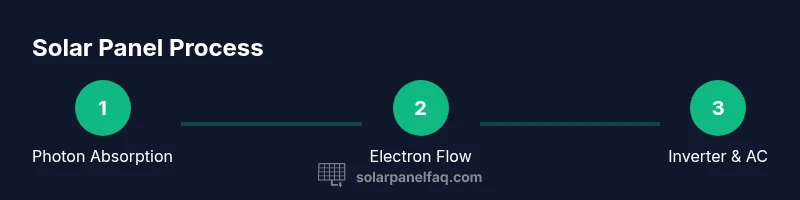
From sunlight striking PV cells to grid-ready AC power, the step-by-step flow is photons → electrons → DC current → inverter → AC power. Add monitoring, safety measures, and proper sizing, and you have a resilient solar system designed for a typical home. Remember: the core ideas are absorption, separation, flow, conversion, and delivery.
Quick reference for homeowners: glossary of key terms
Photons, PV cells, DC, inverter, AC, net metering, mounting, shade, tilt, orientation, efficiency, and performance ratio are core terms you’ll encounter. Keeping these terms in mind helps you read datasheets, compare products, and communicate with installers or utility representatives.
Practical checklist to validate solar readiness
- Confirm roof orientation and available space
- Estimate energy usage with a recent utility bill
- Research local incentives and interconnection requirements
- Plan for monitoring and maintenance routines
- Compare multiple quotes and verify warranty terms
Tools & Materials
- Educational resources (datasheets, diagrams)(Collect official PV datasheets for modules, inverters, and meters.)
- Digital multimeter(Used to measure voltage, current, and continuity in safe scenarios.)
- Safety gear(Gloves and eye protection when discussing live systems.)
- Notebook or whiteboard(Take notes as you learn step by step.)
- Laptop or tablet(For watching tutorials or referencing web resources.)
- Printouts of wiring diagrams(Helpful for visualization during study.)
- Solar panel testing equipment (optional)(Hands-on experiments require caution and supervision.)
Steps
Estimated time: 60-90 minutes
- 1
Identify PV system components
List each part: solar modules, mounting rack, wiring, inverter, combiner box, monitoring hardware, and safety disconnects. Understand each part’s role before advancing.
Tip: Create a simple diagram showing how parts connect to each other. - 2
Grasp the photovoltaic cell structure
Study how a PV cell’s semiconductor layers create an electric field that separates charge carriers when illuminated.
Tip: Refer to datasheets to see material types and cell connections. - 3
Understand light-to-DC conversion
Learn how photons generate electron-hole pairs and how the internal field drives electron flow to produce DC current.
Tip: Note how anti-reflective coatings improve absorption efficiency. - 4
Trace current through a module
Follow the path of DC current from individual cells to the module’s terminal wires.
Tip: Check that wiring polarity matches intended circuit paths. - 5
Link modules into a string
Connect several panels in series or parallel to achieve the desired voltage and current characteristics.
Tip: Vector your design toward the inverter's input range. - 6
Introduce the inverter
Place the inverter between DC module output and the home’s AC distribution, converting power for appliances.
Tip: Verify the inverter’s voltage and frequency specifications match local grids. - 7
Connect to the electrical panel
Route AC power to the main service panel, ensuring proper overcurrent protection and grounding.
Tip: Only proceed with a licensed electrician if you’re unsure about electrical codes. - 8
Understand net metering basics
Learn how excess energy is fed back to the grid and credited on your bill where permitted.
Tip: Check with your utility for interconnection requirements and tariffs. - 9
Set up monitoring and safety
Install a monitoring system and safety disconnects to track performance and enable quick shutdowns.
Tip: Test alarms and ensure access to shut-off points for maintenance. - 10
Plan for shading and orientation
Evaluate roof orientation, tilt, and potential shading to optimize yearly production.
Tip: Use shade analysis tools before finalizing placement. - 11
Consider future storage
If you plan a battery, assess inverter compatibility and charging controls.
Tip: Anticipate additional space, wiring, and warranty considerations. - 12
Schedule maintenance
Set routine checks for panels, wiring, and inverters to sustain performance.
Tip: Clean panels as needed and inspect mounting hardware annually. - 13
Review performance and adjust
Compare actual output to predictions, and adjust orientation or panel count if needed.
Tip: Keep a performance log for year-over-year improvements.
Frequently Asked Questions
What is the basic unit of a solar panel?
A solar cell is the basic unit; multiple cells are connected to form a module. Cells are made from semiconductor material that absorbs light and creates electron flow.
A solar cell is the basic unit, and modules are made of many cells connected together.
How much sunlight is needed to generate electricity?
Direct sunlight improves production, but panels still generate energy in partial sun. Performance depends on orientation, tilt, temperature, and shade.
Direct sun helps a lot, but even shaded or diffused light can generate electricity.
Do solar panels require batteries?
Not always. Grid-tied systems typically do not need batteries, while off-grid setups rely on storage to provide energy when the sun isn’t shining.
Batteries aren’t required for most homes that are connected to the grid.
Can I install solar panels myself?
Solar installation involves electrical wiring and safety codes; work should be performed by licensed professionals to ensure safety and compliance.
Installing solar panels is best left to licensed installers to meet safety codes.
How long do solar panels last?
Most solar panels come with warranties of 25–30 years and can continue producing at reduced efficiency beyond that.
Most panels last 25 to 30 years with some decline in efficiency over time.
What’s the difference between monocrystalline and polycrystalline panels?
Monocrystalline panels typically offer higher efficiency and a sleeker look, while polycrystalline panels are usually less expensive but slightly less efficient.
Monocrystalline usually performs better but costs more than polycrystalline.
What is net metering?
Net metering credits excess solar energy sent to the grid, reducing your electricity bill depending on local policies.
Net metering lets you earn credits for surplus energy sent to the grid.
Watch Video
Top Takeaways
- Understand the signal flow: photons to electrons to current.
- Inverters convert DC to usable AC power safely.
- Shading and orientation significantly impact real-world output.
- Regular monitoring helps catch issues early.
- Plan for maintenance and potential future storage.