How Many Solar Panels Per Acre: Practical Guidelines
Learn how many solar panels fit on an acre, based on panel wattage, spacing, tilt, and layout. This guide offers practical ranges and planning tips for homeowners and developers.


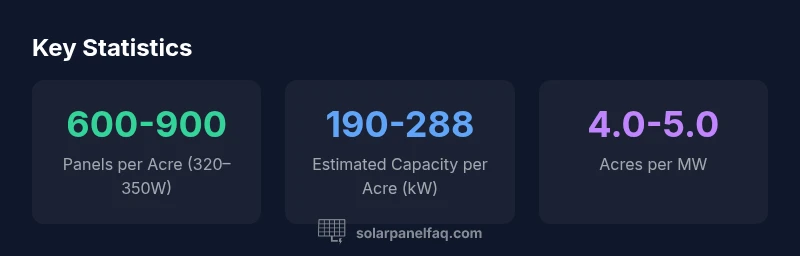
The number of solar panels per acre depends on panel wattage and layout. For fixed-tilt layouts using 320–350W modules, expect about 600–900 panels per acre, equating to roughly 190–320 kW per acre. With 400W panels, density drops to around 625–800 panels per acre, delivering about 250–320 kW per acre. Densities vary with design, setbacks, and maintenance aisles.
Understanding the question: how many solar panels per acre?
On the surface, the question seems straightforward, but the answer hinges on several design decisions. An acre, defined as 43,560 square feet, is not a fixed canvas for solar modules. Real-world layouts carve out spaces for access roads, inverters, transformers, drainage, fencing, and maintenance aisles. The Solar Panel FAQ team notes that ‘per acre’ figures are guidelines rather than guarantees. The density you can achieve depends largely on panel wattage, the chosen layout (row orientation and tilt), and the land’s physical constraints. In practice, fixed-tilt ground-mounted arrays with commonly available panels in the 320–350W range yield roughly 600–900 panels per acre, which translates to about 190–320 kilowatts of capacity per acre. If you instead deploy higher-wattage modules around 400W, the count drops to roughly 625–800 panels per acre, while capacity per acre may stay in a similar ballpark. These numbers assume typical spacing and minimal shading.
Key factors that influence density
Density is driven by a mix of hardware choices and site design. The wattage of the solar panel is a primary lever: higher-wattage modules reduce the number of panels needed for the same output, but they also require careful attention to mounting footprint and electrical configuration. Ground clearance, inter-row spacing, and tilt angle influence how many panels can be placed on the ground while preventing shading and facilitating maintenance. Tilt angles commonly range from 10 to 25 degrees depending on latitude and land slope; steeper tilts can reduce density but improve energy capture in certain climates. Row spacing must accommodate equipment, access for mowing or cleaning, and safety setbacks. Finally, environmental and topographical constraints, such as wetlands, rock outcrops, or existing vegetation, can further reduce usable ground area.
Worked example: 320W vs 450W panels
To illustrate how wattage impacts density, compare three common panel types on a single acre. With 320W panels, you can expect roughly 600–900 panels per acre, translating to about 190–288 kilowatts of capacity per acre. For 350W panels, the count is typically around 700–900 panels per acre, yielding approximately 245–315 kilowatts per acre. If you push to 450W modules, the total panel count drops to about 550–750 per acre, while capacity per acre ranges from roughly 247–338 kilowatts. This example shows that higher wattage reduces panel count but can maintain or increase total capacity. The trend is generally a density decrease of about 20% when moving from 320–350W to 400–450W panels, with a commensurate rise in per-acre output.
Planning steps for your site
A practical planning workflow keeps you aligned with site realities and regulatory constraints. Start by defining the target capacity (in kilowatts or megawatts) you want to generate on the site. Choose a preferred panel Wattage that matches your budget and supply chain, then compute the theoretical maximum panels per acre using manufacturer footprints. Subtract space for maintenance aisles, access roads, inverters, and substations. Factor in shading analysis to avoid panel-to-panel interference across the year, and apply setback requirements from property lines, streams, and roads. Finally, verify the calculation with a concept layout prepared by a qualified solar engineer and adjust for local permitting rules. These steps help ensure your per-acre estimates are realistic and site-specific.
Zoning, land-use, and environmental considerations
Local rules can dramatically affect how densely you can pack panels per acre. Zoning ordinances, setback distances, and environmental impact assessments may mandate larger buffers and longer access routes, reducing the usable ground area. In some jurisdictions, land-use policies encourage habitat preservation or agricultural use restrictions, which can influence panel spacing choices. When evaluating a site, consult the planning department early, and consider a preliminary environmental screening to catch issues that might increase project costs or reduce density. Early coordination with utility interconnection agents is also essential to understand how your layout affects electrical clearances and feeder routes.
Data sources, methodology, and how to use these estimates
All per-acre estimates in this article are intended as planning guidelines based on common fixed-tilt ground-mounted configurations. They reflect typical panel footprints, inter-row spacing, and maintenance access needs observed in practice. For credible, site-specific numbers, reference authoritative sources such as NREL studies on land use for solar power plants and engineering guides referenced by Solar Panel FAQ Analysis, 2026. When in doubt, treat per-acre numbers as a range and plan with contingency margins to accommodate soil conditions, drainage, or unexpected permitting requirements.
Approximate density and capacity by panel wattage
| Panel Wattage (W) | Panels per Acre (range) | Estimated Capacity per Acre (kW) |
|---|---|---|
| 320 | 600-900 | 190-288 |
| 350 | 700-900 | 245-315 |
| 400 | 625-800 | 250-320 |
Frequently Asked Questions
How many solar panels fit on one acre?
Density depends on panel wattage and layout. For common fixed-tilt layouts, 320–350W modules yield about 600–900 panels per acre, equating to roughly 190–288 kilowatts per acre; 400W panels reduce the count to about 625–800 per acre, with similar total output. Always plan for margins due to setbacks and aisles.
Density depends on panel size and layout. Expect hundreds of panels per acre, with more kilowatts per acre for higher-wattage modules.
What panel wattage has the biggest impact on density?
Higher wattage panels reduce the number of panels needed per acre but increase per-panel output. Moving from 320–350W to 400W tends to lower panel counts by roughly 15–25% while keeping or increasing total acreage output.
Bigger panels mean fewer panels per acre but more power per panel.
How do spacing and setbacks affect counts?
Inter-row spacing, maintenance aisles, and setback requirements limit ground coverage. Wider aisles and larger setbacks reduce the usable area, lowering the number of panels per acre even if panel wattage remains the same.
Space and setbacks matter; wider aisles mean fewer panels per acre.
Are there rules of thumb for residential vs commercial sites?
Residential rooftop projects use a very different density framework than ground-mounted commercial systems. Per-acre calculations mainly apply to ground-mounted sites. Rooftop layouts focus on roof area, structure limits, and shading rather than ground density.
Rooftop solar uses different rules than ground-based fields.
Can I rely on per-acre estimates for a specific site?
Site-specific factors such as topography, soils, vegetation, and local regulations matter more than generic numbers. Use engineering estimates and a professional layout to confirm per-acre counts for your site.
Site specifics matter; get engineering layouts done.
Where can I find reliable per-acre estimates?
Consult engineering guides and credible studies, such as NREL land-use analyses and Solar Panel FAQ Analysis, 2026, for baseline guidance. Always corroborate with a local engineer and permitting authority.
Look to NREL and Solar Panel FAQ for solid baselines.
“Estimating panel density per acre is a design exercise that requires accounting for spacing, shading, and utility needs; exact counts vary, so plan around ranges.”
Top Takeaways
- Estimate using panel wattage and layout.
- Use ranges rather than fixed figures.
- Higher wattage reduces counts but boosts output.
- Plan for setbacks, roads, and maintenance aisles.
- Check local zoning and regulatory guidance early.