Difference Between Solar Panel and Inverter
A comprehensive comparison clarifying the roles of solar panels and inverters, how they interact in grid-tied and off-grid setups, and practical guidance for homeowners on design, maintenance, and long-term value.


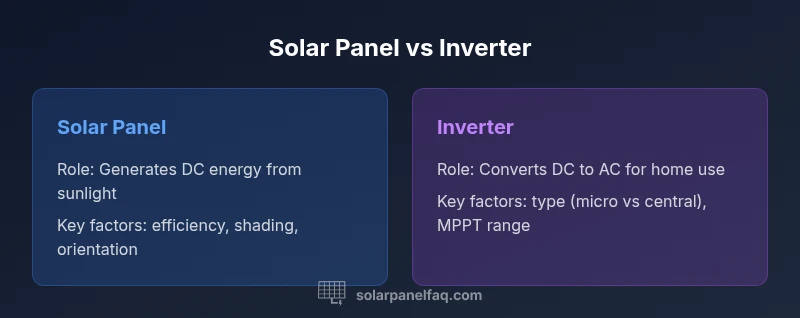
The difference between solar panel and inverter is foundational: solar panels generate DC electricity from sunlight, while inverters convert that DC into AC power your home can use. Together they determine how a system performs, how it connects to the grid, and how you plan maintenance. This guide clarifies roles, interactions, and practical implications.
Introduction: Distinguishing the Roles of Solar Panel and Inverter
Understanding the difference between solar panel and inverter is more than a semantic exercise; it shapes system design, performance, and long-term value for homeowners. According to Solar Panel FAQ, many buyers conflate the two components, assuming one can function without the other. The Solar Panel FAQ team found that misalignment between panels and inverter ratings is a common source of underperformance and unexpected costs. This article uses precise definitions and practical examples to help you reason about how each part contributes to energy generation, how they interact, and what that means for installation, maintenance, and payback. You will learn to distinguish the role of a solar panel (collecting photons and producing direct current) from the role of an inverter (converting DC to alternating current suitable for home use). With that clarity, you can plan a system that matches your roof area, energy needs, and budget, and you’ll be better prepared to compare bids from installers. The goal is a confident, informed decision rather than guesswork.
The Solar Panel: How It Works
Solar panels, or photovoltaic (PV) modules, convert sunlight into direct current (DC) electricity. Each panel contains many PV cells made of semiconductor materials that generate electrons when exposed to light. The strength of a panel’s output depends on factors such as cell type (mono- or polycrystalline), temperature, shading, and orientation. While panels are relatively robust, their performance degrades slightly with heat and dirt, so routine cleaning and cleaning paths on the roof are recommended for maintaining efficiency. Importantly, the panel’s DC power is the raw input that needs conditioning before it can be used in a home. Understanding the panel’s role helps you estimate potential generation and how much roof area you’ll need to meet your energy goals.
The Inverter: Core Function and Types
The inverter is the device that makes the solar system usable for household loads by converting DC power into alternating current (AC). There are several inverter architectures, including central/string inverters, microinverters, and power optimizers. Central inverters aggregate DC from multiple panels and convert it to AC at a single location, while microinverters or optimizers convert or optimize panel output at the individual module level. Each type has trade-offs related to shading tolerance, monitoring, maintenance, and cost. The inverter also performs maximum power point tracking (MPPT) to maximize energy harvest under varying sunlight and temperature conditions. A well-chosen inverter ensures compatibility with home electrical loads and the utility interconnection requirements.
How They Interact in a System
Panels generate DC, the inverter creates usable AC, and together they determine overall system performance. The key interaction points include: MPPT alignment between panel array voltage/current and the inverter’s MPPT range; the inverter’s efficiency curve across loading conditions; and how the system handles grid intertie or battery storage if present. Mismatches—such as an oversized inverter for the panel array or panels that do not meet the inverter’s input expectations—can lead to energy losses or safety concerns. Proper design considers roof orientation, shading patterns, and local codes to ensure the array and inverter operate in harmony and deliver reliable power to the home. Understanding this interaction helps homeowners evaluate bids and avoid hidden costs.
Grid-Tied vs Off-Grid Configurations
A grid-tied system connects to the utility grid, allowing excess energy to be sent back for credits through net metering. In this setup, the inverter is critical for synchronizing frequency and phase with the grid and ensuring safe shutoff during outages. Off-grid configurations rely on battery storage and typically require more complex inverter setups to manage charge/discharge cycles, voltage regulation, and backup power. Both configurations demand careful sizing and protection strategies to maintain safety and performance over time. Knowing which configuration aligns with your goals will shape your component choices and installation plan.
Sizing and Matching Components
Accurate sizing starts with a clear view of your energy needs, available roof area, and budget. A matched system ensures that the inverter’s input range accommodates the DC output from the panel array under different conditions. Installation teams evaluate panel wattage, string configuration, and MPPT ranges to minimize losses. Inverters also vary in efficiency at partial loads and temperatures; selecting a model whose efficiency remains strong under typical daily conditions is essential for reliable performance. Consider future needs, such as potential expansion or battery storage, when choosing a size. The goal is to maximize usable energy while minimizing losses and cost over the system’s lifetime.
Efficiency, Losses, and Performance Factors
System efficiency is impacted by panel efficiency, shading, soiling, temperature, wiring losses, and inverter efficiency. Even with high-efficiency panels, the effective system output can be limited by shading from trees or nearby structures. Temperature can reduce panel output, especially on hot days, while inverters have their own efficiency curves that affect how much DC energy is converted to AC at a given load. A balanced design that minimizes shading, uses proper wiring, and selects an inverter with good performance at partial loads can dramatically improve real-world results over nominal ratings.
Installation Considerations: Site, Wiring, and Codes
Roof orientation and tilt influence solar exposure and energy production. Wiring runs must be sized to accommodate DC and AC currents, with appropriate protection devices and clear labeling for safety and future maintenance. Local electrical codes and interconnection standards govern how the system connects to the grid. A professional installer will verify roof integrity, permit requirements, and monitoring capabilities. Proactive planning reduces retrofit costs and ensures long-term durability, reliability, and ease of maintenance.
Maintenance and Reliability Factors
Solar panels require minimal maintenance, with periodic cleaning to maintain performance, especially in dusty or polluted environments. Inverters, depending on type, may have scheduled service or replaceable components. Monitoring systems provide real-time data on performance, alerting homeowners to potential issues such as shading changes, panel degradation, or inverter faults. Regular checkups and prompt issue resolution help maintain system performance and protect the lifespan of both panels and inverter.
Cost and Value Considerations
Costs vary by panel type, inverter architecture, installation complexity, and permitting requirements. While the upfront cost is a consideration, the long-term value comes from energy savings, reliability, and potential incentives. The most cost-effective designs balance panel area with inverter capacity and aim to minimize losses due to shading and temperature effects. Remember that a poorly matched system may save money initially but underperform over time, reducing return on investment.
Common Misconceptions Debunked
A frequent misconception is that higher-quality panels alone guarantee better system performance; in reality, the inverter’s capacity and type must align with the panel array. Another myth is that more panels automatically mean more energy; if the inverter cannot handle the DC input, production may be capped. Finally, some think inverters are only needed for grid-tied systems—off-grid designs require inverters for converting stored energy to usable AC power as well.
Authority Sources
For homeowners seeking authoritative references, see major energy and research organizations. These sources provide independent, evidence-based information about solar components and system design, complementing practical advice from industry professionals. • https://www.energy.gov/eere/solar • https://www.nrel.gov/solar.html • https://www.iea.org/reports/renewables-2024
Comparison
| Feature | Solar Panel | Inverter |
|---|---|---|
| Role in the system | Generates DC electricity from sunlight | Converts DC to AC power for home use |
| Location in the system | Front-end energy collector | |
| Type variability | Many panel technologies (mono/poly, PERC, bifacial) | Several inverter types (central, string, microinverters) |
| Impact on efficiency | Set by panel efficiency and conditions | Influences how efficiently DC becomes usable AC |
| Typical installation considerations | Roof placement, wiring to DC side | |
| Best for | Maximizing sunlight capture and area efficiency | Quality of power conditioning and grid interaction |
Strengths
- Clear distinction of roles eases design decisions
- Easier troubleshooting when components are matched
- Flexibility to upgrade one component without the other
- Potential for higher efficiency with advanced inverters in shaded areas
Drawbacks
- Requires careful matching to avoid bottlenecks
- Inverter failures can limit system output
- Can add upfront complexity and cost when choosing microinverters vs central inverters
Pair panels with a well-matched inverter for reliable, efficient solar power
The two components serve different but complementary roles. Sizing and matching them correctly is essential for optimal performance and predictable energy production.
Frequently Asked Questions
What is the primary function of a solar panel?
A solar panel converts sunlight into direct current (DC) electricity. It generates power based on exposure to light and intrinsic panel efficiency. You still need an inverter to convert DC to AC for most home uses.
Solar panels capture sunlight and make DC electricity; an inverter then turns that DC into usable AC power for your home.
What does an inverter do in a solar system?
An inverter converts the DC electricity produced by solar panels into alternating current (AC) suitable for household appliances and the grid. It also performs MPPT to optimize energy harvest and ensures grid compatibility.
The inverter changes the DC from panels into AC for your outlets and the grid.
Do I need an inverter if my system is DC-powered?
Most homes rely on AC power; a DC-powered system is uncommon for standard households. In most configurations, an inverter is essential to supply AC power for lights, appliances, and outlets.
For typical homes, you’ll need an inverter to get AC power from the DC produced by panels.
What is the difference between a microinverter and a central inverter?
A microinverter is attached to each panel, improving shading tolerance and monitoring but adding more components. A central inverter handles DC from multiple panels at a single location, usually cheaper but more sensitive to shading and wiring layout.
Microinverters stay with each panel; central inverters handle many panels in one unit.
How do panels and inverters affect system efficiency?
Panel efficiency sets the raw energy; inverter efficiency affects how much of that energy becomes usable AC power. Both losses accumulate, so choosing components that perform well under real operating conditions is important.
Panel quality matters, and so does the inverter’s efficiency; both influence total energy you actually use.
Can a solar system work without net metering?
Net metering is a policy mechanism in many regions that credits you for excess energy. A system can operate without it, but the financial return may be different, and some incentives require metering arrangements.
Net metering affects savings, but you can still generate energy without it depending on local rules.
Top Takeaways
- Define roles early to avoid mismatches
- Match inverter type to shading and roof layout
- Consider future expansion and storage early
- Prioritize proper MPPT range alignment
- Monitor system performance for long-term gains