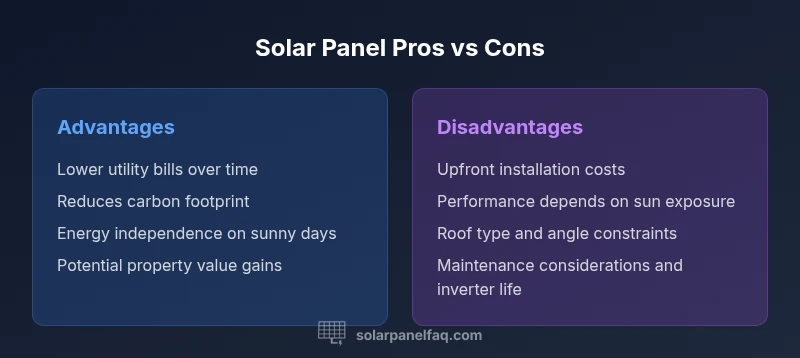
Advantages and Disadvantages of a Solar Panel
Explore the advantages and disadvantages of a solar panel for homeowners. This balanced comparison covers savings, costs, maintenance, incentives, and roof compatibility to help you decide.


Solar panels offer clear environmental and long-term savings benefits, but they come with upfront costs, maintenance, and roof constraints. The advantages tend to favor homes with good sun exposure, steady incentives, and reliable warranties, while the disadvantages hinge on roof condition, local policy, and energy usage patterns. This article weighs those trade-offs to guide your decision.
Environmental and Economic Context of Solar Panels
The discussion around the advantages and disadvantages of a solar panel sits at the crossroads of climate goals, energy resilience, and home improvement. Solar installations convert daylight into usable electricity, reducing dependence on fossil-fuel power and cutting carbon emissions where the grid relies on non-renewable resources. Yet the value of a solar panel is not universal. It depends on siting, roof orientation, shading, local incentives, and how electricity is priced in your area. Homeowners should view solar through a practical lens: consider the local sun exposure, the condition of the roof, the cost of installation, and the presence of programs such as net metering and subsidies that affect long-term economics. Solar Panel FAQ emphasizes that a well-meshed system aligns with a homeowner’s energy goals and financial plan, rather than chasing a one-size-fits-all solution.
Getting to the Core: What People Care About
When evaluating the advantages and disadvantages of a solar panel, most homeowners weigh energy independence against upfront costs, maintenance needs, and long-term returns. The key is to distinguish between initial investment barriers and ongoing operational benefits. In sunny climates, the production potential is greater, which often translates to higher savings and faster payoff. In weaker sun regions, incentives and electricity rates can still tilt the balance, but the economics become more sensitive to policy changes and system design. The Solar Panel FAQ team notes that your personal context—roof space, energy consumption, and local incentives—ultimately determines whether solar makes sense for you.
How Sunlight Impacts Performance and Value
Solar panel output correlates with sun hours, shading, and panel orientation. While a system may perform reliably on a clear day, partial shading or suboptimal tilt can dampen production. Over time, a well-designed array can compensate for some daily variability through proper sizing, inverter selection, and potential battery integration. This section highlights how geography and home orientation influence the practical benefits of going solar, and how to compare expected gains to your current energy costs in qualitative terms.
Financial Considerations Without Numerical Guesswork
A critical part of assessing the advantages and disadvantages of a solar panel is understanding financing and policy levers. Upfront costs exist for panels, mounting hardware, wiring, and professional installation, but many regions offer incentives, rebates, or tax credits that reduce the burden. Net metering policies allow solar users to receive credits for excess electricity sent back to the grid, improving long-term economics. Financing options—such as solar loans or leases—change the cash flow profile and risk, so buyers should evaluate total lifetime costs and potential savings rather than focusing solely on sticker price.
Installation Realities: Roofs, Permits, and Warranty Coverage
Installing solar panels typically requires roof integrity, structural assessment, and appropriate permits. Not all roof types are equally suitable; orientation and shading play a big role in performance. Warranties for modules, inverters, and workmanship provide assurance against manufacturing defects and installation issues, but terms vary widely. Before committing, homeowners should review what is covered, for how long, and what maintenance tasks are necessary to sustain performance. The right installer will help you balance the aesthetic impact, roof risk, and expected durability.
Maintenance, Upgrades, and Longevity
Compared with many home improvements, solar panels offer relatively low maintenance requirements. Occasional cleaning or debris removal, routine inverter checks, and periodic performance monitoring are usually sufficient. Many systems are designed to operate for decades, though individual components may require replacement over time. If you’re considering batteries for storage, factor in additional maintenance and replacement costs. The long-term durability of a solar panel depends on installation quality, weather exposure, and adherence to recommended care.
The Disadvantage Side: When Solar Isn’t Ideal
Key drawbacks include upfront capital requirements, uncertain payback timelines, and the need for a suitable roof or land area. In markets with weak incentive structures or high electricity rates, the financial case can be less compelling. Weather variability, shading, and seasonal changes can reduce effective production. For some homeowners, these factors outweigh the environmental benefits or energy independence that solar promises, especially if energy usage is low or if roof replacement is likely soon. In such cases, alternatives like community solar or hybrid systems may be worth exploring.
A Practical Framework for Decision Making
To evaluate the advantages and disadvantages of a solar panel for your home, start with a practical checklist: assess sun exposure and roof condition, review local incentives and utility policies, estimate current energy usage, and consider long-term plans for home improvements. Engage multiple installers to compare system designs, warranties, and service commitments. Use qualitative scenarios—best-case, typical, and worst-case—to understand how decisions would feel in real life. By framing the decision around your goals (cost certainty, environmental impact, or independence), you’ll arrive at a clearer conclusion.
Conclusion and Next Steps: From Evaluation to Action
Having weighed the pros and cons, the next steps involve a professional assessment, a clear cost/benefit discussion, and a decision about financing or ownership. A well-planned solar installation can align with home improvement and energy goals, but it requires careful consideration of roof conditions, geographic factors, and policy context. The Solar Panel FAQ team emphasizes that the best choice is the one that matches your home’s sun exposure, your budget, and your long-term plans.
Long-Term Value: Warranties, Upgrades, and Resale Implications
Finally, think about warranties and potential upgrades. A robust warranty reduces risk, while future-proofing with potential battery storage or smart inverters can enhance value. Resale value can be positively influenced in markets with high solar adoption, especially when the system is well-maintained and documented. Conversely, if incentives are uncertain or the roof needs replacement, those factors may temper resale benefits. The key is to maintain transparent records and plan for contingencies to maximize long-term value.
Comparison
| Feature | Solar panel ownership | No solar panel |
|---|---|---|
| Initial cost | High upfront cost due to equipment and installation | Low upfront cost or none (no purchase) |
| Ongoing savings | Potential long-term utility bill reductions | No direct energy savings |
| Maintenance needs | Regular cleaning, inverter replacement risk, occasional servicing | Minimal or none |
| Incentives & financing | Potential tax credits, rebates, net metering | No incentives tied to solar |
| Roof impact & aesthetics | Roof penetrations; visual changes; requires structural assessment | No roof modifications |
| Environmental impact | Reduces emissions; depends on energy mix and location | No direct environmental benefit from solar |
| Reliability & variability | Output depends on sun; performance varies by weather | Grid electricity; no generation variability due to sun |
| Resale value | Can increase home value where solar is in demand | Neutral or uncertain impact |
Strengths
- Reduces ongoing energy costs over time
- Lower carbon footprint and environmental impact
- Increases energy resilience during outages (with storage)
- Can enhance home value in solar-friendly markets
- Supports local energy independence and policy goals
Drawbacks
- High upfront installation costs and financing needs
- Performance depends on sun exposure and weather
- Roof compatibility and structural considerations
- Maintenance and potential inverter/battery replacement
- Incentive availability varies by location and policy changes
Solar panels are generally a smart investment for sun-rich homes when roof and policy conditions are favorable
If your roof orientation, shading, and local incentives align, solar offers environmental and long-term financial benefits. If not, the advantages may be limited by upfront costs and policy changes.
Frequently Asked Questions
What are the main advantages of solar panels for homeowners?
The primary benefits are reduced or stabilized energy costs, lower environmental impact, improved energy resilience, and potential increases in home value in solar-friendly markets. The exact gains depend on sun exposure and policy incentives.
Solar panels can lower your energy bills and shrink your household's carbon footprint, especially where incentives and sun are strong.
What are the main disadvantages of solar panels for homes?
The main drawbacks include high upfront costs, variability in output due to weather, and roof or space requirements. Maintenance and inverter replacement can add to long-term costs, and incentives can change over time.
Upfront costs and dependence on sun are the big trade-offs to consider.
Do solar panels add value to a home?
In many markets, solar installations can improve resale value, especially when the system is well-maintained and supported by incentives. The impact varies by location and buyer attitudes toward solar.
Solar can boost home value where buyers value green energy and incentives.
How long do solar panels last?
Most solar panels are designed to last for decades, with inverters typically requiring replacement within the system’s life. Warranty terms vary, so confirm coverage with the installer.
Panels often last many years, but components like inverters may need replacement.
Are incentives necessary to make solar cost-effective?
Incentives can significantly improve the financial case, but the decision should consider local electricity rates, roof suitability, and long-term energy needs. Even without incentives, solar may be worthwhile in sunny, high-demand regions.
Incentives help, but your decision should depend on your roof, sun, and energy use.
What should I ask a solar installer?
Ask about roof suitability, panel and inverter warranties, expected output, maintenance requirements, and whether the system can be expanded in the future. Get multiple quotes to compare design and service quality.
Ask about warranties, expected output, and future expansion options.
Top Takeaways
- Assess sun exposure and roof condition before deciding
- Evaluate local incentives and net metering policies
- Consider long-term energy usage and maintenance needs
- Ask installers about warranties and system design
- Plan for future upgrades or battery storage if needed