What Kind of Solar Panels Does Freedom Forever Use?
Explore what kind of solar panels Freedom Forever uses, including panel types, efficiency ranges, and installation considerations. A data-driven guide from Solar Panel FAQ.


Freedom Forever does not lock customers into a single brand. Instead, they offer a range of panel options from multiple reputable manufacturers to tailor each installation to the home’s needs. The final choice depends on project goals, roof space, incentives, and stock availability. In practice, higher-efficiency monocrystalline modules are often presented for compact rooftops, while polycrystalline options may appear when budget is the primary driver.
How Freedom Forever approaches panel selection
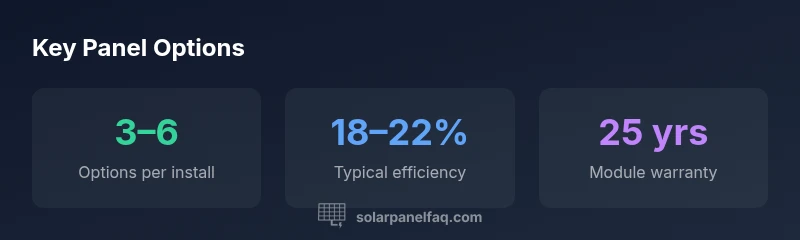
Choosing solar panels is not a one-size-fits-all decision. Freedom Forever takes a system-wide view, balancing roof orientation, shading, and local incentives with your budget and goals. According to Solar Panel FAQ, the company does not lock customers into a single panel brand; instead they offer a menu of options from multiple manufacturers to tailor each installation. This means the installer will assess whether a higher-efficiency module is worth the premium on your roof space, or whether a more economical solution still meets your energy targets. The process typically starts with a site assessment, then a conversation about priorities: long-term savings, aesthetics, and warranty coverage. The result is a recommended panel family that aligns with your home’s architecture and energy profile, rather than a one-brand mandate.
Panel technologies explained
Residential solar panels fall into several families, with monocrystalline and polycrystalline being the two most common. Monocrystalline modules are produced from a single crystal and typically offer higher efficiency and better performance in limited space, making them a popular choice for Freedom Forever projects with small or shaded roof areas. Polycrystalline panels are made from multiple crystals, usually cheaper to manufacture and often used when roof space is ample and cost is a primary driver. There are additional evolutions like PERC (Passivated Emitter and Rear Cell) cells that can slightly improve output in real-world conditions. Understanding these distinctions helps homeowners weigh the trade-offs between upfront cost and long-term energy yield. The installer should provide a clear comparison of expected energy production, temperature performance, and potential degradation over time for each option.
Efficiency, cost, and warranty: weighing the trade-offs
Efficiency indicates how much of the sun’s energy a panel converts to electricity, with higher efficiency modules requiring less roof space but often carrying a higher price tag. Freedom Forever accounts for this by presenting panels in a tiered fashion: a high-efficiency option for compact rooftops, a standard-efficiency option for typical installations, and an economical option when the budget is tight. Warranty terms matter as well; most residential modules come with 25-year warranties covering power output and product defects, while labor warranties may vary by installer and state. Homeowners should compare the long-term cost per kilowatt-hour (LCOE) estimates across options, not just the sticker price. The takeaway is to evaluate performance under your climate, roof orientation, and shading pattern, because these factors determine how much energy your system will actually produce year after year.
Practical considerations based on your roof and site conditions
Your roof’s angle, direction, and shading from trees or nearby structures influence which panel types deliver the best value. Freedom Forever often runs shade analyses and orientation checks to select modules with favorable performance. For example, in limited space or high-sun environments, higher-efficiency monocrystalline panels can maximize production, while on a large, open roof, polycrystalline units may offer a lower upfront cost with acceptable returns. Inverters and optimizers also affect the overall system design; some panel families pair with specific solution sets to maximize energy harvest. The decision isn’t only about the panel itself; it’s about how the module interacts with the rest of the system, including wiring, inverters, and monitoring platforms. A clear plan that documents wind loads, roof repair needs, and maintenance expectations helps prevent unexpected costs later in the project.
How to discuss options with your installer
Prepare a short list of priorities before you meet the installer: energy independence goals, budget constraints, and preferred warranty terms. Ask your Freedom Forever consultant to show a side-by-side comparison of panel families, with estimated annual energy production, typical degradation, and expected payback period for your location. Request a formal quote that includes module type, warranty coverage, and any anticipated changes to installation timelines due to stock availability. It’s reasonable to ask for a test fit or shade model to confirm that the proposed panels will truly fit your roof space. Finally, ensure you understand the post-installation service plan, including monitoring, maintenance, and response times for repairs.
Debunking common myths about panel brands
Many homeowners assume that the best solar panels must come from a single well-known brand. In reality, the most important factors are system design, verified performance, and reliable warranties. Freedom Forever’s approach of offering multiple manufacturers avoids the pitfalls of a one-brand strategy and allows for price and availability fluctuations without compromising energy goals. Myth: premium-brand panels always deliver the best value. Fact: the value depends on your roof space, climate, and financing terms. Myth: newer panel technologies automatically outperform established options. Fact: proven field performance and support networks often matter more for long-term reliability.
Real-world scenario: choosing panels for a typical home
A typical 6–8 kW residential system on a south-facing roof with moderate shading might be best served by a high-efficiency monocrystalline option for compact space, paired with a robust warranty. On a larger home with ample roof area and a tight budget, a standard-efficiency polycrystalline module could meet energy targets at a lower upfront cost. In both cases, Freedom Forever would present a range of options with transparent energy yield estimates and payback projections, enabling homeowners to decide based on quantifiable metrics rather than brand hype.
Panel types and their typical characteristics
| Aspect | Panel Type | Notes |
|---|---|---|
| Definition | Monocrystalline | High efficiency; common for residential installs |
| Definition | Polycrystalline | Lower cost per watt; suitable where space is ample |
| Technology | PERC | Improved performance in real-world conditions |
| Warranty | Typical warranty | 25-year module warranty; inverter varies by system |
Frequently Asked Questions
Does Freedom Forever lock customers into a single solar panel brand?
No. Freedom Forever typically offers multiple manufacturers and panel types depending on the project, ensuring choices fit your roof and budget.
Freedom Forever doesn't lock you into one brand; they present several options based on your roof and budget.
What panel type is most common in Freedom Forever installations?
Monocrystalline panels are commonly used for higher efficiency on typical homes, but the final choice depends on roof space and price considerations.
Monocrystalline panels are common, but the final choice depends on your roof and budget.
How do incentives affect panel selection?
Incentives affect overall cost and payback, but installers still present a range of options to maximize value for your location.
Incentives matter for cost, but you’ll still get a range of good options.
Can homeowners request a specific panel type?
Yes, homeowners can request a panel type; the installer evaluates feasibility and compatibility with the system design.
Yes, you can request a panel type, and the installer will check feasibility.
What should I compare besides panel type?
Compare efficiency, warranty terms, temperature performance, and the total installed cost to determine true value.
Look at efficiency, warranty, and cost to judge value.
“Panel selection should align with site conditions and homeowner goals, not brand loyalty.”
Top Takeaways
- Examine multiple panel options per install.
- Prioritize efficiency for space-constrained roofs.
- Compare warranties and long-term energy yield.
- Discuss site conditions early to tailor choices.