Power Outdoor Lights with Solar Panels: A Complete Guide
Learn to power outdoor lighting with a solar panel system—from sizing and components to safe installation and maintenance. Practical steps, safety tips, and strategies for wire-free, reliable outdoor illumination.


Powering outdoor lights with a solar panel is a practical, wire-free solution that enables pathways, gardens, and entryways to glow after dark. This guide outlines sizing, components, installation, and maintenance to help you design a reliable system. You’ll learn how a solar panel, battery, and controller work together to run LED fixtures efficiently, even on partly cloudy days.
Understanding the goal: solar panel to power outdoor lights
Powering outdoor spaces with a solar panel to power outdoor lights is a straightforward way to illuminate walkways, gardens, and entryways without running electrical lines. The core objective is to harvest sunlight, store it in a battery, and release it through efficient LED fixtures when you need light after dark. This approach reduces energy bills, increases resilience during outages, and simplifies maintenance for homeowners. For best results, you’ll balance solar generation, storage, and load so your lights perform reliably across seasons. According to Solar Panel FAQ, the process starts with a clear lighting plan, which informs panel size, battery capacity, and controller choice. The guidance that follows is designed for homeowners seeking long-term results rather than quick, one-off installs. By understanding how these components interact, you’ll design a system that powers outdoor lights consistently, even on partly cloudy days.
Site assessment: sun exposure, shading, and mounting
Your system’s performance hinges on site conditions. Identify a roof, wall, or stand-alone post with strong sun exposure for the solar panel, and note any shading from trees or buildings during peak hours. Mark the mounting height and angle to maximize sun capture through the seasons. Consider wind, snow, and potential impacts on wiring. A well-sited panel reduces the chance of energy shortfalls and helps your outdoor lights run longer through the night.
Selecting panels, batteries, and controllers
Choose a solar panel with a balance of efficiency and cost, favoring proven monocrystalline or high-efficiency polycrystalline modules. Pair the panel with a storage battery appropriate for your nighttime load; lithium-based options offer longer cycle life, while deep-cycle lead-acid remains a budget-friendly choice. A charge controller—preferably MPPT for higher efficiency—protects the battery from overcharging and prevents reverse current flow. All three components must be rated to work together within your lighting plan to deliver consistent performance.
Sizing your system: estimating load, production, and storage
Start by listing every outdoor light you plan to operate and add their wattages. Sum these to determine total load. Estimate how many hours per night the lights will run in your location. Use these figures to project daily energy needs in watt-hours and then pick a panel that can generate enough energy during peak sun hours to meet that demand. Ensure the battery capacity is sufficient to store enough energy for overnight use, respecting safe operating limits for the chosen chemistry.
Wiring, safety, and best practices
Install a durable, weatherproof DC circuit from the panel to the battery, then to the lights through a properly rated charge controller. Use fuses or circuit breakers close to the battery to protect wiring, and keep all connections clean and dry. Route cables away from foot traffic and potential damage, and use a junction box with gasketed seals where wires join. Grounding and proper diagnoses help prevent surprises during storms and residential power fluctuations.
Installation steps overview (high level)
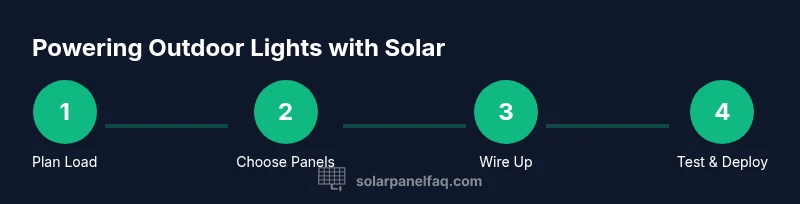
Plan your layout before any mounting. Install the solar panel in its sunny spot, connect it to the charge controller, and wire the battery to the controller. Run a single cable from the controller to your lighting circuit with appropriate gauge wiring. Mount the lights where illumination is most useful, then test the system across day and night cycles to verify consistent performance.
Lighting options: LEDs, brightness, and color
LED fixtures are the most efficient choice for solar-powered setups. Consider lumens rather than wattage alone to gauge brightness for pathways or accents. Select warm-to-neutral color temperatures for comfortable, inviting outdoor spaces. Lower power draws extend battery life, so prioritize efficiency and proper beam angles to maximize coverage.
Weather, maintenance, and seasonal tweaks
Regularly clean the solar panel’s surface to maintain output, particularly in dusty or pollen-heavy environments. Inspect wiring and seals after severe weather, and reseal connectors if needed. Tilt and orientation adjustments may be beneficial as sun paths shift with the seasons. A proactive maintenance routine preserves performance and extends component life.
Troubleshooting basics
If lights fail to illuminate, check the panel for sun exposure, verify battery voltage, and inspect the controller for fault indicators. Ensure all connections are tight and corrosion-free, and confirm that fuses or breakers are intact. For dim or erratic lighting, inspect the panel’s angle, panel cleanliness, and the battery’s health and charge state.
Cost considerations and long-term savings
A solar lighting solution reduces ongoing electricity costs and trenching or rewiring work. While initial costs cover panels, batteries, and controllers, the long-term savings accrue through lower energy bills and minimal maintenance. Plan for component replacement over time, especially for batteries, and look for warranties that fit your expected lifespans.
Tools & Materials
- Solar panel (Wp rating appropriate for load)(Select based on total lighting load and sun hours; consider margin for cloudy days)
- Battery storage (12V deep-cycle or Li-ion)(Choose capacity to cover overnight needs; lithium offers longer life)
- Charge controller (MPPT preferred)(Prevents overcharging and ensures efficient energy use)
- LED outdoor lights(Energy-efficient fixtures with appropriate IP rating for weather exposure)
- DC wiring and connectors (appropriately gauged)(Waterproof connectors recommended; avoid sharp bends)
- Fuses/circuit breakers(Place close to the battery for protection)
- Mounting hardware (brackets, poles, sealants)(Corrosion-resistant materials; ensure stability)
- Multimeter and basic tools(Used to verify voltages and connections; wear personal protective equipment)
- Weatherproof junction box(Optional for neat, protected connections)
- Dusk-to-dawn sensor or timer (optional)(Can optimize runtime and save energy)
Steps
Estimated time: 2-4 hours
- 1
Assess lighting needs and plan
List all outdoor lights you want to power and note each fixture's wattage. Estimate nightly operating hours and map a layout that covers priorities like paths and entryways. This planning guides panel size, battery capacity, and controller type.
Tip: Write down a simple load sheet to reference during shopping. - 2
Gather components and safety gear
Collect a compatible solar panel, battery, and MPPT controller. Have the right gauge wiring, fuses, connectors, and mounting hardware on hand. Put on safety gear and prepare for outdoor work.
Tip: Double-check compatibility between all components before purchase. - 3
Mount the solar panel in optimal sun
Choose a sunny, unobstructed spot. Mount the panel at a height that’s easy to access for cleaning but less prone to accidental damage. Secure the frame and ensure a stable tilt angle for year-round performance.
Tip: Prefer a fixed tilt that aligns with your latitude for consistent output. - 4
Connect panel to controller and battery
Run conductors from the panel to the controller input, then from the controller to the battery. Install fuses close to the battery and ensure polarity is correct. Keep cables neatly organized to avoid wear.
Tip: Label wires and avoid twisting them during routing. - 5
Wire lights to the system
Connect LED fixtures to the controller’s load output or directly to the battery if the controller supports it. Use short, weatherproof runs to minimize voltage drop and protect connections from moisture.
Tip: Test each fixture individually before finalizing the layout. - 6
Test, adjust, and document
Power the system and observe performance across day and night. Check for flicker, insufficient brightness, or isolated outages. Document wiring, component models, and any adjustments for future maintenance.
Tip: Keep a simple diagram of the wiring as a reference.
Frequently Asked Questions
Can I power multiple outdoor lights with one solar panel?
Yes, if the panel can generate sufficient energy for the combined load and the battery can store enough energy for overnight use. Proper sizing and a capable controller are essential.
Yes, you can power multiple lights with one panel as long as you size the system correctly and use a capable controller.
Do I need a battery bank for nighttime operation?
A battery stores energy harvested during the day so lights can run after dark. Without storage, lights would only work when sun is available.
A battery is typically required to run outdoor lights at night.
Is it safe to install this myself?
Yes, with proper caution and adherence to electrical safety practices. Follow manufacturer instructions, use appropriate PPE, and avoid water-damaged areas.
You can install it yourself if you follow safety guidelines and stay within your skill level.
What maintenance is needed for long-term performance?
Regularly clean panels, inspect wiring for wear or corrosion, check seals, and test the system seasonally. Replace aging batteries per manufacturer recommendations.
Clean the panel surface, check connections, and replace batteries as needed.
How do weather conditions affect performance?
Cloudy days reduce energy generation, so sizing should include a cushion for reduced sun. Heavy snow or debris can shade panels and reduce output.
Cloudy weather lowers generation. Plan with extra capacity and keep panels clear of debris.
Watch Video
Top Takeaways
- Plan the load before choosing components
- Select efficient LEDs to maximize run time
- Use a proper charge controller for safety and longevity
- Maintain panels and connections for reliable performance
- Document the system layout for easy future tweaks