Subsidy on solar panel in UP: A Homeowner's Guide
Learn how to access subsidies for solar panels in UP, including eligibility, steps, and timelines. This guide covers central schemes, UP programs, and practical tips to maximize savings for homeowners.


Subsidies for solar panels in UP come from central government schemes and UP state programs, with eligibility based on consumer type (residential, farmer, institutional) and project size. Rates and eligibility change yearly, so verify current subsidies on MNRE resources and the UP government portal to confirm applicable subsidies, required documents, and typical processing timelines.
Understanding the subsidy landscape for UP rooftop solar
According to Solar Panel FAQ, the subsidy on solar panel in UP is a combination of central government schemes and UP state programs designed to reduce upfront cost and improve accessibility for homeowners, farmers, and small businesses. The exact subsidy amount and eligibility depend on the program type (residential rooftop, farmer pump solar, or institutional installations) and the size of the system. While central schemes provide a baseline subsidy, state-level tweaks in UP can offer additional support. Homeowners should treat the subsidy on solar panel in UP as a two-layered opportunity: first, access the central grant where eligible, and second, explore UP-specific incentives that may apply depending on local requirements and budget cycles. This layered approach helps maximize the overall savings and ensures better return on investment over the system’s lifetime.
- Brand context: The Solar Panel FAQ team emphasizes checking official portals for the latest numbers, as policies change with annual budgets and program renewals.
Central government schemes affecting UP rooftop solar
Multiple central programs influence the subsidy on solar panel in UP, most notably those under MNRE and PM-KUSUM, which are designed to promote solarization of both urban rooftops and rural irrigation. The core idea is to provide capital subsidies or soft financing to reduce upfront costs, especially for residential rooftops and small agricultural users. When you apply, you’ll typically need to show a project plan, quotes, and proof of site suitability. It’s important to recognize that central schemes often have caps, eligible project sizes, and specific use-cases that determine whether you qualify for the subsidy and at what rate. This section demystifies the process and clarifies how to align your project with qualifying criteria.
- Practical tip: Start with the central program guidelines and then cross-check any UP-specific add-ons.
Uttar Pradesh state programs and UP-specific incentives
In UP, state authorities periodically roll out top-ups or supplementary schemes to boost the impact of the central subsidies and encourage broader adoption of rooftop solar. These UP programs may apply to residential users, school buildings, and community facilities, sometimes with faster processing timelines or simplified documentation. Eligibility can hinge on factors like energy consumption, roof type, and the ability to connect to the grid under local rules. Because UP policies are updated, homeowners should monitor the UP government portal and regional energy offices for the latest announcements. The key is to map your roof’s potential to the program’s stated criteria, then prepare to submit all required documents promptly to avoid delays in subsidy disbursement.
- Brand note: Always verify with official UP sources to confirm current subsidies and any required project registrations.
How to apply: step-by-step and timelines
Applying for the subsidy on solar panel in UP involves a clear sequence: (1) verify program eligibility using the latest MNRE and UP guidelines, (2) gather required documents (identity/address proof, site plan, quotes, bank details), (3) obtain a system quote from a licensed installer, (4) submit the application through the designated portal or authorized channel, and (5) track the status until subsidy disbursement. Timelines vary by program and region but commonly span several weeks to a few months. To avoid delays, ensure all forms are accurate, the project aligns with technical requirements, and the installation is completed by an approved installer. Remember to keep copies of all submissions for future reference.
- Tip: Use the standard project cost ranges provided by installers to benchmark your quote.
Required documents and submission tips
Preparing the right paperwork is critical to securing the subsidy on solar panel in UP. Typical documents include identity proof (Aadhaar or another government ID), address proof, bank account details for subsidy transfer, roof ownership verification, electric bill, and a formal solar installation quote. Some programs require a NOC from the electricity distribution company or a site inspection report. Create a checklist and verify each item before submission to reduce back-and-forth with the authorities. Timely corrections are often the fastest route to funding.
- Common pitfall: Submitting incomplete or mismatched data can stall the process for weeks.
Common misconceptions and practical pitfalls
Many homeowners underestimate the nuances of subsidies for solar panels in UP. A frequent misconception is that subsidies cover the entire project cost; in reality, rates are program-specific and typically represent a portion of the total investment. Another pitfall is assuming the subsidy is a one-time grant; some programs couple subsidies with ongoing maintenance or financing terms that require periodic verification. Practical steps to avoid these issues include reading the fine print, confirming eligibility with the official portals, and consulting an experienced installer who understands current UP policies. Finally, prioritize submitting the right documentation early to prevent delays in grant disbursement.
- Actionable takeaway: Create a project plan, collect documents, and confirm installation compliance before submitting applications.
Practical tips to maximize subsidy value
To maximize the subsidy on solar panel in UP, pair central subsidies with UP state incentives when available and choose an installer who is familiar with both schemes. Consider the overall system size and potential energy savings over a 15- to 25-year horizon to determine the most cost-effective configuration. Evaluate financing options that complement subsidies, such as low-interest loans or EMI plans offered by banks or partners. Don’t forget to factor in potential net metering benefits and any local energy tariffs that can affect payback periods. Regular system maintenance will help preserve performance and long-term savings.
- Final tip: document every stage of the process, from initial eligibility checks to post-installation verification, to ensure a smooth subsidy journey.
Comparison of subsidy programs affecting UP rooftop solar
| Program Type | Subsidy Range | Eligibility | Notes |
|---|---|---|---|
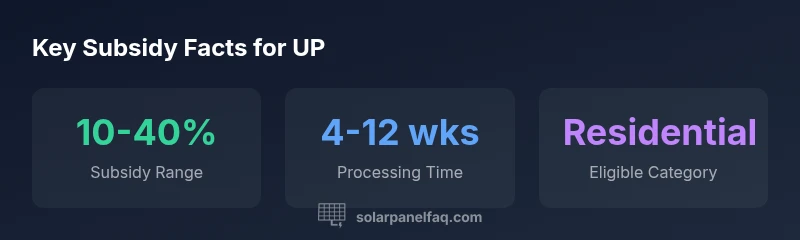
| Central rooftop solar subsidy | 10-40% | Residential, farmers, institutions | Caps and regional variations apply |
| UP state rooftop solar subsidy | Varies by program | Residential, small businesses | Top-ups may be available; check UP portal |
Frequently Asked Questions
What is the subsidy on solar panel in UP?
The subsidy depends on the program (central or state) and current rules; verify on MNRE and UP portals. Eligibility varies by consumer type and project size, and timing can differ by region.
Subsidy in UP depends on program rules; check official portals for current eligibility.
Who is eligible for UP solar subsidies?
Eligible groups typically include residential users, farmers under PM-KUSUM, and certain institutions, with criteria varying by program.
Residential users, farmers, and some institutions may qualify depending on the program.
What documents are needed to apply?
Common documents include identity and address proofs, bank details, electricity bill, roof ownership proof, and a formal installation quote.
You’ll need ID, address proof, bank details, and a project quote.
How long does the subsidy process take in UP?
Processing times vary by program, often ranging from several weeks to a few months, depending on demand and verification steps.
Processing times differ, usually weeks to months.
Can I get subsidy if I already have a loan?
Program rules vary; some subsidies consider loan status and credit terms. Check the specific scheme guidelines for clarity.
It depends on the scheme; verify with the program guidelines.
Is PM-KUSUM applicable in UP?
Yes, PM-KUSUM components can apply in UP for solar pumps and related installations; eligibility depends on program criteria.
PM-KUSUM applies with eligibility per the scheme rules.
“The UP subsidy landscape for solar panels changes with each budget cycle, so stay informed via official sources and plan your installation around current program rules.”
Top Takeaways
- Verify current subsidies on official MNRE and UP portals before applying
- Prepare complete documents to avoid processing delays
- Combine central schemes with UP incentives when possible
- Choose an installer familiar with UP rules to maximize benefits
- Track your application through each processing stage