How to Get Solar Subsidy in UP: A Practical Guide
Learn how homeowners in Uttar Pradesh can qualify for solar subsidies. This step-by-step guide covers eligibility, required documents, official portals, timelines, and tips to maximize savings while staying compliant with UP and central schemes.


To get a solar panel subsidy in UP, first check eligibility under state and central schemes, prepare required documents, and submit your application via official portals. Get a site assessment, size your system appropriately, and monitor submission status. Start with the UP government portal and MNRE resources to confirm current schemes and deadlines.
Subsidy Landscape in Uttar Pradesh
In Uttar Pradesh, solar panel subsidies are part of a broader national push to promote clean energy. While central schemes under the Ministry of New and Renewable Energy (MNRE) provide nationwide incentives, state programs in UP may offer additional subsidies or faster processing for eligible homeowners. The Solar Panel FAQ team found that program details can change with new fiscal years, so always verify current rules on official portals. By understanding the landscape, you can align your installation with eligible schemes and avoid common missteps. This section lays the groundwork for a streamlined application process and helps you set realistic expectations for timelines and disbursement. The emphasis here is on accuracy, official channels, and long-term savings. According to Solar Panel FAQ, staying informed about both state and central policies improves your odds of subsidy approval and reduces surprises later in the process.
Eligibility Criteria You Should Know
Eligibility generally hinges on a few core factors: your status as a homeowner, the installation location (rooftop or ground-mounted in favorable conditions), system size within limits, and compliant equipment that meets specified standards. In UP, schemes often favor new installations that connect to the grid and meet safety and performance criteria. Always confirm eligibility on the official UP government portal and MNRE resources to avoid investing in a project that won’t qualify. If you’re unsure, contact a qualified installer who understands the current rules. Solar subsidies also require a valid address proof and ownership verification, so have those ready before applying. The Solar Panel FAQ team emphasizes that eligibility is never assumed—verify through primary sources.
Required Documents and Pre-Application Prep
Preparing documents ahead of time speeds up the subsidy review. Typical requirements include identity proof, address proof, ownership documents, and a recent electricity bill for the installation address. You may also need bank details for subsidy disbursement and a property map or site plan from a licensed installer. Create a digital folder with clearly named scans (e.g., ID.pdf, Address.pdf, Ownership.pdf) and keep originals for verification. Having ready documents reduces back-and-forth inquiries and helps you submit a clean application the first time. Always cross-check the exact list on the official portals, as requirements can vary by program.
Using Official Portals: Where to Apply
Applications for UP subsidies are usually submitted through official government portals and MNRE’s central platforms. Start by visiting the UP government portal to locate state schemes and application instructions. Then consult MNRE’s resources for nationwide guidelines and to verify that a given UP scheme is active. When you fill out forms, double-check that all inputs match your documents exactly (spellings, addresses, spellings of names). Save confirmation numbers and take screenshots of each submission page for your records. Avoid third-party sites for submissions to prevent data leaks or misrouting of funds.
Choosing the Right Installer and System Size
A careful early sizing decision pays dividends later. Seek a licensed installer with experience in UP programs and inquire about how subsidies apply to the chosen equipment. An installer who understands government criteria can advise on system size, panel type, mounting method, and shade analysis. They should provide a detailed proposal with technical specs and a clear breakdown of gross costs versus subsidy-eligible components. Remember that errors in sizing or equipment can affect eligibility or reduce subsidy value, so consult multiple quotes and compare them side-by-side.
Step-by-Step Application Process Overview
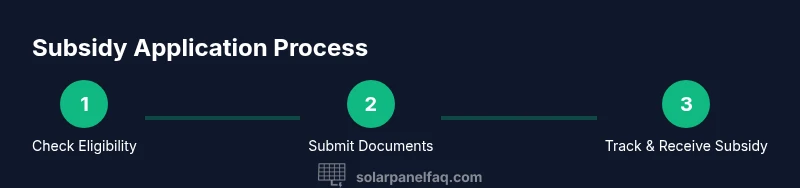
A structured approach makes the process smoother. Start with eligibility checks on official portals, gather required documents, and obtain a site assessment. The next steps involve submitting the subsidy application, providing any supplementary information requested by the reviewing authority, and monitoring the status until approval. If authorities request clarifications, respond promptly with precise, well-organized documentation. This proactive workflow minimizes delays and improves chances of timely subsidy disbursement.
Timelines, Approvals, and What to Expect
Processing times vary by program and the workload of the reviewing authority. You may encounter verification checks, document re-uploads, and occasional requests for additional information. Keeping a calendar of deadlines and regular status checks on the portal reduces the risk of missing windows. The Solar Panel FAQ team recommends setting reminders for key milestones and maintaining organized records to simplify any audits or post-implementation checks.
Common Pitfalls and How to Avoid Them
Avoid submitting incomplete forms or mismatched information, which commonly delay approvals. Ensure that your property ownership is clearly documented and that the installation plan complies with safety standards. Don’t rely on unofficial channels for updates or funds; rely on official portals for status updates and disbursement notices. Finally, be mindful of cap limits or eligibility ceilings that may apply to your scheme and plan your installation accordingly.
Tools & Materials
- Smartphone or computer with internet access(Used to access official UP MNRE portals and submit forms.)
- Identity proof (e.g., Aadhaar, PAN)(Scan of government-issued ID as part of eligibility.)
- Address proof(Proof of residence at the installation site.)
- Ownership documents for the property(Demonstrates the applicant’s authority to install on the property.)
- Recent electricity bill (installation address)(Helps verify location and energy baseline.)
- Bank details for subsidy disbursement(Account and IFSC information for funds transfer.)
- Digital folder of scanned documents(Organize documents with clear names (ID.pdf, Address.pdf).)
- Installer proposal and site plan(Official plan from a licensed installer showing system specs.)
- Measuring tape and basic drawing tools (optional)(Helpful for site survey and layout planning.)
Steps
Estimated time: 6-12 weeks
- 1
Check eligibility
Visit the official UP government portal and MNRE resources to review current subsidy schemes and eligibility criteria. Confirm your installation type and capacity fall within the approved ranges. This reduces the risk of submitting ineligible projects.
Tip: If uncertain, contact the stated support channels on the official sites to confirm before proceeding. - 2
Estimate system size and budget
Calculate your annual electricity usage and determine a feasible system size with your installer. Include equipment costs, installation charges, and expected subsidy portions to form a realistic budget.
Tip: Ask for multiple sizing scenarios (e.g., 3 kW, 5 kW) to compare cost and subsidy implications. - 3
Collect required documents
Gather identity, address, property ownership proofs, and the installation plan. Scan documents with legible resolution and organize them in a dedicated folder.
Tip: Label files clearly (e.g., ID_Aaadhaar.pdf, Ownership_Title.pdf) to speed up verification. - 4
Get a site survey and quotes
Request assessments from approved installers and obtain written quotes. Compare system size, mounting type, panel efficiency, and warranty terms.
Tip: Prefer installers with prior subsidy experience and good compliance records. - 5
Submit subsidy application
Fill the form on the official portal, attach scanned documents, and review inputs for accuracy. Submit and capture the confirmation/registration number.
Tip: Take a screenshot of the submission page for future reference. - 6
Track status and respond to queries
Regularly check the portal for updates. If authorities request additional information, respond promptly with organized, complete documents.
Tip: Set calendar reminders for expected verification windows and deadlines. - 7
Receive subsidy and install
Upon approval, coordinate with your installer to schedule installation and subsidy disbursement. Ensure post-installation checks and compliance with safety standards.
Tip: Keep installation completion reports and warranty certificates for records.
Frequently Asked Questions
Who is eligible for solar subsidies in UP?
Eligibility typically depends on owner-occupancy status, installation type, system size, and compliance with defined standards under state and central schemes. Always verify through the official UP government portal and MNRE resources before proceeding.
Eligibility depends on owner status, installation type, and meeting standards; check official UP and MNRE sources for current rules.
What documents are required for subsidy application in UP?
You will generally need identity proof, address proof, property ownership documents, a recent electricity bill, bank details for subsidy disbursement, and an installer-provided plan. Confirm the exact list on official portals.
Expect ID, address, ownership proofs, a recent electricity bill, and bank details; verify the exact list on official portals.
How long does the subsidy application process take in UP?
Processing times vary by program and portal workload. Regular status checks and timely responses to requests for information help avoid delays.
Processing times vary; monitor status and respond quickly to any requests to speed up the process.
Can subsidies be claimed for already installed solar panels in UP?
Most subsidy programs focus on new installations. Retroactive subsidies are uncommon; verify current guidelines on official portals before purchasing.
Subsidies typically apply to new installations; check current guidelines before proceeding.
Is subsidy available for rental properties in UP?
Many schemes target owner-occupied installations, but some programs may offer provisions for tenants under certain conditions. Check the policy details on official portals.
subsidies usually favor owner-occupied setups; confirm specifics on the official portals.
What is the difference between central and state subsidies?
Central schemes apply nationwide with uniform guidelines, while UP state schemes may offer additional incentives or faster processing for residents. Review both portals for the latest terms.
Central schemes apply nationwide; UP may add state incentives—check both sources for current terms.
How can I maximize my chance of subsidy approval?
Submit complete, accurate documents, choose compliant equipment, and maintain ongoing communication with the reviewing authority. Early preparation and professional guidance help minimize back-and-forth.
Provide complete docs, use compliant equipment, and stay in touch with authorities to improve approval chances.
Where can I find official information about UP subsidies?
Start with the UP government portal and MNRE’s official site. These sources provide current schemes, eligibility criteria, and submission guidelines. Avoid unofficial forums for critical updates.
Use the official UP portal and MNRE site for current schemes and procedures.
Watch Video
Top Takeaways
- Verify UP and MNRE subsidy eligibility before investing.
- Prepare a complete document bundle to speed processing.
- Use official portals for submissions and status updates.
- Compare multiple quotes for sizing and cost clarity.
- Track timelines proactively to avoid delays.