Free Solar Panels for Low-Income Families: Access and Savings
Discover legitimate pathways to obtain free or subsidized solar panels for eligible households. Learn about eligibility, how to apply, timelines, and what to expect during installation and maintenance.


Free solar panels for low-income families are available through a mix of government, utility, and nonprofit programs that reduce or cover installation costs. Eligibility typically requires income verification and homeownership or long-term occupancy. This quick guide points you to legitimate sources and outlines the typical application process, expected timelines, and common hurdles so you can start with confidence.
What free solar panels really mean for homeowners and renters
For many households, the idea of free solar panels sounds simple, but the reality depends on a patchwork of programs that may cover the equipment, installation, or related services. According to Solar Panel FAQ Team, credible pathways include government grants, utility-backed incentives, charitable foundations, and community partnerships designed to reduce upfront costs and accelerate energy independence. In practice, programs differ in what they cover, who qualifies, and how long the process takes. Some programs require ownership of the home; others offer options for renters through property agreements or community solar subscriptions. The key is to treat free solar as a benefit that reduces cost and risk rather than a guaranteed, universal entitlement. You will still encounter prerequisites such as roof suitability, energy audits, and ongoing reporting. The remainder of this article explains how to locate legitimate opportunities, prepare a strong application, and set realistic expectations about maintenance, warranties, and long-term savings.
Eligibility and criteria for free solar programs
Eligibility criteria vary by program, but some common threads appear across many reputable options. Income limits are typical, with ceilings that reflect household size and regional cost of living. Residency and property status also matter: some programs target owner-occupied homes, while others offer alternatives for renters through long-term leases or community solar channels. Roof condition and shading play a practical role because panel output depends on sun exposure and structural safety. In some regions, a pre-install energy audit is required to measure current consumption and identify efficiency upgrades that can increase overall savings. Programs may demand that participants participate in energy education or commit to monitoring energy use for a defined period. While the specifics differ, the overarching goal is to ensure the program helps households reduce bills without creating new financial risk. The Solar Panel FAQ Team notes that many legitimate options combine multiple support elements, such as technical assessments with subsidies and financing alternatives, making careful comparison essential.
Where to search for legitimate programs and how they work
Begin with federal, state, utility, and nonprofit sources. The federal Weatherization Assistance Program (WAP) and LIHEAP energy assistance often connect households to efficiency upgrades and, in some cases, solar pilots. Utilities may offer low-income solar subscriptions or credits, while local housing authorities run programs that bundle energy audits with equipment grants. Nonprofits and community solar cooperatives can provide discounted equipment or shared ownership opportunities. Always verify that a program is legitimate by using official government portals and avoiding door-to-door solicitations. The Solar Panel FAQ Team emphasizes that credible programs provide written terms, transparent eligibility criteria, and clear timelines. When in doubt, contact a known program administrator rather than responding to unsolicited offers.
How programs typically operate: grants, rebates, leases, and partnerships
Most programs do not hand out panels free to anyone; instead they operate via four common models. Grants pay for equipment or installation in full or in part, with strict eligibility checks. Rebates reduce out-of-pocket costs after installation and may require proof of income. Leases and power purchase agreements (PPAs) allow you to benefit from solar without owning the panels, with the provider retaining ownership. Partnerships between installers, utilities, and housing agencies can bundle energy audits, equipment, and service into one package. The best approach is to read the program terms carefully and request written timelines, warranty coverage, and maintenance responsibilities. Remember that eligibility can change year to year, and some programs cap total funding.
Preparing your application: documents, timelines, and tips
Gather documentation early: proof of income, proof of residence, government-issued ID, current utility bills, and roof information. Create a simple checklist and keep copies of everything in a digital folder with easy-to-find labels. Use official portals or recognized partners rather than informal emails or social media requests. Fill forms completely and accurately; missing data slows review and can trigger required corrections. Write a brief personal statement describing how energy costs affect your household and why assistance would make a difference. If a request for additional information arrives, respond promptly and politely. Denial is not the end—ask for the specific reason and how to improve the chances on reapplication. The Solar Panel FAQ Team recommends staying organized and adopting a consistent communication cadence with program staff.
Installation process and typical timelines
After approval, a site assessment confirms roof condition, shading, and electrical readiness. If upgrades are needed, they may be scheduled before installation but funded by the program. Installation can take a day or two on a standard home, with more complex roofs or older electrical panels requiring extra time. Permitting, local inspections, and utility interconnection can add weeks to the schedule. Some programs provide a fixed window from approval to activation, while others remain flexible due to supply constraints. Once installed, review the warranty coverage, maintenance responsibilities, and who monitors system performance. Keep a record of contact information for troubleshooting and ensure you understand the expected output and savings projections.
Costs beyond the panels: maintenance, monitoring, and possible charges
Even when the hardware is provided at no cost, there can be ancillary charges. Roof repairs or electrical upgrades may be required to ensure safe operation. Some programs include ongoing monitoring or annual service fees; others rely on homeowner responsibility after a warranty expires. Confirm who bears the cost of inverter replacements, mounting hardware, and conduit if needed. Understand warranty terms for the panels, inverters, and workmanship, and verify how long coverage lasts and what it includes. Local electricity rates heavily influence realized savings, so compare your post-installation bills under different rate plans. The key takeaway is to view free solar as part of a broader energy strategy that also emphasizes insulation, air sealing, and efficient appliances.
Myth vs. reality: common misconceptions
Many people assume free solar means zero effort or risk on the homeowner. In reality, programs set conditions, require documentation, and enforce ongoing reporting or audits. Some promoters promise instantaneous approval; the process can take weeks or months and depends on local funding cycles. Beware of scams that request upfront fees or sensitive data beyond what's necessary. Reputable programs publish terms in writing and provide direct contacts. The reality is that free solar aims to reduce energy bills for households facing high costs, often by bundling solar with efficiency upgrades and education to maximize benefits.
Next steps: deciding whether to pursue free solar options
Start by comparing total cost of ownership with scenarios that include traditional solar options. Consider installation availability, warranty coverage, potential credits, and future energy needs. If you decide to apply, map a realistic timeline, organize documents, and contact official program administrators. Keep notes of all communications and save confirmations. If you are unsure, seek guidance from the Solar Panel FAQ Team or an official program portal to verify eligibility. The goal is clear: affordable, reliable clean energy tailored to your home.
Tools & Materials
- Application form or online intake portal(Access via official program website)
- Proof of income(Recent pay stubs, benefit letters, tax returns)
- Proof of residence(Utility bill or lease agreement)
- Photo ID(Driver's license or state ID)
- Roof condition and property details(Recent roof inspection or photos)
- Computer with internet access(Needed for online submissions)
- Contact information for program staff(Optional but helpful)
Steps
Estimated time: 6-12 months
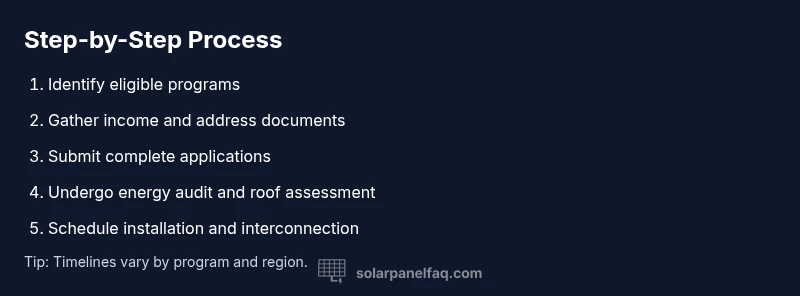
- 1
Identify eligible programs
Search official portals to find programs serving your area and household type. Read eligibility criteria carefully and note any deadlines or required documents. Create a quick checklist so you don’t miss items during the application.
Tip: Start with official government portals to avoid scams and save time. - 2
Gather required documents
Assemble income proofs, residence details, identification, and roof information. Scan documents and save digital copies with clear labels. Having everything ready reduces review delays and increases your chances of a smooth review.
Tip: Organize documents in a single folder and keep backups. - 3
Submit applications through official channels
Complete each form accurately and attach supporting documents. Use official portals or known partners, and save submission receipts. If you receive a request for additional information, respond promptly to avoid delays.
Tip: Double-check data before submitting; small errors slow processing. - 4
Respond to verification and schedule assessments
Program staff may request clarifications or schedule energy audits and roof assessments. Prepare access to your home and ensure inspectors can work safely. Clarify any costs or required upgrades identified during the assessment.
Tip: Schedule promptly and keep a log of all communications. - 5
Plan for installation and post-install follow-up
Once approved, coordinate installation dates with the program and installer. Review warranties and maintenance responsibilities and confirm who monitors system performance after activation. Collect all relevant contact information for troubleshooting.
Tip: Verify interconnection steps with your utility to avoid delays.
Frequently Asked Questions
Can I qualify for free solar panels if I rent my home?
Some programs offer options for renters through long-term leases or community solar arrangements; others require ownership. Always check official guidelines and confirm with the program administrator.
Renters may qualify in some programs, but you should verify the rules with the program administrator.
Do all states offer free solar panel programs?
Availability varies by location. Some states run pilots or provide significant subsidies; others offer limited or no free solar options. Check official state and utility portals for current opportunities.
Availability depends on your state and utility programs; look up official sources to confirm.
What documents are typically required?
Common requirements include proof of income, proof of residence, government ID, and roof information. Some programs may ask for utility bills or consent for credit checks.
You’ll usually need income proof, ID, and proof of residence.
How long does approval and installation take?
Timelines vary by program and region. Some approvals happen within weeks, others take several months due to funding cycles and scheduling constraints.
Approval and installation timelines differ by program and location.
Will the panels be truly free or are there hidden costs?
Many programs cover hardware and installation, but some may include ancillary costs such as roof upgrades or ongoing monitoring. Read terms carefully and ask for a written breakdown.
Sometimes there are extra costs; always get a written breakdown before agreeing.
Watch Video
Top Takeaways
- Identify credible programs early
- Gather required documents in advance
- Expect variable timelines and follow-ups
- Understand installation and maintenance responsibilities
- Verify warranties and post-install support