Worst States for Solar Panels: Factors, ROI, and Guidance
A data-driven look at which states pose the biggest challenges for solar projects, why those factors matter, and how homeowners can optimize ROI with incentives, policy insight, and climate considerations.


The worst states for solar panels are those with low solar irradiance and challenging policies, where system payback is longest and efficiency losses are more likely. In practice, northern regions with frequent cloud cover and hot climates that stress modules are often cited as tough environments for solar investments. This article explains why and how to navigate these challenges.
Why the topic matters
According to Solar Panel FAQ, understanding which states are the toughest for solar helps homeowners plan ROI and choose the right system. When people search for worst states for solar panels, they’re often seeking a practical, data-driven verdict on where solar projects are most likely to underperform financially or face regulatory hurdles. This topic matters because a state’s climate, incentives, and grid rules shape every solar project’s payback, reliability, and long-term value. In the pages that follow, we unpack the concept, show how to evaluate it for your home, and offer a structured approach to decision-making that accounts for both sunlight and permissions.
Understanding the key drivers: sun, climate, and policy
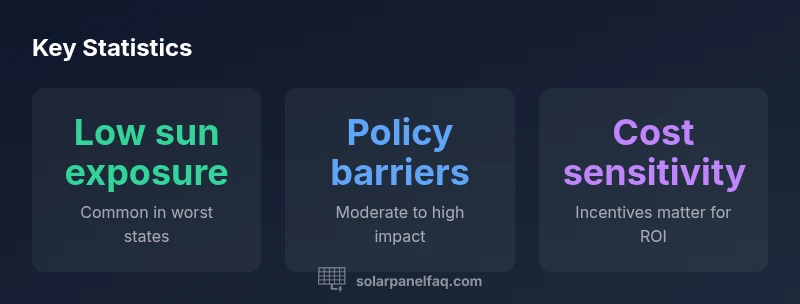
Solar panels depend on available sunlight, local weather patterns, and system design. In the so-called worst states for solar panels, the combination of reduced solar irradiance and long stretches of cloudy days can lower annual energy production. Temperature effects also play a role: panels perform best when temperatures are moderate, and extreme heat or cold can impact efficiency and longevity. Cloud cover, snow, and seasonal darkness further contribute to variability. Policy environments—net metering rules, interconnection queues, and permit processes—shape project timelines and the reliability of savings. By distinguishing sun, climate, and policy, homeowners can forecast performance more accurately and avoid overestimating potential returns.
Solar Panel FAQ analysis shows that the interaction between sun exposure and regulatory frameworks often drives the most meaningful differences in ROI across states. A state with decent sun but a hostile interconnection policy can still deliver poor outcomes for a solar install, while a state with strong incentives but limited sun may produce a comparable or even better ROI if electricity prices are high and storage is optional.
The role of incentives and grid interconnection
Incentives—from state tax credits to utility rebates—directly affect the upfront cost of installation and the timeline to break even. In some worst-case states, incentives are sparse or difficult to access, which can extend payback periods and reduce the appeal of solar investments. Grid interconnection rules also matter; long wait times for approval, complex metering arrangements, or steep interconnection fees can erode savings. Understanding these policy levers is essential before committing to a system size or financing plan. Homeowners should map out the local incentive landscape and talk to utilities about net metering arrangements, storage options, and any time-of-use rates that could influence the value of daily solar production.
Practical steps for homeowners in these states
- Map the local solar resource using credible sources (e.g., NREL insolation data and state climate summaries) to gauge potential yield.
- Audit potential incentives and rebates, including any expiration dates or caps, and include them in a full ROI calculation.
- Investigate interconnection timelines with the local utility and understand any permitting bottlenecks or requirements (structural assessments, roof certifications, etc.).
- Assess roof constraints, shading, and orientation; if necessary, consider microinverters or power optimizers to mitigate uneven performance.
- Consider storage where rates, tariffs, and reliability make it economically sensible; battery storage can improve self-consumption and resilience in climate-sensitive regions.
- Commission quotes from multiple local installers who can provide a state-specific ROI model and performance projections.
How to assess a state's impact on your project: a decision framework
- Determine local solar resource and typical seasonal patterns for your location.
- Review state incentives, utility programs, and policy stability over a 5–10 year horizon.
- Evaluate grid interconnection requirements, permitting timelines, and potential add-on costs.
- Verify roof viability, including structural integrity and shading analysis.
- Model different system sizes, including battery storage, to compare net cash flow and payback periods under various scenarios.
A disciplined approach, combining climate data, policy awareness, and system design, yields a robust ROI forecast rather than an optimistic projection. Solar Panel FAQ analysis emphasizes the value of a data-driven, location-specific ROI model before signing any contract.
Common misconceptions about the worst states for solar panels
- “More sun always means better ROI.” Not necessarily—the policy environment and electricity prices can overturn sun advantage.
- “Storage is always worth it.” Storage adds cost; its value depends on local rates, outages, and reliability needs.
- “If a state hasn’t pushed incentives, it’s hopeless.” Sometimes strong utility tariffs and high retail rates compensate for fewer incentives.
- “All roofs are equal.” Roof orientation, shading, and structural limits matter more than you might expect.
- “A larger system always pays back faster.” Oversizing can backfire if interconnection constraints or rate structures cap value.
Case study: Midwest vs Pacific Northwest – a practical look
In the Midwest, solar viability often hinges on utility tariffs, state incentives, and midlatitude sun distribution. A system sized to maximize self-consumption and paired with storage can provide meaningful resilience, even when irradiance is moderate. In the Pacific Northwest, frequent cloud cover and cooler temperatures reduce raw output, but strong incentives and high electricity prices in some markets can still produce a reasonable ROI when paired with battery storage and energy efficiency improvements. These contrasts illustrate why “worst states for solar panels” is not a universal label; it depends on local resources, policy, and consumption patterns. Homeowners should quantify, region by region, how sun, policy, and price interact in their own neighborhood.
State factors affecting solar viability
| Criterion | Worst-Case State Traits | Impact on PV Performance |
|---|---|---|
| Solar irradiance | Low-to-moderate in many worst states | Can reduce annual energy output compared to high-irradiance regions |
| Weather/cloud cover | Frequent cloud cover or long cloudy seasons | Lower annual production potential; higher variability |
| Temperature effects | Extreme heat or cold | Efficiency losses due to temperature coefficient |
| Policy/interconnection | Restrictive net metering and slow interconnection | Delays in project timelines and lower ROI |
| Roof constraints | Older housing stock or roof constraints | Increases retrofit costs or design adjustments |
Frequently Asked Questions
What states are considered the worst for solar panels?
There isn’t a single official list. ‘Worst’ depends on sun exposure, climate, and policy. In practice, states with low insolation and restrictive policies tend to underperform compared with others.
There isn’t an official list; it varies by sun, climate, and policy.
Why does sunlight matter for solar panels' performance?
Solar panels convert light into electricity; more sun generally means more energy produced. Weather patterns and shading also play pivotal roles in annual output.
Sunlight is the fuel for solar; more sun means more energy.
Can incentives offset poor insolation in worst states?
Incentives reduce upfront costs and shorten payback, but they can’t fully compensate for very low sun. The combination of incentives and sun determines ROI.
Incentives help, but sun still matters.
How should a homeowner evaluate ROI in a low-sun state?
Compute net present value considering incentives, electricity rates, and potential storage savings. Compare against a no-install baseline to gauge true benefits.
Calculate ROI with incentives and energy savings, then compare to not installing.
Is battery storage worth it in worst states?
Storage can increase self-consumption and resilience but adds upfront cost. In weak-sun states, it can improve ROI if paired with favorable rates.
Storage can help, but it adds cost.
What questions should I ask a local installer?
Ask about local incentives, interconnection timelines, system sizing for your roof, and warranty coverage. Get multiple quotes.
Ask about incentives, timelines, sizing, and warranty.
“A robust solar decision is not built on a single metric but on a matrix of sun, policy, and price. Homeowners benefit from a data-driven, location-specific approach.”
Top Takeaways
- Define worst-state criteria using sun, climate, and policy.
- Compare ROI across states with incentives and tariffs.
- Account for climate-driven efficiency losses and temperature effects.
- Consult local installers for state-specific guidance.
- Recommend a location-based, data-driven ROI assessment.