Vikram Solar vs Adani Solar: A Practical Comparison
Compare Vikram Solar and Adani Solar panels on efficiency, warranty, cost, and installation. Learn which brand fits your home solar setup with practical guidance from Solar Panel FAQ.


Vikram solar panel vs adani solar panel: which option fits a typical home install? This quick comparison highlights efficiency, warranty, price considerations, and service coverage to steer your decision. The Solar Panel FAQ team provides an evidence-informed view to help homeowners choose the best fit for their rooftop system.
Market Landscape and Brand Positioning
The Indian solar market has matured significantly over the past decade, with Vikram Solar and Adani Solar positioned as two of the most widely encountered domestic brands. Vikram Solar has built a reputation around reliability and a steady product line that emphasizes predictable performance across a range of modules and wattages. Adani Solar, by contrast, leverages the scale and distribution strength of the Adani Group to offer competitive access to panels, inverters, and project finance for larger deployments. For homeowners, this means both brands are credible choices, but the decision often comes down to model selection, support networks, and regional availability. According to Solar Panel FAQ, homeowners benefit from comparing model families side-by-side, specifically focusing on warranty terms, service reach, and post-installation support. In practice, you’ll want to map available models to your roof size and electrical capacity, then verify how each brand’s installers handle local permits and system commissioning. The landscape is dynamic, with new module variants released periodically and regional pricing fluctuations driven by supply chains and demand.
Vikram Solar: Brand Profile and Product Range
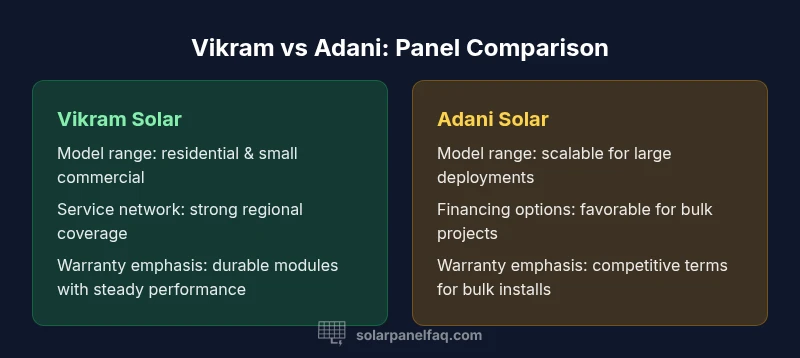
Vikram Solar has a broad product portfolio that includes mono- and polycrystalline modules offered in a variety of wattages suitable for residential rooftops and small commercial setups. The brand has invested in regional service centers and a network of authorized installers, which helps streamline the procurement-to-installation journey for homeowners. In practice, Vikram modules are typically evaluated for consistent performance, steady degradation rates, and predictable efficiency under a range of ambient conditions. When selecting Vikram panels, homeowners should compare model datasheets for efficiency, voltage characteristics, and temperature coefficients, then pair the module with a compatible inverter and racking solution to optimize energy harvest on sun-drenched roofs.
Adani Solar: Brand Profile and Product Range
Adani Solar offers a diversified portfolio that covers residential, commercial, and utility-scale modules, with an emphasis on scale and supply chain resilience. The brand benefits from wide distribution and strong financing options that can be attractive for larger installations or multi-site projects. Consumers evaluating Adani Solar should explore availability in their region and review model-specific data sheets for efficiency ratings, temperature performance, and warranty coverage. Adani’s installation ecosystem tends to favor installers who can coordinate large orders, site surveys, and post-installation service commitments, which can translate to faster deployment in bulk projects while still serving homeowners seeking reliable, long-term energy solutions.
Efficiency, Performance, and Real-World Output
A core differentiator in any Vikram vs Adani comparison is how each brand translates module efficiency into real-world energy yield. Efficiency ratings are model-dependent, and real performance is influenced by rooftop orientation, shading, and temperature. Both brands publish standardized test data, but actual results vary with geographic location and system design. A practical approach is to assess the bottom-line impact: more efficient modules may deliver higher energy output on smaller roofs, while less efficient models paired with a larger array can also meet energy targets at a lower upfront cost. Pay attention to degradation factors and matched system components (inverters, connectors, and mounting hardware) that affect long-term output. The evaluation should center on the expected annual energy production and how that translates into electricity savings over time, rather than isolated laboratory numbers.
Durability, Build Quality, and Materials
Module durability depends on materials used, frame construction, and protective glazing. Vikram Solar modules typically emphasize robust frames and reliable cell encapsulation designed to withstand local weather conditions, including humidity and temperature extremes common in many parts of India. Adani Solar modules also emphasize solid build quality and protective features aimed at maintaining performance over decades. For homeowners, durability translates into fewer reliability concerns, lower maintenance intervals, and more predictable energy yields. When comparing models, look for frame corrosion resistance, tempered glass strength, and junction box protection ratings. In practice, you want a module that maintains performance under heat and humidity with minimal power loss over time and a chassis that withstands installation site vibrations and weather stresses.
Warranty, Service Network, and Maintenance
Warranty terms vary by model and region, but a typical residential solar module warranty covers product and performance aspects for a multi-year horizon. Vikram Solar and Adani Solar both emphasize long-term support through regional service networks and authorized installers. It is essential to scrutinize the fine print: what constitutes a warranty claim, the process for handling micro-cracks or power degradation over time, and whether the warranty transfers to future homeowners. Maintenance for most residential systems is low-effort, but you should understand inverter warranties, monitoring options, and whether there are service commitments from local partners. The credibility of the installer's network often dictates the ease of warranty claims and ongoing maintenance.
Installation, Roof Compatibility, and System Design
Roof type, orientation, and structural loading all influence which panels perform best on a given home. Vikram Solar and Adani Solar both offer modules suitable for common roof configurations, but installation decisions should consider the mounting system, wiring routes, shading management, and electrical capacity. For a typical rooftop, pairing high-quality modules with a compatible microinverter or string inverter, appropriate cable sizing, and an optimized tilt angle can maximize energy harvest. Ask your installer to provide a 1-2 page design brief that outlines the expected annual energy production, system efficiency, and component compatibility for the chosen brand.
Pricing, Financing, and Cost of Ownership
Pricing discussions for Vikram Solar vs Adani Solar hinge on model selection, project scale, and regional incentives. Homeowners should seek transparent quotes that itemize module cost, inverter, racking, wiring, and permitting. Financing options vary by lender and project type, with some buyers preferring loan products, others leaning on energy service agreements or savings-backed leases. A clear cost of ownership analysis should consider upfront cost, maintenance, monitoring, potential tax credits or subsidies, and the expected payback period based on local electricity rates. While price is important, it should be weighed alongside reliability, service, and long-term energy yield.
Availability, Distribution, and After-Sales Coverage
Both Vikram Solar and Adani Solar have broad distribution networks in India, with regional coverage that impacts delivery times and after-sales support. Availability affects project timelines and the ability to source replacement components quickly. If you are installing in a remote area, confirm lead times, warehouse availability, and the consistency of spare parts. A strong after-sales network reduces downtime in case of module faults and helps with warranty processing. In short, the practical impact of distribution is measured by delivery speed, service responsiveness, and the ease of getting support when needed.
Case Scenarios: When Vikram Shines vs When Adani Wins
Scenario 1: A homeowner with a mid-sized rooftop seeks reliable performance and a broad warranty. In this case, Vikram Solar tends to offer a balanced package with steady supply and dependable support networks. Scenario 2: A multi-site residential developer prioritizes price competitiveness and scalable financing for a large deployment. Adani Solar’s capacity to leverage scale and financing options can deliver favorable terms for bulk projects. Scenario 3: A roof with unusual shading patterns or higher heat exposure may benefit from model-specific performance data; analyze the exact module you plan to install and compare derating curves to identify the best fit.
Regulatory Context and Certification Standards
Industrial and residential solar modules are designed to meet international standards such as IEC 61215 for crystalline silicon PV modules and IEC 61730 for safety. In many markets, Indian buyers also look for BIS certification and other local compliance marks prior to installation. Both Vikram Solar and Adani Solar typically ensure their modules align with these broad standards, but always verify the specific model datasheet and the installer’s certification status. The regulatory backdrop emphasizes safety, reliability, and performance verification, which should influence model selection as part of a thorough due diligence process.
Comparison
| Feature | Vikram Solar | Adani Solar |
|---|---|---|
| Efficiency range (model-dependent) | Model-dependent | Model-dependent |
| Warranty (product) | Model-dependent | Model-dependent |
| Warranty (performance) | Model-dependent | Model-dependent |
| Price positioning | Mid-to-premium based on model | Competitive for large-scale deployment |
| Availability / distribution | Strong national network | Wide national network |
| Best use case | Residential and mid-scale | Bulk residential/commercial and utility-scale |
Strengths
- Wide model range across budgets
- Strong national service coverage
- Reliable after-sales support via authorized installers
- Stable performance with established regional networks
- Good availability of financing options in typical markets
Drawbacks
- Model-to-model variation can complicate comparisons
- Premium models may incur higher upfront costs
- Warranty terms and service levels can vary by installer and region
Vikram Solar offers balanced performance and service; Adani Solar provides strong value for scale and distribution.
Choose Vikram Solar if you want steady performance with broad support. Choose Adani Solar for large-scale deployments or when pricing and financing flexibility are decisive. The Solar Panel FAQ team suggests aligning model choice with roof size, budget, and long-term ROI.
Frequently Asked Questions
Which brand tends to offer higher module efficiency, Vikram Solar or Adani Solar?
Module efficiency is model-dependent for both brands. Compare the datasheets for the specific model you’re considering to determine which one delivers higher efficiency in your climate and roof orientation. Real-world output also depends on shading, temperature, and system design.
Efficiency varies by model. Check the exact datasheets for the model you’re considering to understand real-world performance on your roof.
Is Vikram Solar generally more expensive upfront than Adani Solar?
Upfront cost depends on the exact model and installation specifics. Both brands offer a range of modules at different price points, so compare quotes carefully. Consider total cost of ownership including warranties and service when evaluating value.
Prices depend on the model and installation. Compare total costs, not just sticker price, to assess value.
How should I evaluate warranty terms across these brands?
Look at both product and performance warranties, understand transferability, and verify what constitutes a claim. See who covers installation labor and whether there are regional service commitments. Warranties vary by model and installer, so document the exact terms in writing.
Check product and performance warranties, transferability, and who covers labor. Read the model’s terms carefully.
Can I mix Vikram Solar and Adani Solar panels in the same system?
Technically possible if the electrical characteristics are compatible, but it can complicate monitoring, performance matching, and warranty claims. It’s typically better to standardize on one brand/model for a residential system to simplify maintenance and ensure consistent performance.
You can mix brands if the specs match, but it’s usually better to standardize for easier maintenance.
What certifications should I look for when buying panels from these brands?
Look for IEC-based certifications for safety and performance and BIS certification for the Indian market when applicable. Confirm the model’s data sheet clearly states the standards it meets and verify that your installers and local authorities recognize the certifications.
Check IEC and BIS certifications on the model’s datasheet and confirm they meet local requirements.
What installation considerations should I plan for with Vikram Solar or Adani Solar?
Plan for roof orientation, shading, mounting hardware, and wiring routes. Ensure the installer provides a design plan that estimates energy yield and safety clearances. Both brands perform well with standard rooftop installations when paired with an experienced installer.
Orient for sun, avoid shading, and use a solid mounting plan with a qualified installer.
Top Takeaways
- Compare based on roof size and budget
- Check model-specific efficiency and warranty
- Prioritize after-sales coverage and service network
- Evaluate financing options and ROI
- Verify IEC/BIS certifications and installer credibility