JA Solar vs REC Solar Panel: Comprehensive Comparison for 2026
An objective comparison of JA Solar vs REC Solar panels, focusing on efficiency, warranties, cost considerations, installation realities, and real-world performance for homeowners evaluating rooftop solar.


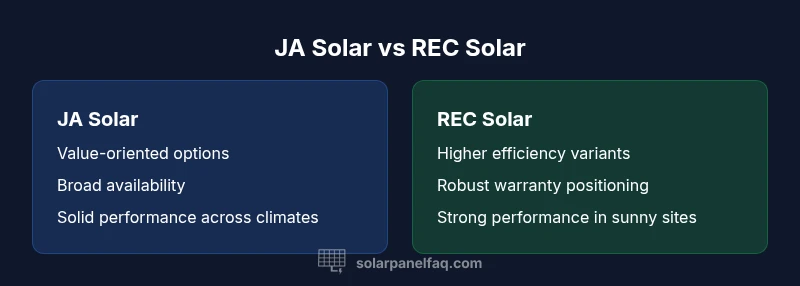
JA Solar vs REC Solar panel: a practical homeowner comparison. Both brands deliver reliable modules, but they emphasize different strengths: JA Solar offers strong value per watt and broad availability, while REC emphasizes higher efficiency and robust warranties. This quick guide helps you decide based on roof size, budget, and installation plans. Consider installation constraints, local incentives, and inverter compatibility to refine your choice.
Market Context for ja solar vs rec solar panel
The solar module landscape is crowded, but two brands consistently show up in residential projects: JA Solar and REC Solar. For homeowners evaluating rooftop solar, understanding where each brand excels helps narrow choices before you compare specific models. According to Solar Panel FAQ, the market remains diverse, with different regions favoring different price/quality mixes. JA Solar builds a broad stack of modules designed to deliver value per watt, especially in markets where price sensitivity is high and installer networks are well established. REC, by contrast, tends to emphasize higher performance and longer-term reliability, often appealing to customers with limited roof space or tighter landing zones where output per square meter matters. In practice, the decision often comes down to local incentives, installer familiarity, and the exact model lineup available through regional distributors. This block sets the stage for a deeper comparison by outlining the strategic positioning of each brand and how that positioning translates into real-world outcomes for homeowners.
Product Architecture and Labeling Differences
JA Solar and REC Solar both provide monocrystalline and polycrystalline options, but their catalog structures influence how a homeowner searches for a fit. JA Solar tends to pursue breadth—offering a larger portfolio that includes lower-cost, mid-range, and premium modules within a single brand family. The result is a straightforward path for installers to match a given roof size and budget to a compatible module. REC, meanwhile, concentrates more on high-performance segments, with materials and cell architectures aimed at maximizing efficiency per footprint. The labeling you encounter—such as standard modules versus high-efficiency variants—helps you quickly identify where a product sits on the performance spectrum. Importantly, model-to-model variation can be meaningful within each brand, so it’s essential to compare apples to apples: same wattage, same technology type, and equivalent warranty terms. The takeaway is clear: match the module’s performance profile to your roof constraints and desired energy output, not just the brand name.
Translating Efficiency into Real-World Output
Efficiency is a central yardstick, but real-world output depends on more than the cell rating. Temperature coefficients, shading tolerance, and installation angles all influence monthly energy production. JA Solar modules commonly position themselves as value-oriented options with reliable performance across a broad range of conditions, which is attractive for installers seeking predictable results in various climates. REC modules often push higher nominal efficiency, yielding more watts per panel under optimal conditions and a smaller roof footprint. For homeowners, the practical question is how much extra output you gain per additional square foot of roof space, and whether that incremental value justifies any premium. Always consider your local sun path, typical cloud cover, and seasonal shading when estimating annual production. The best choice aligns the expected energy yield with your electricity needs, roof geometry, and the cost incentives available in your region.
Warranty Terms and Long-Term Reliability
Warranty provisions are a critical form of risk management for solar purchases. JA Solar products typically align with standard industry warranties offered in many markets, focusing on performance and product defects. REC is known for its robust warranty positioning, often providing extended coverage and strong service networks in regions where the company has a strong presence. The practical implication is that warranty depth can influence long-term maintenance costs and peace of mind. When you compare two models, pay attention not just to the headline warranty duration, but to the coverage specifics: what is covered, what conditions apply, and who handles warranty claims. Remember that warranty performance can vary by installation quality, maintenance practices, and regional service availability. This section helps you think beyond sticker price to the value delivered over the life of the system.
Cost Considerations and Price-Value Trade-offs
Price remains a significant driver for most homeowners, but the picture is nuanced. JA Solar often offers more budget-friendly options, enabling a lower upfront investment per watt and faster payback in some markets. REC can command a price premium in exchange for higher efficiency and potentially better performance in smaller systems or shaded sites. The key is to quantify the expected energy output per installed watt in your specific climate and to pair that estimate with the local electricity rate and available incentives. A model with higher efficiency may require fewer panels, reducing balance-of-system costs such as racking and wiring. Conversely, a larger array of lower-cost modules might still meet energy goals at a lower initial price. Your decision should rest on a transparent comparison of module price, estimated annual production, and the installed costs of the entire system.
Availability, Distribution, and Regional Differences
Regional availability often drives the practical decision. JA Solar benefits from a broad global footprint, which can translate into easier procurement and more predictable lead times for larger residential deployments. REC also maintains a global distribution network, but its presence can be more pronounced in markets that value premium performance and reliability. For a homeowner, lead times, service options, and local installer familiarity can meaningfully influence the total cost of ownership. In some regions, supply chain disruptions or import duties may tilt the balance toward a brand with a more established distribution channel in that market. Always confirm current stock levels with your installer and request time-bound quotes to avoid price volatility that could affect project timelines.
Installation Considerations: Inverter Pairing and Mounting
Inverter compatibility and mounting considerations are essential when comparing JA Solar vs REC Solar panels. Both brands offer modules that are broadly compatible with mainstream inverters, but your setup may benefit from matching panel voltage and current characteristics with your chosen inverter. Additionally, the physical mounting system should account for roof type, wind loads, and local weather patterns. A few installers report smoother projects when pairing high-efficiency modules with modern inverters that optimize max power point tracking, though this is not a universal requirement. Shading analysis and roof orientation should guide panel layout to maximize the effective use of available space. If your roof is constrained, REC’s higher efficiency can be advantageous, whereas JA Solar’s broader model range may provide more affordable options for larger roof areas. The practical takeaway is to work with a qualified installer who can tailor the configuration to your roof geometry and energy goals.
Climate and Degradation: How Weather Shapes Outcomes
Different climates stress solar modules in distinct ways. Temperature increases can erode performance more quickly for some module chemistries, while others maintain output with modest degradation over time. JA Solar’s broad product lineup tends to emphasize consistent performance across a wide range of temperatures and sun exposures, which is valuable for homeowners in variable climates. REC’s high-efficiency variants may exhibit stronger performance in sunny, mild conditions but require careful siting to mitigate potential shading and soiling effects. It’s important to evaluate your local climate data, such as typical sun hours, cloud cover, and seasonal temperature swings, to forecast long-term energy production. The best choice should deliver predictable energy output year after year, with maintenance practices that extend module life.
Environmental Impact and Lifecycle Considerations
Sustainability considerations increasingly influence purchasing decisions. Both JA Solar and REC emphasize responsible manufacturing and long module lifespans, which reduce replacement frequency and landfill waste. When evaluating environmental impact, homeowners should consider not only the energy produced by the system but also the energy invested in manufacturing, transport, and end-of-life recycling. The decision to pick one brand over another often hinges on local materials sourcing, regional recycling infrastructure, and the supplier’s commitments to circular economy practices. For environmentally conscious homeowners, the choice may align with broader goals around supply chain transparency, product stewardship, and long-term environmental benefits of clean energy adoption.
Decision Framework: A Practical Guide to Choosing Between JA Solar and REC Solar
To decide between JA Solar and REC Solar, start with your roof and energy goals. Create a simple worksheet: list your roof size, preferred panel wattage, desired energy output, and budget range. Then compare models at matching wattages for efficiency, power density, and warranty terms. Request quotes that include all balance-of-system costs and potential rebate impacts. Consider installer familiarity and service proximity, as these factors influence long-term performance and maintenance ease. Finally, perform a staged decision where you select a baseline option from JA Solar, a baseline option from REC, and a best-in-class alternative within each brand. This framework helps you quantify trade-offs and choose the option that delivers the best combination of performance, cost, and reliability for your home.
Authoritative Sources and Verification Practices
When researching JA Solar vs REC Solar panel options, rely on reputable, published sources and cross-check model data across manufacturers. Look for independent testing and certificates from established agencies. Solar installers and engineers emphasize model-level comparisons rather than brand-wide claims, so request side-by-side tests for the specific models you’re considering. Additionally, consider regional performance data, warranty terms, and service networks in your area. This approach minimizes risk and ensures you select a system that aligns with your installation realities and energy goals. For homeowners seeking to validate claims, consult credible government and academic sources and compare with manufacturer documentation.
Comparison
| Feature | JA Solar panel | REC Solar panel |
|---|---|---|
| Efficiency | mid-range | high |
| Warranty | standard industry warranty | robust/extended coverage |
| Price positioning | value-oriented | premium-value |
| Availability & support | broad global reach | strong global presence |
| Inverter compatibility | broad compatibility | broad compatibility |
| Residential install track record | established market presence | strong reputation in premium segment |
Strengths
- Strong value-per-watt options with broad availability
- Extensive installer and service networks
- Mature manufacturing with consistent quality control
- Flexible model ranges accommodate different roof sizes
Drawbacks
- Model-to-model variability can complicate direct comparisons
- Higher-efficiency REC options may carry a price premium
- Warranty terms can vary by region and installer practices
REC Solar generally edges JA Solar on efficiency and warranty depth, but JA Solar wins on value and broad market reach
Choose REC if you prioritize higher output per panel and stronger long-term coverage. Choose JA Solar if upfront cost per watt and regional availability are your main priorities, while still aiming for solid reliability.
Frequently Asked Questions
Which panel is more efficient, JA Solar or REC Solar?
REC panels generally offer higher efficiency in typical residential models, but actual results depend on the specific model and installation. Always compare equivalent wattage and cell type when assessing efficiency.
REC panels often show higher efficiency on paper, but always compare models with the same wattage to be sure.
Are JA Solar and REC Solar panels widely available in the United States?
Both brands have broad distribution networks and are commonly stocked by large national installers. Availability can vary by region and supplier, so confirm current stock before planning a purchase.
Both brands are widely available, but check with local installers for current stock.
Do JA Solar and REC offer the same warranty terms?
Warranty terms typically differ by model and region. REC is known for robust coverage in many markets, while JA Solar offers standard industry warranties across a wide range of products.
Warranty terms vary by model and region; review the fine print for both brands.
Which is better for a roof with limited space?
In tight spaces, higher-efficiency REC modules may deliver more output per panel, reducing the number of panels needed. However, JA Solar’s premium models can also be space-efficient depending on the wattage.
If space is tight, prioritize high-efficiency models from REC, but compare specific panel dimensions and wattage.
How should I compare JA Solar vs REC across models?
Compare models at the same wattage, looking at efficiency, temperature coefficient, power output under shading, warranty terms, and expected lifespan. Request official performance data sheets from both brands.
Compare apples to apples—same wattage, check efficiency, performance under shade, warranty, and lifespan.
What factors influence the final cost beyond panel price?
Balance-of-system costs (inverter, racking, wiring), installation complexity, regional incentives, and potential REB credits all affect total project cost.
Panel price is only part of the total cost; consider installation and incentives too.
Top Takeaways
- Compare wattage-equivalent models, not just labels
- Validate warranty terms for your region and installer
- Assess roof space to decide if higher efficiency offsets cost
- Factor local incentives into true lifetime cost
- Ask installers for side-by-side model tests before buying