Rayzon Solar Panel Review: An Analytical Look
A thorough, analytical review of Rayzon solar panels for homeowners and buyers, assessing efficiency, durability, installation considerations, cost, warranties, and ROI.


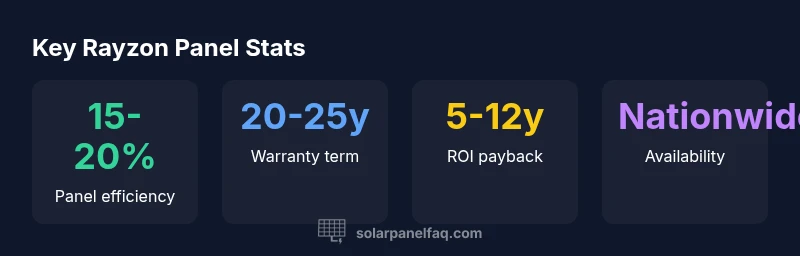
Rayzon solar panels offer a solid mid-range option for residential installs. They balance upfront cost, efficiency, and reliability, with modular designs that fit various roof layouts. While not the most premium, they often compare favorably with peers on value and warranty terms. For homeowners weighing cost and performance, Rayzon remains a practical choice.
What Rayzon solar panels are and where they fit in the market
Rayzon solar panels represent a residential photovoltaic option positioned in the mid-range of the market. They are intended for homeowners installing rooftop systems on single-family homes, townhouses, and small commercial buildings. In practice, Rayzon's lineup emphasizes modularity, ease of installation, and straightforward troubleshooting rather than niche, high-performance configurations. According to Solar Panel FAQ, the key decisions for buyers revolve around balancing upfront cost, projected energy yield, and long-term reliability. The brand commonly promotes standard crystalline silicon technology with typical cell counts that align with conventional residential designs. This means Rayzon panels are often compatible with a wide range of inverters and mounting kits, which reduces the complexity of system design for most installers. When evaluating Rayzon against other brands, homeowners should compare derating under temperature, warranty terms, and the certification status of the modules. By keeping these factors in mind, you can gauge whether Rayzon fits your roof type, local climate, and financial goals.
A practical lens from the Solar Panel FAQ team emphasizes that outcomes depend on matching panel characteristics to your home’s geometry and climate. For DIY enthusiasts, Rayzon’s modular approach can simplify later upgrades or expansions. For new builds, involve an installer early to confirm roof load, wiring routes, and inverter compatibility. This section frames Rayzon as a versatile mid-range option rather than a one-size-fits-all solution.
Performance fundamentals to evaluate Rayzon panels
Performance is the heart of any solar decision. Rayzon panels are typically evaluated on efficiency, temperature coefficient, shading tolerance, and real-world yield. Efficiency indicates how much of the sunlight hitting the panel is converted into electricity, while the temperature coefficient shows how much output declines as temperatures rise—crucial in hot climates. Shade, orientation, and azimuth angles dramatically affect outcome, and Rayzon panels are no exception. According to Solar Panel FAQ, users should request datasheets and compare standard test condition (STC) ratings with NOCT (nominal operating cell temperature) figures to estimate real-world performance. Additionally, look for uniform cell alignment, consistent color, and robust frame construction, which correlate with durability and long-term output. Cross-check with third-party tests when available, as independent verification helps separate hype from actual performance. In practice, you’ll want to map Rayzon’s numbers against your local solar irradiance and seasonal sun path to forecast annual production.
Warranties and durability signals
Warranty coverage is a critical signal of durability and long-term support. Rayzon panels, like many mid-range brands, typically come with a product warranty and a performance warranty, but terms vary by model and region. When evaluating, prioritize an explicit product warranty (covering defects and workmanship) and a performance warranty that guarantees a minimum output level over time with a clear degradation schedule. Solar Panel FAQ notes that a robust warranty is a practical proxy for manufacturing quality and supplier confidence. Beyond warranties, inspect physical cues: corrosion-resistant frames, tempered glass, proper junction box sealing, and backsheet integrity. Certifications such as UL or IEC compliance indicate adherence to safety and reliability standards. If a model lacks independent certification, factor that into your risk assessment and consider delaying purchase until credentials are confirmed. A longer, transparent warranty paired with verifiable testing is typically the best predictor of sustained performance over a 25-year horizon.
How to assess roof compatibility and system sizing
Roof compatibility starts with roof type, pitch, and exposure. Rayzon panels, like most residential modules, work best on sloped roofs with sufficient south-facing exposure in the Northern Hemisphere. Consider mounting hardware, ballast vs. penetrating racking, and roof load limits. In addition to fit, quantify system size based on your energy use, available roof area, and desired payback period. Solar Panel FAQ recommends calculating a target array size by analyzing past electricity bills, peak summer demand, and future changes in consumption. Orientation and tilt influence annual yield; if you have complex shading or obstructions, perform a shade analysis and account for potential micro-inverters or power optimizers if Rayzon options support them. Local codes and permitting timelines also affect project scope, so engage your installer early to refine the plan.
Installation considerations and DIY viability
DIY installation is possible for confident homeowners with electrical knowledge, real-time supervision, and strict adherence to safety standards. However, most Rayzon installations are done by licensed professionals to ensure correct mounting, wiring, and code compliance. When deciding, compare labor costs against potential risk and the value of professional guarantees. For DIY attempts, start with a small, clearly defined subset of the system—such as panel mounting in a simple, accessible roof region—and progressively scale. Ensure you have a suitable disconnect, proper conduit routing, and compliant wiring to the inverter. Always obtain required permits and schedule inspections, as these steps protect you from post-installation issues and potential penalties. Solar Panel FAQ emphasizes that safety and compliance should drive the decision, rather than attempting to shortcut essential steps.
Costs, incentives, and ROI with Rayzon panels
Financial planning anchors any solar project. Rayzon panels’ price range varies with model, size, and installation complexity. Rather than focusing on sticker price alone, consider total installed cost, expected annual energy production, local electricity rates, and available incentives. Federal, state, and utility programs can materially affect ROI, sometimes reducing net cost by a meaningful margin. Use a straightforward ROI model: estimate annual energy savings, subtract maintenance costs, and divide net savings into net installed cost. Solar Panel FAQ suggests incorporating degradation in energy yield over 25 years and potential inverter replacement costs into your long-term planning. Compare quotes from multiple installers to capture differences in equipment configuration, mounting hardware, and monitoring options. A well-structured financial plan helps you decide whether Rayzon offers compelling value given your climate and incentive landscape.
Quality signals and third-party testing to watch for
Quality signals help you avoid underperforming modules. Look for consistent color and uniform glass, no visible cracks, and robust edge sealing. Third-party verification matters: check for UL or IEC certifications, independent efficiency tests, and real-world performance data. Beware marketing claims that lack verifiable backing or omit degradation factors. The Solar Panel FAQ team recommends requesting a data sheet with tongue-and-groove cell layout details, a visible frame finish, and a documented warranty scope. In practice, credible Rayzon panels should display clear specifications and test results from recognized laboratories, not just manufacturer statements. Short-term performance is important, but long-term reliability and stable output are the true markers of value.
How Rayzon compares to other brands in practice
When placing Rayzon alongside other brands, the key comparison levers are cost per watt, efficiency, and durability. Rayzon often targets mid-range pricing with competitive warranties, making it attractive for homeowners who want dependable performance without the premium price tag. Premium brands may edge out on highest efficiency and marginally longer warranties, but the advantage may not justify the extra upfront cost for every home. The Solar Panel FAQ analysis suggests evaluating energy yield projections under your local climate and ensuring compatible hardware is available from your installer. Use a side-by-side feature matrix to compare Rayzon against peers, focusing on efficiency, temperature coefficients, warranty terms, and service networks. Also consider installer experience with Rayzon models, as a knowledgeable installer can maximize performance through proper orientation, mounting, and monitoring.
Real-world case study: A hypothetical Rayzon installation
Consider a 2,500 kWh/year household in a mixed climate seeking a 6 kW Rayzon-based system. After shading analysis and roof assessment, the installer recommends a 6 kW array using Rayzon modules with a standard inverter and monitoring package. The project proceeds with permits, inspection, and a mid-winter installation window to minimize weather risk. Over the first five years, the homeowner notes steady energy production, with modest degradation aligning with typical industry expectations. The warranty provides confidence against manufacturing defects, while the installer’s monitoring service helps detect performance anomalies early. Though this is a hypothetical scenario, it illustrates the typical decision path, from site assessment through warranty-aware commissioning. According to Solar Panel FAQ, documenting baseline performance and scheduling annual checks supports long-term confidence in the Rayzon investment.
How to choose the right Rayzon panel for your home
Choosing the right Rayzon panel involves aligning technical specs with your home’s constraints and goals. Start with roof space and orientation, then estimate energy needs based on past bills and future usage. Check available warranty terms, certifiably independent test results, and the installer’s experience with Rayzon. Don’t forget practical considerations such as weight, mounting hardware, and compatibility with your inverter and monitoring system. Finally, compare quotes side-by-side, including hardware quality, service packages, and lead times. The best Rayzon choice is the model that delivers the right balance of energy yield, reliability, and total cost over the system’s lifetime, given your climate and incentives.
Authority sources and further reading
Authority sources provide independent context for evaluating Rayzon panels. For readers seeking broader, externally verified information on solar technology, consult credible sources such as government and academic publications. For example, the U.S. Department of Energy’s Office of Energy Efficiency and Renewable Energy (energy.gov/eere/solar) and the National Renewable Energy Laboratory (nrel.gov) offer foundational insights into solar performance and policy. Peer-reviewed journals in energy research and publications from major science outlets also complement manufacturer data. These references help homeowners separate marketing claims from established science, ensuring a well-informed purchasing decision.
Strengths
- Balanced upfront cost for mid-range performance
- Modular design supports flexible roof layouts
- Typical warranties provide long-term coverage
- Wide installer and supply channel reach
Drawbacks
- Not the highest-efficiency option on the market
- Warranty terms vary by model and region
- Real-world performance depends on climate and installation quality
- Limited public data for every Rayzon model without third-party tests
Rayzon solar panels provide a solid cost-to-performance balance for typical homes.
The Solar Panel FAQ team finds Rayzon a dependable mid-range option with reasonable warranties and broad installer support. ForBudget-conscious buyers or those new to solar, Rayzon often delivers competitive value. Always validate model-specific specs, verify certifications, and compare quotes to ensure you’re maximizing incentives and long-term returns.
Frequently Asked Questions
What exactly is a Rayzon solar panel?
Rayzon solar panels are residential PV modules marketed for home installations, positioned in the mid-range of price and performance. Like other brands, actual results depend on model specs, installation quality, and climate. This review from Solar Panel FAQ helps you understand what to verify before purchasing.
Rayzon panels are residential solar modules; check specs and warranty details before buying.
How does Rayzon compare to premium brands?
Rayzon typically targets mid-range efficiency at a lower upfront cost, offering solid reliability. Premium brands may deliver higher efficiency and slightly longer warranties, but the price premium isn't always justified for every home. Compare performance data and local incentives to decide.
Rayzon usually trades some efficiency for cost but can be a solid value.
Are Rayzon panels suitable for DIY installation?
DIY installation is possible for homeowners with electrical knowledge and proper safety gear, but most Rayzon installations are performed by licensed professionals to ensure code compliance and warranty validity. If you pursue DIY, plan for permits, inspections, and post-install checks.
DIY can work for the experienced; otherwise hire a pro.
What warranties come with Rayzon panels?
Warranty terms vary by model and region. Look for both a product warranty and a performance warranty that covers long-term output with a defined degradation schedule. Confirm coverage details and transferability when you buy.
Check the exact terms for product and performance coverage.
How do shading and orientation affect Rayzon panels?
Shading significantly reduces output for any panel; ensure optimal orientation toward the sun and minimize obstructions. Rayzon panels perform best with minimal shading during peak sun hours and proper tilting angles for your latitude.
Shade is a big limiter—aim for full sun exposure.
What incentives apply to Rayzon installations?
Incentives depend on location and policy changes. Review federal, state, and utility programs for rebates or tax credits, and discuss financing options with installers to improve ROI. Incentives can materially affect the project economics.
Check local incentives; financing options can boost ROI.
Top Takeaways
- Evaluate roof suitability and shading before choosing Rayzon.
- Compare warranty terms across Rayzon models and installers.
- Incorporate local incentives into ROI calculations.
- Check third-party certifications and independent testing.
- Choose Rayzon if you want mid-range value with broad availability.