Flexible vs Rigid RV Solar Panels: A Practical Comparison
Compare flexible and rigid RV solar panels—weight, installation, durability, efficiency, and cost to help you choose the best fit for curved roofs or flat decks.


TL;DR: For RV setups, flexible panels excel on curved or lightweight roofs, while rigid panels offer higher efficiency and better durability on flat roofs with more mounting options. The best choice hinges on roof geometry, weight limits, and whether installation ease or long-term power density matters most. A balanced hybrid can work for some rigs.
Key Differences Between Flexible and Rigid RV Panels
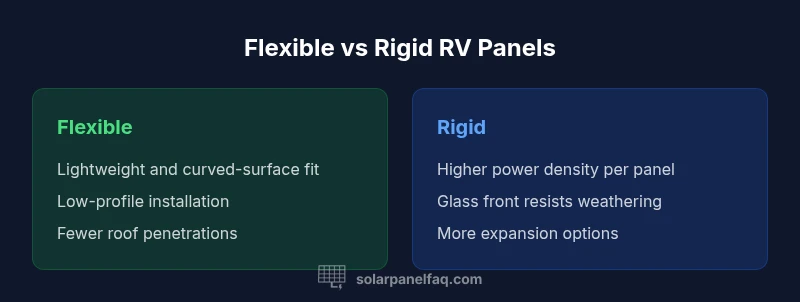
According to Solar Panel FAQ, the difference between flexible and rigid RV panels begins with construction and mounting. Flexible panels are typically thin-film or ultra-thin crystalline units that bend to conform to non-flat surfaces. This can dramatically reduce weight and simplify installation on rounded or irregular roofs, enabling installation without heavy hardware. Rigid panels are crystalline silicon modules protected by glass and aluminum frames; they provide a sturdy, fixed mounting on flat or gently curved surfaces and often deliver higher peak power per watt in the same footprint. The trade-offs go beyond weight: flexible panels spread across a curved roof can leave seams and edges prone to water intrusion if not sealed properly, and their flexible backing may degrade faster when exposed to heat and UV over many years. Rigids, while heavier, tend to tolerate weather better thanks to a rigid glass front and robust frame, and they’re typically easier to wire in series for larger systems. Installation approaches also differ: flexible panels commonly rely on adhesive-based mounting or clamps that minimize roof penetrations; rigid panels usually require rails or brackets and, in some cases, drilled penetrations for long-term waterproofing. In practice, the decision hinges on roof geometry, payload limits, and your plans for future expansion or upgrading of power capacity.
When to Choose Flexible Solar Panels for Your RV
If your RV has a curved or irregular roof, flexible solar panels often deliver the best combination of fit and weight. They can conform to contoured fiberglass, aluminum, or composite surfaces without bulky frames, reducing drag and improving fuel economy slightly in theory. Installation is typically faster, with adhesive bonding or lightweight clamps that avoid roof penetrations. However, you must seal edges carefully and inspect seals regularly, since flex modules can creak or lift if exposed to extreme heat or long periods of vibration. Flexible panels are also popular for seasonal campers who want rapid, reversible installations, or for DIY enthusiasts who want a clean, low-profile look. Expect a slightly lower open-circuit voltage per square foot in some thin-film models, and plan for adequate airflow behind the panel to avoid heat buildup. In short, choose flexible panels when roof shape or weight is the dominant constraint and you don’t mind a potential maintenance routine to keep seals watertight.
When to Choose Rigid Solar Panels for Your RV
Rigid panels are an excellent choice when your roof is flat or only mildly curved, and when you want maximum energy density per square foot. The glass front and metal frame offer durability against hail, wind, and UV exposure, and many rigid panels come with straightforward mounting rails that support tiling in larger systems. They’re often easier to clean and inspect, and wiring in series to reach higher voltages is a familiar task for many installers. Warranty coverage can be more consistent across established brands, and replacement parts are widely available. On the downside, rigid panels add weight and require more robust mounting hardware; they demand prime mounting locations and can be less forgiving on curved surfaces. If you anticipate adding more capacity over time, rigid modules make expansion straightforward, though you may need to reconfigure wiring to optimize your charge controller. In most scenarios, rigid panels win on reliability and power density when the roof is suitable.
System Design and Installation Considerations
Your RV solar design begins with a clear picture of your battery bank, inverter, and typical daily energy use. Regardless of panel type, you’ll want an efficient charge controller (MPPT is generally preferable for higher voltage arrays) and a well-planned wiring topology (series vs parallel) to balance voltage, current, and shading. Flexible panels placed on curved surfaces may reduce the need for penetrations, but you must protect adhesive seams from water and heat cycling with proper edge sealing. Rigids require rails and sometimes roof penetrations but can offer more robust long-term reliability if mounted correctly. When sizing, calculate total wattage based on daytime use plus reserve for attic fans or heating, then scale to your battery storage capacity. Don’t overlook shading from vents, antennas, or tree limbs, which can dramatically reduce output. Finally, plan for future expansion by designing a modular system that can add panels without overburdening your controller or wiring.
Cost, Longevity, and Practical Tradeoffs
Total system cost depends on panel type, wattage, and installation approach. Flexible RV panels generally offer a lower profile and lighter weight, which can reduce installation complexity but may carry a higher price per watt and potential maintenance costs if seals degrade. Rigid panels typically deliver higher peak efficiency per panel and longer service life under typical RV conditions, but they require heavier mounting hardware and more roof space. When budgeting, consider not just the sticker price but the cost of mounting hardware, wiring, and a compatible charge controller. Price ranges exist to fit different budgets: entry-level kits or single panels can be relatively affordable for small setups, mid-range configurations add multiple panels with more robust mounting hardware, and premium systems deliver high-wattage arrays with longer warranties and more modular expansion options. In essence, the right choice balances roof constraints, power goals, and long-term maintenance expectations rather than chasing the lowest upfront price alone.
Maintenance, Warranties, and Safety
Warranty terms vary by type and brand; rigid panels often offer longer coverage for the glass and frame, while flexible panels may emphasize seal warranties and edge durability. Regardless of type, expect cleaning to remove dust and grime, periodic seal inspections around roof edges, and monitoring for leaks after heavy rain. Inspect connections and cabling for wear from vibration. Safety considerations include avoiding walking on panels when hot and disconnecting the system during maintenance. When choosing an installer, verify credentials and ask about support for roof warranties and travel or off-grid trips. A reputable setup will include a plan for seasonal storage or off-season use and will emphasize evaluating the ability to replace a single panel without reworking the entire array. Keep a spare panel of the same type on hand for future expansion.
Practical Use-Cases and Real-World Scenarios
Consider a scenario where you frequently travel in hot climates with a curved fiberglass roof and don’t want heavy hardware. Flexible panels shine here, enabling a low-profile installation with reversible mounting. Another scenario is a weekend camper with a flat or slightly curved roof where a rigid array near the center provides consistent power and easier maintenance. If you plan to upgrade gradually, a modular system with panels that can be replaced or added later works well regardless of type. In both cases, ensure your charge controller and battery bank can handle the chosen array and that you have a safe, watertight approach to cabling and junction boxes. The key is to tailor the system to your travel patterns, climate, and storage habits.
Quick Start Checklist and Next Steps
Create a simple energy budget (daily loads vs. desired autonomy). Sketch your roof layout and max supporting weight. Choose an installation method (adhesive vs rails) and select a charge controller with headroom for future expansion. Request quotes that include mounting hardware and warranty terms. Finally, map out a 12–24 month plan to verify performance and adjust the system as you gain real-world data.
Comparison
| Feature | Flexible RV Panels | Rigid RV Panels |
|---|---|---|
| Weight / Mounting | Lightweight, adhesive or clamp mounting | Heavier, rail-based mounting with possible penetrations |
| Efficiency per Watt | Typically lower peak efficiency per module (varies by model) | Typically higher peak efficiency per module in standard conditions |
| Durability & Weather Resistance | Better weight advantages but edge wear risk; protection varies | Robust protection; glass front resists hail and UV better |
| Best Roof Type | Curved/irregular roofs, minimal intrusion | Flat or gently curved roofs, long-term reliability |
| Installation & Maintenance | No roof penetrations; seals must be maintained | Rails/clamps; may require penetrations for mounting |
| Cost & Payback Context | Lower upfront weight, potential higher per watt costs | Higher upfront but often lower cost per watt over time |
Strengths
- Low weight preserves RV payload
- Easier installation on curved roofs
- Minimal roof penetrations with adhesive mounting
- Faster initial installation
- Can preserve roof integrity on non-flat surfaces
Drawbacks
- Typically lower peak wattage per panel (model dependent)
- Potential edge wear and seal maintenance for flexible panels
- Rigid systems can be heavier and harder to install on curved roofs
- Hybrid configurations require careful electrical planning
Rigid panels generally win on power density and long-term durability when the roof geometry permits; flexible panels win on curved roofs and weight constraints.
Choose rigid panels if your roof supports a higher-watt, durable array and lowest maintenance; choose flexible panels if you need a lightweight, curved-roof solution and easier, quick-install options.
Frequently Asked Questions
What is the main difference between flexible and rigid solar panels for RV use?
The main difference lies in construction and mounting: flexible panels bend to fit curved roofs and are lighter, while rigid panels use a glass-front crystalline module with rails and offer higher peak wattage per area on suitable roofs.
Flexible panels bend to curved RV roofs and are lighter, whereas rigid panels use glass-front modules with rails and often deliver higher wattage per area on compatible roofs.
Are flexible panels reliable on curved RV roofs?
Flexible panels can be reliable on curved roofs when edge sealing and heat management are properly addressed. Regular inspection of seals and mounting edges is important due to flexing and exposure to heat cycling.
Yes, with proper sealing and maintenance; inspect edges regularly for wear.
Can I mix flexible and rigid panels in the same system?
Mixing types is possible but complex. Ensure compatible voltages and currents, and use a charge controller capable of handling the combined array. A modular approach can ease future upgrades.
Mixing is possible with careful electrical planning and proper controller sizing.
How should I mount flexible panels on an RV roof?
Use high-quality outdoor adhesives or clamps and seal edges to prevent water intrusion. Avoid over-tightening and ensure the roof is clean and dry before installation. Consider professional mounting for guidance on seal integrity.
Adhesive or clamp mounting works; seal edges and keep the roof dry.
How do I estimate how many watts I need for my RV?
Start with your daily energy use, add a safety margin, and estimate sun hours to size the array. Pair with a battery bank large enough for overnight usage and future growth.
Calculate daily load, add a margin, and size the system for expected sun hours.
What about warranties and maintenance for RV panels?
Warranties vary by type and brand; rigid panels often have longer glass/frame coverage, while flexible panels emphasize seal durability. Regular cleaning and seal checks help preserve performance.
Check warranty terms and schedule regular seal checks and cleaning.
Top Takeaways
- Measure roof curvature and payload limits before selecting panels
- Match panel choice to your daily energy needs and expansion plans
- Plan for a compatible charge controller and battery bank
- Consider warranty terms and maintenance requirements
- Explore modular or hybrid options for flexibility