Generator vs Solar Panel for Home: A Comprehensive Comparison
Explore a detailed, objective comparison of generator vs solar panel for home, covering cost, reliability, environmental impact, and practical scenarios to help homeowners decide the best power solution for 2026.


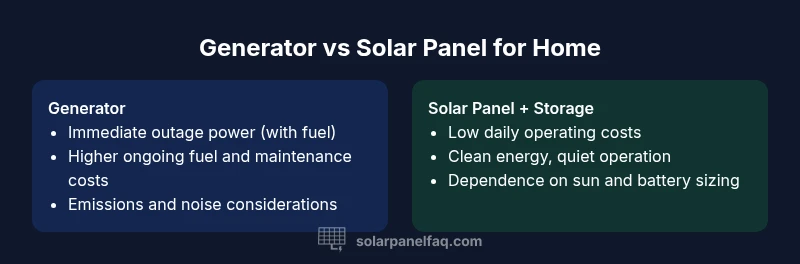
TL;DR: For most homes, a solar panel system with storage is the smarter long-term choice compared to a gas-powered generator, due to lower operating costs, reduced emissions, and resilience when paired with storage. A generator remains valuable for extended outages, high-demand events, or off-grid locations where sun is scarce.
Generator vs solar panel for home: framing the decision
When homeowners compare generator vs solar panel for home options, the core questions extend far beyond the sticker price. The decision hinges on reliability, long-term operating costs, environmental impact, and the role of storage and grid interaction. According to Solar Panel FAQ, the choice often boils down to whether you prioritise consistent daily power, potential energy independence, or backup resilience during outages. Among the most common win conditions: solar panels paired with batteries excel in reducing daily energy costs and emissions, while generators excel in guaranteed power during prolonged outages or in off-grid locations with limited sun. This section sets up a framework you can apply to your home, whether you live in a dense city with a robust grid or a rural area with seasonal sun.
We’ll use practical criteria and concrete scenarios to help you map your energy needs, roof or yard space, and tolerance for noise or maintenance. Keep in mind that the Solar Panel FAQ team emphasizes that the best choice often blends technologies—solar plus storage with a back-up generator for extreme outages. The goal is to maximize reliability while minimising ongoing costs and environmental impact over the system’s lifetime, rather than chasing the lowest upfront price.
In this comparison you’ll see how daily power needs, outage tolerance, and long-term economics interact with equipment choices, installation complexity, and the local policy landscape. We’ll also cover how to size systems, what to ask installers, and how to evaluate performance after installation so that you can make an informed decision for 2026.
bold: true},
Cost framework: upfront, ongoing, and maintenance
Understanding total cost of ownership is essential when choosing between a generator and a solar panel system with storage. Generators typically involve lower upfront hardware costs but incur ongoing fuel expenses, maintenance intervals, and periodic part replacements. In contrast, solar panels plus battery storage require higher initial investment and more complex installation, but operating costs trend lower over time as electricity from the grid or net metering offsets consumption. The cost narrative is also shaped by incentives, financing options, and the local utility structure, which can dramatically influence the long-term value proposition. The Solar Panel FAQ analysis shows that homeowners who adopt battery-backed solar with net metering generally achieve greater bill reductions over several years, especially in high-tuel demand regions. Yet the total cost is sensitive to battery depth of discharge, inverter efficiency, and system size relative to household load. When evaluating options, compare not only the sticker price but also annual fuel costs (for generators), maintenance cycles, and the expected lifespan of major components like inverters and batteries. This section provides a practical checklist to quantify costs without relying on uncertain price guesses.
- Upfront hardware: generator price vs solar panel array plus inverter and battery storage
- Ongoing costs: fuel, maintenance, and potential battery replacements
- Indirect costs: noise, emissions, and maintenance time
- Financial incentives: rebates, tax credits, and net metering credits
- Payback horizon: how long before savings offset initial investment
bold: true},
Reliability and resilience: outage performance
Reliability and resilience are central to any power system decision. A traditional gas-powered generator offers immediate, unconditional power during an outage, assuming fuel is available. If outages are frequent and lengthy, a generator can seem indispensable. Solar panels, by themselves, depend on daylight and weather; however, when paired with battery storage, they can provide substantial resilience by delivering daytime power and backing up critical circuits when the sun is shining. The Solar Panel FAQ team emphasizes that the reliability of solar-plus-storage hinges on battery capacity, proper sizing, and the ability to maintain charge during consecutive outages. Grid-tied solar with storage can also benefit from utility programs that allow for reduced grid draw or even grid export during peak hours. In regions with long outages due to weather or infrastructure limits, a hybrid approach—solar plus battery with a back-up generator—can deliver robust resilience without fully committing to one technology. When evaluating outage resilience, consider: (1) peak load requirements, (2) critical circuits you want to back up, (3) average outage duration, and (4) fuel availability or fuel-security plans. Solar Panel FAQ notes that the right mix often reduces the odds of being left powerless, across a broad range of scenarios.
bold: true} ,
Environmental impact and energy independence
Environmental considerations are increasingly central to home energy choices. Generators rely on fossil fuels, produce emissions, and generate noise that some homeowners find intrusive. Solar panels, by contrast, produce clean electricity with minimal ongoing emissions and very quiet operation, especially when paired with modern inverters and battery storage. The environmental calculus also includes lifecycle considerations: manufacturing, transportation, and end-of-life recycling. The Solar Panel FAQ team highlights that solar plus storage can substantially reduce a household’s carbon footprint over its lifetime, particularly when paired with a smart energy management strategy and access to net metering. Battery production and recycling pose challenges, but advances in chemistry and second-life applications continue to improve sustainability. In discussions about environmental impact, it’s important to weigh local air quality improvements, fuel supply chain risks, and the broader energy mix from your utility. A well-designed hybrid system can minimize environmental impact while maximizing resilience.
- Emissions during operation: generator vs solar
- Noise and air quality considerations
- End-of-life management for batteries and panels
- Local grid interactions and renewable credits
bold: true},
Space, installation, and roof considerations
Space and installation logistics heavily influence whether you opt for a generator or a solar panel system with storage. Generators require a protected, well-ventilated location with adequate clearance, fuel storage, and regular service access. Solar panels demand roof real estate or ground-mounted space, optimal orientation, and protection from shading. In urban homes with limited roof area, a hybrid approach may emphasize maximizing a smaller solar footprint while keeping a compact generator as a back-up. The battery bank adds another dimension: it needs safe, ventilated enclosure and thermal management. The Solar Panel FAQ team notes that local codes, HOA rules, and permit processes can impact installation timelines and costs. A detailed site assessment is essential to determine whether your roof can support the load, whether a generator’s location is feasible, and how to integrate battery storage with your electrical panel. This section provides a practical decision tree for space and installation feasibility, with checklists for: roof age and structure, shading analysis, access for maintenance, and proximity to living spaces.
- Roof orientation and shading; impact on solar yield
- Battery enclosure and ventilation requirements
- Generator exhaust considerations and noise isolation
- Permitting, codes, and HOA rules
bold: true},
Hybrid approaches: pairing solar with generator backup and batteries
In many real-world homes, the smartest solution is a hybrid system that blends solar, storage, and a back-up generator. This arrangement captures the strengths of each technology: solar reduces daytime energy use and emissions, batteries provide short-term backup for critical loads, and a generator closes the gap during extended outages or high-demand periods when solar output is insufficient. The design challenge is sizing each component so that they support one another without overbuilding. For example, a generator can be reserved for outages that exceed battery duration, or for high-demand events when daylight is scarce. A well-planned hybrid system also leverages smart energy management to prioritize essential loads during outages, maximizing resilience while keeping costs reasonable. The Solar Panel FAQ Team emphasizes engaging with an experienced installer who can model usage patterns, peak loads, and outage scenarios to determine the right mix for your home. In practice, a hybrid setup may include: a moderate solar array, a battery bank sized for daytime and evening needs, and a compact, efficient generator for rare but critical outages.
- Roles of solar, storage, and generator in outage scenarios
- Sizing considerations for a balanced hybrid system
- Control strategies: prioritizing loads and sequencing
bold: true},
Real-world scenarios: urban vs rural, seasons, and policy
Real-world decisions are rarely made in a vacuum. Urban homeowners with robust grid access and favorable net metering policies may find solar-plus-storage to be highly cost-effective, especially if air quality and noise restrictions discourage generator use. In rural or remote locations with limited grid reliability or limited fuel access, a generator becomes more attractive, but solar with battery storage can still provide significant day-to-day savings and emergency power. Seasonal variations matter: longer nights or cloudier months reduce solar yield, increasing the value of storage capacity. Policy and incentives strongly influence overall economics; some regions offer generous rebates or favorable interconnection rules that tilt the balance toward solar. The Solar Panel FAQ team recommends modeling your scenarios using a few representative weeks of typical weather, then testing the system’s resilience against outages you may realistically encounter. The goal is to choose a configuration that minimizes your total energy cost while preserving comfort, independence, and safety.
- Urban vs rural load profiles
- Seasonal variability and storage needs
- Policy incentives and interconnection rules
- Realistic outage scenarios and resilience targets
bold: true},
How to evaluate options: a practical checklist and steps
Evaluating generator versus solar panel systems should be concrete and action-oriented. Start with a careful audit of your home’s energy consumption, peak loads, and critical circuits you want backed up. Then assess site feasibility: roof condition, shading, space for a battery enclosure, and the noise tolerance for a generator. Use a reliable sizing approach to determine the necessary solar array size and battery capacity to cover your typical day and evening usage. Solar Panel FAQ recommends engaging with multiple licensed installers to compare system designs, warranties, and service commitments. Ask for a detailed load analysis, a battery round-trip efficiency estimate, and a generator back-up plan that includes fuel storage and safety considerations. Finally, quantify the financials by evaluating total installed cost, potential incentives, expected savings on electricity bills, and the payback period you are comfortable with. This checklist helps homeowners move from abstract preferences to a concrete, installable plan that aligns with their budget, climate, and lifestyle.
- Conduct a full load analysis and identify critical loads
- Assess roof, yard, and enclosure space; check permits
- Obtain multiple bids; compare warranties and service terms
- Include a realistic payback and lifetime cost analysis
- Plan for maintenance, fuel logistics, and recycling options for end-of-life equipment
bold: true}],
comparisonTable
comparisonTable: {"items":["generator","solar panel + storage"],"rows":[{"feature":"Outage reliability","values":["Immediate power with fuel supply for generator","Backup depends on battery capacity and sun; may vary by weather"]},{"feature":"Operating costs","values":["Fuel and maintenance costs over time","Low ongoing costs after installation once batteries are sized"]},{"feature":"Emissions and noise","values":["Fossil fuel emissions and noise","No ongoing emissions; quieter operation"]},{"feature":"Installation and space","values":["Site for fuel storage; exhaust considerations","Roof or ground space; needs battery enclosure"]},{"feature":"Eligibility for incentives","values":["Limited solar incentives if not solar-ready","Net metering, storage incentives, and tax credits may apply"]}]}
PROS-CONS
prosCons: {"pros":["Lower long-term operating costs with solar + storage","Reduced emissions and quieter operation vs generator","Potential for energy independence with net metering","Hybrid setups offer resilient, scalable solutions"],"cons":["Higher upfront costs and installation complexity","Requires sun exposure and storage capacity","Battery degradation and replacement costs","Fuel backup may be needed during extended outages in some scenarios"]}
VERDICT-BOX
verdictBox: {"verdict":"Solar with storage generally offers better long-term value and lower emissions; a back-up generator remains useful for extended outages or off-grid locations. The best choice often combines solar, storage, and a strategically sized generator.","confidence":"high","summary":"Choose solar + storage for daily cost savings and environmental benefits; add a generator when outages are prolonged or sun is intermittently unavailable. A hybrid system tends to deliver the strongest balance of reliability, cost, and sustainability."}
KEY-TAKEAWAYS
keyTakeaways: ["Prioritize solar + storage for daily cost savings and emissions.","Size storage to cover critical loads during typical outages.","Consider a backup generator only for extended outages or off-grid needs.","Explore incentives and net metering to improve economics.","Use a professional load analysis to tailor the system to your home"]
FAQ-SECTION
faqSection: {"items":[{"question":"Can a home solar panel system fully replace a generator?","questionShort":"Can solar fully replace?","answer":"A solar panel system with storage can cover many daily needs and essential loads, but full replacement depends on your outage duration, sun exposure, and battery capacity. For longer outages or limited sun, a back-up generator may still be desirable.","voiceAnswer":"Solar can cover most daily needs with storage, but for long outages or cloudy days, a backup generator might still be needed.","priority":"high"},{"question":"What maintenance do generators require, and how does that compare to solar panels?","questionShort":"Generator maintenance vs solar","answer":"Generators require regular fuel maintenance, oil changes, and periodic part replacements. Solar panels require minimal moving parts upkeep, with battery maintenance and inverter checks being the main concerns for storage systems.","voiceAnswer":"Generators need frequent servicing; solar systems mostly need periodic checks on inverters and batteries.","priority":"high"},{"question":"How does net metering affect the cost of a solar + storage setup?","questionShort":"Net metering impact","answer":"Net metering can significantly improve the economics by allowing you to sell excess solar power back to the grid, reducing overall electricity costs. The exact value depends on local utility policies and energy prices.","voiceAnswer":"Net metering can boost savings, but terms vary by location.","priority":"medium"},{"question":"Is a generator necessary if I have a battery-backed solar system?","questionShort":"Generator with battery solar","answer":"Not always. If outages are infrequent and sun is reliable, a battery-backed solar system may suffice. A generator is commonly kept as a safety net for extended outages or extreme weather." ,"voiceAnswer":"A generator is often a backup, not a default necessity when you already have batteries.","priority":"medium"},{"question":"What factors affect the lifespan of solar panels and batteries?","questionShort":"Lifespan factors","answer":"Solar panels typically have long lifespans with warranty coverage, while batteries influence overall system life depending on cycling, depth of discharge, and climate. Proper maintenance and timely replacements shape total cost of ownership.","voiceAnswer":"Lifespan depends on usage, climate, and maintenance—plan for eventual component replacements.","priority":"medium"}]}
mainTopicQuery
home power options
Comparison
| Feature | generator | solar panel + storage |
|---|---|---|
| Outage reliability | Immediate power with fuel supply for generator | Backup depends on battery capacity and sun; may vary by weather |
| Operating costs | Fuel and maintenance costs over time | Low ongoing costs after installation once batteries are sized |
| Emissions and noise | Fossil fuel emissions and noise | No ongoing emissions; quieter operation |
| Installation and space | Site for fuel storage; exhaust considerations | Roof or ground space; needs battery enclosure |
| Eligibility for incentives | Limited solar incentives if not solar-ready | Net metering, storage incentives, and tax credits may apply |
Strengths
- Lower long-term operating costs with solar + storage
- Reduced emissions and quieter operation vs generator
- Potential for energy independence with net metering
- Hybrid setups offer resilient, scalable solutions
Drawbacks
- Higher upfront costs and installation complexity
- Requires sun exposure and storage capacity
- Battery degradation and replacement costs
- Fuel backup may be needed during extended outages in some scenarios
Solar with storage generally offers better long-term value and lower emissions; a back-up generator remains useful for extended outages or off-grid locations. The best choice often combines solar, storage, and a strategically sized generator.
Choose solar + storage for daily cost savings and environmental benefits; add a generator when outages are prolonged or sun is intermittently unavailable. A hybrid system tends to deliver the strongest balance of reliability, cost, and sustainability.
Frequently Asked Questions
Can a home solar panel system fully replace a generator?
A solar panel system with storage can cover many daily needs and essential loads, but full replacement depends on your outage duration, sun exposure, and battery capacity. For longer outages or limited sun, a back-up generator may still be desirable.
Solar can cover most daily needs with storage, but for long outages or cloudy days, a backup generator might still be needed.
What maintenance do generators require, and how does that compare to solar panels?
Generators require regular fuel maintenance, oil changes, and periodic part replacements. Solar panels require minimal moving parts upkeep, with battery maintenance and inverter checks being the main concerns for storage systems.
Generators need frequent servicing; solar systems mostly need periodic checks on inverters and batteries.
How does net metering affect the cost of a solar + storage setup?
Net metering can significantly improve the economics by allowing you to sell excess solar power back to the grid, reducing overall electricity costs. The exact value depends on local utility policies and energy prices.
Net metering can boost savings, but terms vary by location.
Is a generator necessary if I have a battery-backed solar system?
Not always. If outages are infrequent and sun is reliable, a battery-backed solar system may suffice. A generator is commonly kept as a safety net for extended outages or extreme weather.
A generator is often a backup, not a default necessity when you already have batteries.
What factors affect the lifespan of solar panels and batteries?
Solar panels typically have long lifespans with warranty coverage, while batteries influence overall system life depending on cycling, depth of discharge, and climate. Proper maintenance and timely replacements shape total cost of ownership.
Lifespan depends on usage, climate, and maintenance—plan for eventual component replacements.
Top Takeaways
- Prioritize solar + storage for daily cost savings and emissions.
- Size storage to cover critical loads during typical outages.
- Consider a backup generator only for extended outages or off-grid needs.
- Explore incentives and net metering to improve economics.
- Use a professional load analysis to tailor the system to your home