Lithium Battery vs Tubular Battery for Solar Panels: A Comprehensive Comparison
Analytical comparison of lithium battery vs tubular battery for solar panels, covering energy density, lifecycle, cost, safety, and maintenance to help homeowners decide.


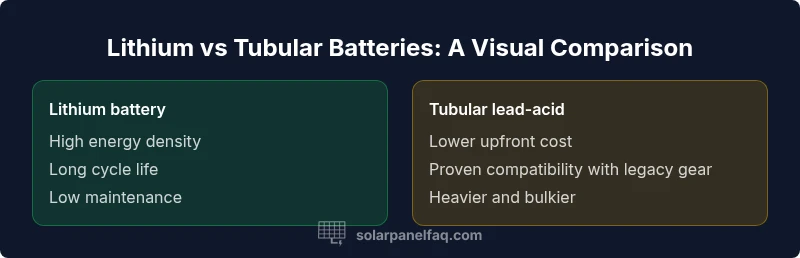
In the debate lithium battery vs tubular battery for solar panels, the core trade-offs are energy density, lifecycle, safety, and total cost of ownership. For most homes, lithium options offer higher energy density and longer life with lower maintenance, while tubular batteries can be cheaper upfront and simpler to integrate with legacy systems. The right choice hinges on budget, space, and long-term goals.
Lithium Battery vs Tubular Battery for Solar Panels: Key Differences
When evaluating lithium battery vs tubular battery for solar panels, homeowners should focus on three core axes: energy density, lifecycle, and installed cost. Lithium batteries (including Li-ion and LiFePO4 variants) deliver much higher energy density, enabling smaller, lighter packs that fit in limited spaces. Tubular lead-acid batteries, a traditional choice in many off-grid installations, are heavier and bulkier but can be cheaper upfront and more forgiving in older systems. According to Solar Panel FAQ, the decision should account for how you use stored energy, how much space you have, and the long-term value you expect from your investment. This comparative lens helps homeowners avoid overpaying for capacity they do not need and underscores why this topic remains central to residential solar storage planning.
In practical terms, the lithium battery vs tubular battery for solar panels decision often boils down to two scenarios: you want compact, long-lasting storage and are willing to invest upfront for a better long-term payoff; or you prefer a lower upfront cost and a system that integrates with older equipment without reconfiguring your entire energy storage architecture. The Solar Panel FAQ team emphasizes that compatibility with existing inverters and charge controllers matters as much as chemistry when you’re deciding between these options.
Where space is at a premium and a sleek, modular storage footprint matters, lithium systems tend to prove advantageous. For homeowners upgrading a legacy solar setup without replacing the inverter or charger, tubular batteries offer a more straightforward path to integration, particularly when existing equipment is built around lead-acid standards. This distinction—compact, modern lithium storage versus traditional tubular units—shapes both installation choices and post-installation maintenance expectations.
block_type_id 0
Comparison
| Feature | Lithium battery (Li-ion / LiFePO4) | Tubular lead-acid battery |
|---|---|---|
| Energy density (physical footprint per kWh) | High (compact form) | Moderate to low (larger footprint) |
| Cycle life / longevity | Typically longer cycle life with better depth of discharge | Historically shorter cycle life; robust in deep-cycle designs |
| Weight per kWh | Significantly lighter for equivalent capacity | Heavier per kWh, impacting mounting and structure |
| Upfront cost relative to capacity | Higher upfront cost | Lower upfront cost in many cases |
| Maintenance needs | Low maintenance; sealed cells with BMS | Requires regular electrolyte checks and ventilation considerations |
| Temperature sensitivity | Generally more sensitive; needs proper thermal management | Better tolerance in some configurations but risk of gas buildup in vented systems |
| Inverter/charger compatibility | Requires Li-compatible BMS and proper charging regimes | Widely compatible with older, lead-acid-based systems |
| Best-use scenario | New builds, space-constrained homes, long-term ownership | Renovations or budget-conscious upgrades with legacy gear |
Strengths
- Higher energy density enables smaller storage footprint
- Longer cycle life reduces replacement frequency
- Lower maintenance with sealed chemistries
- Easier enhancements or expansions over time
Drawbacks
- Higher upfront cost and potential financing hurdles
- Need for sophisticated charging and BMS integration
- Electricity safety and recycling considerations in disposal
Lithium storage generally wins on space, longevity, and maintenance for most homes; tubular systems excel when upfront budget is constrained or when integrating with existing lead-acid setups.
Choose lithium if you want compact capacity and longer life with simpler future upgrades. Pick tubular if upfront cost and straightforward integration with legacy hardware are your top priorities.
Frequently Asked Questions
What is the difference between lithium batteries and tubular batteries?
Lithium batteries offer higher energy density, lighter weight, and longer cycle life with modern BMS protection, while tubular batteries are heavier, cheaper upfront, and robust in traditional lead-acid configurations. The choice depends on space, budget, and long-term energy goals.
Lithium is lighter and lasts longer, tubular batteries are cheaper upfront and work well with older systems.
Can tubular batteries be used with modern solar inverters?
Yes, but you may need a compatible charge controller and system configuration to ensure proper charging and balance. Modern lithium setups often require different BMS integration.
They can work, but you’ll want the right controller and safety features.
Which lasts longer in a home solar system?
Lithium-based storage generally offers longer cycle life and better depth of discharge characteristics, leading to extended service life with fewer replacements.
Lithium usually lasts longer, so you replace components less often.
Are lithium batteries safe for home use?
When properly installed with a battery management system and proper ventilation, lithium storage is safe for homes. Tubular lead-acid batteries also have safe operating profiles when used as designed.
Yes, with proper setup and safety measures.
What about cost and payback period?
Lithium systems tend to have higher upfront costs but can offer lower lifetime costs due to reduced maintenance and longer life. Tubular systems generally have lower initial costs but may require more frequent replacements.
Upfront will be higher with lithium, but long-term savings can balance it.
What factors should I consider before deciding?
Consider available space, existing inverter/charger compatibility, climate and temperature ranges, maintenance capacity, and long-term energy goals to decide which storage chemistry best fits your home.
Think about space, equipment compatibility, climate, and long-term goals.
Top Takeaways
- Prioritize space efficiency with lithium for long-term ownership
- Factor in charging equipment and BMS needs for lithium systems
- Consider existing inverter/charger compatibility before switching chemistries
- Expect higher upfront costs with lithium but lower lifecycle costs
- Tubular systems remain viable in budget constraints and with legacy gear
- Plan for end-of-life recycling and system maintenance from the start