How to Use Solar Energy from Solar Panels at Night
Learn how solar panels can power your home after sundown through storage, batteries, and smart inverters. Explore grid-tied options, safety, and cost considerations for reliable night-time solar energy.


Power from solar panels is not produced at night unless energy is stored or drawn from the grid. The reliable approach combines battery storage, smart inverters, and grid-tied net metering to power your home after sundown. A well-designed system ensures continuous night-time power while minimizing cost and environmental impact for most households and climates.
How night-time solar energy works
When the sun sinks below the horizon, solar panels stop producing electricity directly. The question many homeowners ask is how is it possible to use solar energy from solar panels at night. The answer lies in two pillars: energy storage during daylight and intelligent energy management that channels that stored energy to home loads after sunset. In practice, a typical home system stores energy in batteries during the day and releases it at night through an inverter. If the system is connected to the grid, net metering can also offset consumption by drawing grid energy when storage is depleted or during high-demand periods. The result is a seamless power supply after dark, without constantly burning fossil fuels. The rest of this guide breaks down the components and decisions that make this possible.
Storage options: batteries and beyond
The core idea behind night energy is simple: capture more energy than you need during the day and hold it for use later. Batteries are the most common storage method, but there are other approaches as well. Lithium-ion and lithium iron phosphate (LFP) batteries offer high energy density and long lifespans, while lead-acid options remain common for lower upfront costs. In some designs, thermal storage or pumped-hydro concepts are used for larger installations, though they are less common in typical residential homes. When selecting storage, consider usable capacity, cycle life, depth of discharge, and safety features. The right mix depends on your daily load, available space, and local climate.
Inverters and energy management
An inverter converts stored DC energy into usable AC power for home circuits. For night-time operation, you’ll likely need a hybrid inverter or an inverter-charger that can manage charging from daytime solar while simultaneously delivering load at night. Smart inverters with MPPT (maximum power point tracking) optimize charging efficiency, especially when daylight conditions vary. Battery management systems (BMS) protect cells from overcharging, temperature swings, and imbalance. A well-integrated control system ensures energy flows from panels to storage and then to the house without user intervention.
Grid-tied vs off-grid strategies for night use
Grid-tied systems with net metering allow you to draw electricity from the grid when your stored energy is depleted, often offsetting consumption with credits during peak hours. Off-grid setups rely entirely on stored energy, which requires larger battery banks and careful load shaping. Hybrid setups blend both approaches, providing night-time power from batteries while still using grid energy when necessary. Your choice depends on local policies, utility rates, and goals for resilience.
Battery technologies explained
Battery chemistry affects cost, longevity, and safety. Li-ion and LFP chemistries dominate many modern residential systems due to energy density and long cycle life. Other options include sealed lead-acid for smaller budgets and flow batteries for very large installations, though these are less common in typical homes. Each chemistry has unique charging behavior, temperature sensitivity, and maintenance needs. Understanding the trade-offs helps you pick a system that aligns with your usage patterns and climate.
Design considerations for night energy capacity
Sizing for night use starts with a clear picture of your evening loads and how long you want to sustain them. Consider peak evening appliances, lighting, and essential circuits. Depth of discharge limitations affect how much usable energy you can rely on without shortening battery life. Location, ventilation, and fire-safety compliance influence where and how storage hardware is installed. A conservative design often outperforms an oversized, unmanageable system.
Real-world setups and case studies
A typical small-family home might install a modest battery bank paired with a standard solar array and a hybrid inverter, delivering several hours of nighttime power during a routine evening. A larger home might require a larger battery bank and a higher-efficiency inverter, with more sophisticated energy management. In both cases, a well-planned layout considers the daily load profile, weather patterns, and potential outages. Real-world setups demonstrate that even with imperfect sun days, strategic storage can provide meaningful resilience and lower energy costs over time.
Maintenance, safety, and long-term costs
Storage systems require routine inspection of battery health, connection integrity, and venting for safety. Follow manufacturer guidelines for ventilation, temperature monitoring, and fire-safety practices. Regular software updates for inverters and BMS help optimize performance and safety. Over the lifetime of a storage system, you’ll encounter costs related to battery replacement, inverter servicing, and potential retrofits to align with changing energy needs. A proactive maintenance schedule reduces risk and prolongs system life.
Common myths debunked
Myth: “Night power is impossible without fossil fuels.” Reality: Proper storage and smart control can provide reliable night-time power. Myth: “Batteries are unsafe and high-maintenance.” Reality: Modern systems include robust safety features and monitoring to keep operations within safe limits. Myth: “Grid-tied systems can’t survive outages.” Reality: Hybrid configurations can ride through outages by drawing from stored energy while the grid is down.
Tools & Materials
- Solar panels(Existing or planned installation)
- Battery storage system(Choose chemistry and capacity to meet night-time load)
- Hybrid inverter with battery management(Must support both charging from PV and supplying home loads)
- Charge controller (if off-grid or separate stage)(Not always needed with modern inverters)
- DC wires, conduits, and disconnects(Adequate gauge for expected current)
- AC wiring and breakers(Compliant with local electrical codes)
- Energy monitoring system(Helpful for optimization and troubleshooting)
- Safety PPE and fire safety gear(Insulated gloves, eye protection, and fire extinguisher)
- Ventilation/installation space(Adequate clearance and airflow for batteries)
Steps
Estimated time: 4-12 weeks
- 1
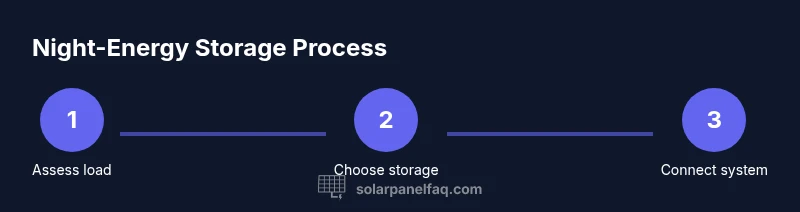
Assess energy needs
Inventory your evening and night loads, identify critical circuits, and estimate how many hours you want to cover with stored energy. Use past utility bills and daily usage to set a target storage capacity.
Tip: Start with essential loads (lights, fridge, router) to create a reliable baseline. - 2
Choose storage approach
Decide between a simple battery backup or a full storage-and-grid system. Consider space, budget, and desired resilience. Hybrid systems offer flexibility for outages and daily use.
Tip: Match battery chemistry to climate: high-temp regions benefit from certain chemistries with better thermal stability. - 3
Size the system
Estimate required usable capacity by multiplying nightly load by desired hours of autonomy, then apply a safe depth-of-discharge to protect battery life. Plan for future growth.
Tip: Conservatively size to avoid frequent battery cycling that reduces lifespan. - 4
Select components
Choose a hybrid inverter, compatible battery bank, and appropriate cabling. Ensure safety ratings, warranty terms, and manufacturer certifications align with local codes.
Tip: Verify compatibility between inverter, battery chemistry, and BMS in advance. - 5
Install and connect
Follow professional guidance or hire a licensed installer. Ensure proper grounding, venting for batteries, and adherence to electrical codes during wiring.
Tip: Never bypass safety interlocks or improper venting; adverse events are preventable with proper installation. - 6
Commission and optimize
Power up the system, run through a full discharge/charge cycle, calibrate monitoring, and set up alerts for abnormal readings. Review night-time performance and adjust usage patterns as needed.
Tip: Record baseline performance to track improvements after weather changes.
Frequently Asked Questions
Can solar power be used at night without storage?
No. Solar panels generate electricity when exposed to light. At night, you rely on stored energy or grid power via a net metering setup.
No. Solar panels need daylight to generate power. Night-time use relies on stored energy or drawing from the grid with net metering.
What is required to store solar energy for night use?
A battery bank, a compatible inverter, and proper controls are needed. A grid-tied option with net metering can also offset some night-time use.
You need batteries, an inverter, and proper controls; grid-tied setups can help offset some night use with net metering.
Which battery types are common in home storage?
Lithium-ion and lithium iron phosphate are common for their balance of efficiency and lifespan. Lead-acid is cheaper upfront but requires more maintenance and space.
Most homes use lithium-based batteries for performance and lifespan; lead-acid is less common today for new installations.
How long can stored energy power a home?
Duration depends on your battery size and load. A typical setup can cover several hours of essential loads, but exact times vary with usage and weather.
Duration varies with battery size and how much you run at night; it’s different for every home.
Are there safety concerns with battery storage?
Yes. Batteries require proper venting, temperature control, and防 fire safety measures. Regular inspection and following manufacturer guidelines reduces risk.
Batteries require venting, temperature control, and safe handling—follow guidelines to stay safe.
Is it cheaper to use grid power at night or invest in storage?
Costs depend on local electricity rates, incentives, and battery price. Storage often pays off over time through savings and resilience, especially in high-rate regions.
Costs vary by location and incentives; storage often pays back over time but depends on rates and upfront costs.
Watch Video
Top Takeaways
- Store daytime energy for use at night to maintain reliability.
- Hybrid inverters simplify night-time operation and optimization.
- Appropriate battery choice and sizing are critical for resilience.
- Safety, codes, and maintenance extend system life.